


This spring, Caroline Starr Rose invited me to chat about our upcoming books, THE BURNING SEASON and THE TROUBLE WITH HEROES, both of which have wilderness settings and themes of survival, in more than one sense of the word.
Hi, Kate. I love that we both have verse novels coming out this spring with main characters learning about themselves via the natural world. Could you tell me a bit about The Trouble with Heroes? Would you describe it as a survival story or…?
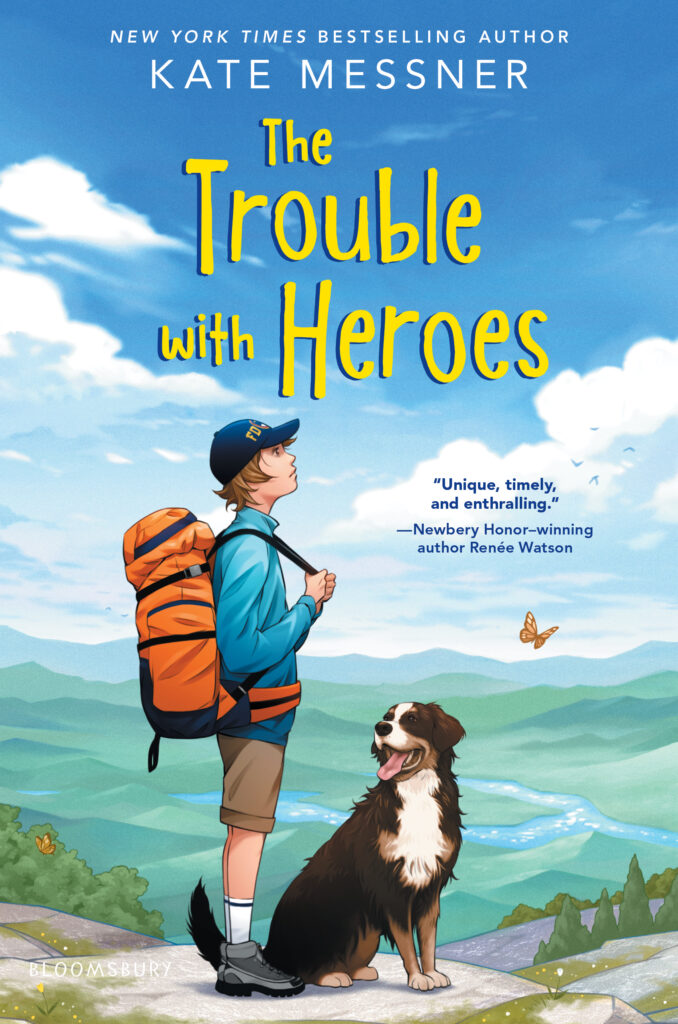
It’s definitely a survival story – and in more than one sense of the word for the main character, Finn. On the verge of failing seventh grade, he gets caught vandalizing a cemetery. The headstone he kicked over belonged to one of the first women to hike all 46 Adirondack High Peaks, and her daughter makes Finn an offer. She’ll drop all the charges if he climbs all 46 mountains in a single summer. Also? He has to bring her mother’s drooly Bernese mountain dog, Seymour, along on every climb.
Oh my gosh. Bernese mountain dogs are the cutest. And I’m getting Peak vibes from this description. Remember that Roland Smith book? Loved it. So did my students way back when.
These mountains are rugged and remote, and the climbs involve everything from knee-deep mud to near-vertical rock climbs, so Finn has his work cut out for him. But his emotional journey may be an even greater struggle, as he begins to face the loss of his dad two years earlier and the legacy he left behind.
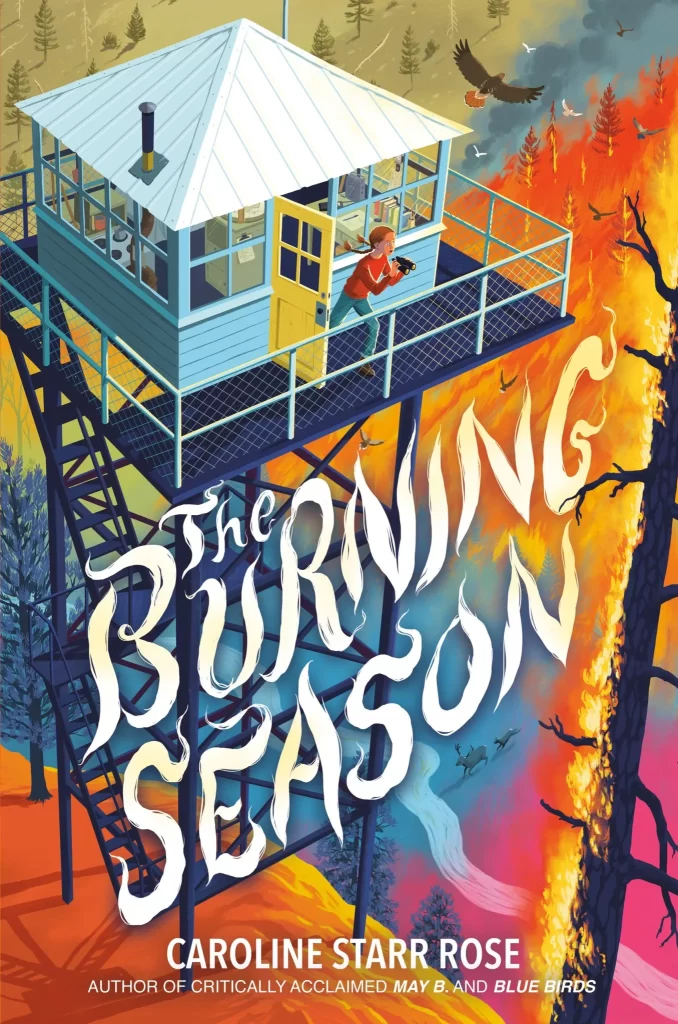
What about your new book? The cover immediately caught my attention because my oldest lives in California, so we’re constantly watching the wildfires.
The Burning Season is about a girl named Opal who has been raised in a fire tower in New Mexico’s Gila Wilderness. She will one day be the fourth-generation woman in her family to serve as a lookout in the tower, and as part of her family’s tradition, she has started her training on her twelfth birthday. Opal is proud of her family’s legacy and work, but she longs to go to school in town and she’s keeping a secret: she’s afraid of fire. When her mom goes to town on a supply run and her gran goes missing, Opal is the only one left in the tower. Then she sees smoke in the distance. With the tower’s radio dead, Opal realizes she’s the one who will have to face the fire, and she’ll have to do it alone.
Like Finn, Opal has lost her dad. He died fighting a wildfire before she was born.
You’re a hiker, right? Is that how you came to this story?
One of the first questions readers ask about this book is “So have you climbed all 46 of those mountains?” And the answer is yes! But I didn’t climb them all in a single summer like Finn has to; it took me eight years to summit them all. I’d like to tell you that I loved every minute, but honestly, there were times out there when I’d be standing in knee-deep mud wondering, like Finn, why people climb mountains on purpose. The mountains become a part of you, though, and they call you back. And Finn learns along the way that his dad has a connection to those mountains, too. That becomes important to him. It’s fascinating to me that both of our characters live in the shadow of hero dads. (Finn’s father was a 9/11 firefighter who died later, during the COVID-19 pandemic.) What was the inspiration for Opal’s story?
First, I’ve wanted to write about my beloved home, New Mexico, for ages. And I wanted to write a “girl in a tower” story. I wasn’t sure exactly what that meant at the time I first thought of it, but I love working with limitations (a limited setting in this example). I thought perhaps my tower would be a lighthouse, but there have been a fair number of lighthouse books. Then I saw in Sunset magazine a picture of a fire tower that had been converted into a home and realized that was it! That was my tower. There are a number of fire towers still in service across the state (as there are in many Rocky Mountain regions). So there was my New Mexico connection. And wildfire is a huge, never-going-away issue we deal with here and in many places across the country. The idea felt relevant and important.
At the same time I knew I wanted to explore the ideas of solitude, nature, and survival as I had with my first verse novel, May B. (which is also a book with a limited setting). In a lot of ways I see The Burning Season as May B. 2.0. I never say it in the story, but I picture Opal as May’s great-great-great granddaughter. There are some fun parallels between the girls and some Easter eggs for astute readers to find. Opal’s Great Aunt Dor (her gran’s great aunt, actually), was modeled after Hallie Dagget, the first woman to serve in a fire tower for the US Forest Service in 1913.
Are Finn and Seymour out there alone? How does this time on the mountains help Finn see himself and his world?
We have fire towers in the Adirondacks, too! Sometimes they’re open during the summer and fall, so you can climb up after you summit for an even higher view of the surrounding peaks. There, though, wildfires are rare enough that we sometimes forget what the towers are really for.
Finn doesn’t do any fire tower hikes, but he does summit a whole lot of mountains and has more than the dog for company. Obviously, no one’s going to sentence a rising eighth grader to climb 46 mountains alone, so volunteer 46ers go along with him on each hike. They’re people who have already climbed the 46 High Peaks and are there in case anything goes wrong (though they’re under strict orders to let him figure things out himself!) These “trail nannies,” as Finn calls them, become unexpected mentors for him, each opening his eyes to something he doesn’t realize he needs in order to heal.
I love how timely both of our novels are, in different ways. What do you hope readers will take away from The Burning Season?
While Opal’s situation is unique, I think fear is a very real part of being a person. Learning to talk about it is the first step in lessening the power it can have on us. I’d also like readers to see the complex nature of fire and its role in the world. Fire can destroy but it can also heal. They’re necessary for forest growth and renewal.
And what do you hope readers take from The Trouble with Heroes?
I hope they’ll understand that they’re not alone. I’ve realized that this is actually the underlying theme of so much of what I write. At the beginning of this novel, Finn feels pretty isolated, and there’s a scene later on where he’s blown away by how many people show up for him, again and again, no matter how many times he screws up. I think you may know that I used to be a middle school English teacher, and I taught so many kids like this, boys especially. Kids who had kind of given up on themselves, and they were always surprised when you hadn’t given up on them, too. I loved those kids, and I hope a lot of them find this book.
I used to teach middle school, too. I adored my students – and I love readers this age. They are curious, open-minded, and fun.
Thanks so much for the conversation, Caroline. I can’t wait to read Opal’s story!
Likewise, Kate. Can’t wait to dig into Finn’s.