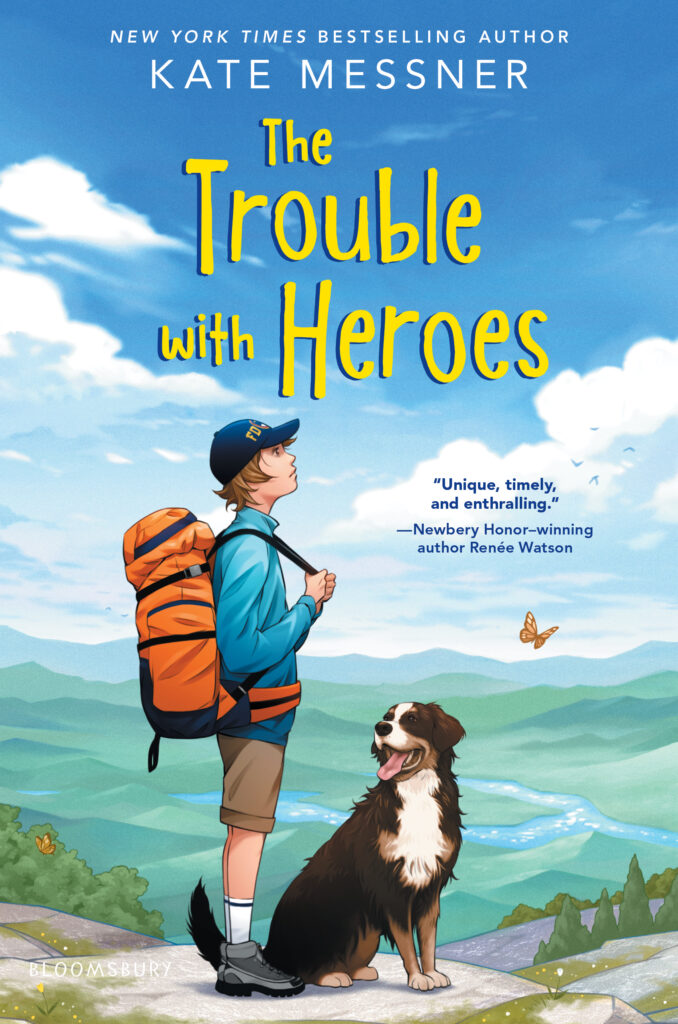
This post is a thank you note – that also includes presents for YOU!
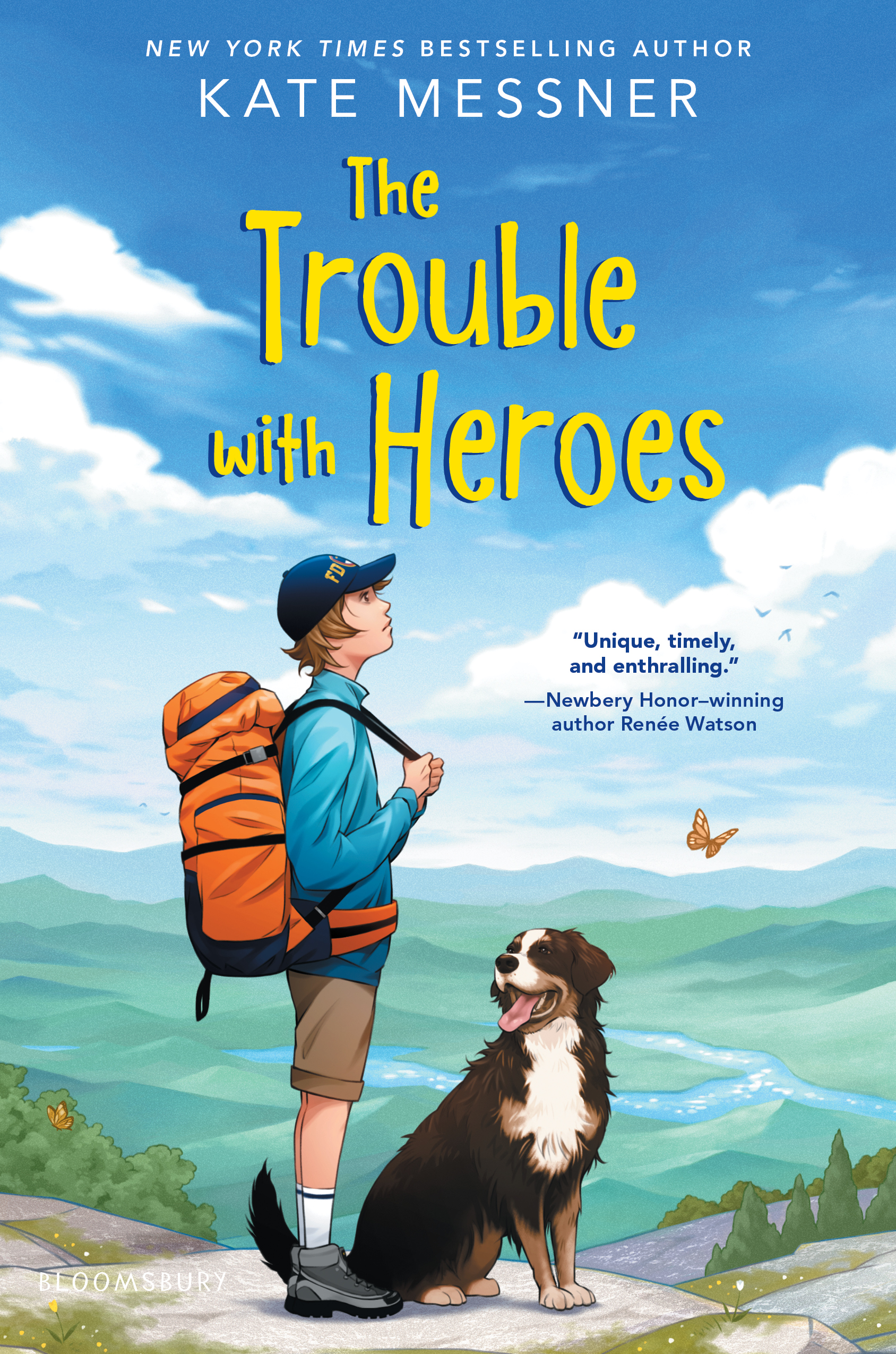
First the thank you… I’m wildly grateful that my MG novel THE TROUBLE WITH HEROES has already landed on over twenty state book award lists in the US, as well as Hong Kong’s Battle of the Books list and Singapore’s Red Dot Student’s Choice Book Award list.
I know from your emails & social media posts that many schools are planning to read Finn and Seymour’s story with kids or entire communities this year, so I wanted to offer up some resources that will make your planning easier and make the reading more fun!
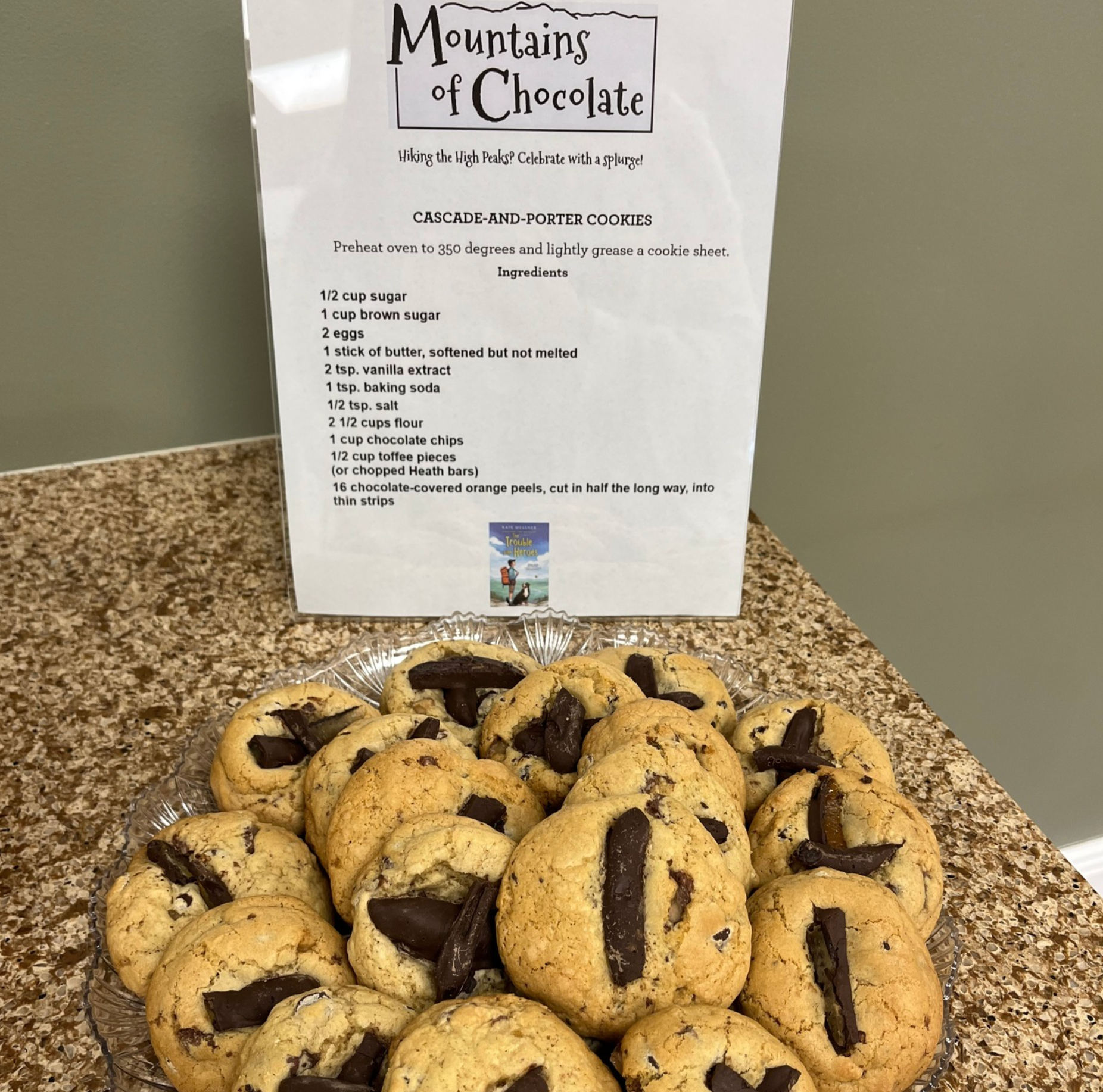
Below is the recipe for Cascade and Porter Cookies, which are featured in the book (along with other cookie recipes named for the Adirondack High Peaks) You can bake up a batch for your book club discussion!
Cascade-and-Porter Cookies
Preheat oven to 350 and lightly grease a cookie sheet.
Ingredients:
1/2 cup sugar 1 cup brown sugar 2 eggs 1 stick of butter, softened but not melted 2 tsp vanilla extract 1 tsp baking soda 1/2 tsp salt 2 1/2 cups flour 1 cup chocolate chips 1/2 cup jagged toffee pieces (or chopped Heath bars) 16 chocolate covered orange rinds, cut in half the long way, into thin strips*
*If these aren’t easily available, you can substitute a sprinkle of orange zest (grated orange peel) instead.
Mix together sugar and wet ingredients until smooth
Stir in salt and baking soda, then flour.
Add chocolate chips and mix.
Scoop balls of dough onto cookie sheet 2 inches apart
Bake at 350 for 7 minutes.
While cookies are baking, cut the orange rings in half the long way and chop toffee into pea-sized pieces.
After 7 minutes, remove baking sheet from oven and press half an orange rind (or orange zest substitution) and a sprinkle of toffee pieces gently into the middle of each cookie.
Return to oven and bake for another 2-5 minutes, until cookies golden brown and edges are beginning to look crisp.
Cool on a baking rack before eating
VIRTUAL POETRY WORKSHOPS FOR THE TROUBLE WITH HEROES
Here are four on-demand poetry workshops to share with your readers! Each runs 10-20 minutes and guides writers through creating their own poem in the style of Finn’s poetry in the book .
THE TROUBLE WITH HEROES Poetry Workshop #1 – Writing Place Poems with Sensory Language (22 minutes)
THE TROUBLE WITH HEROES Poetry Workshop #2 – Writing “Found Poems” (11 minutes)
THE TROUBLE WITH HEROES Poetry Workshop #3 – Writing Memory Poems (22 minutes)
THE TROUBLE WITH HEROES Poetry Workshop #4 – Revising Poems – Strategies to Play With (11 minutes)
WHAT’S NEXT?
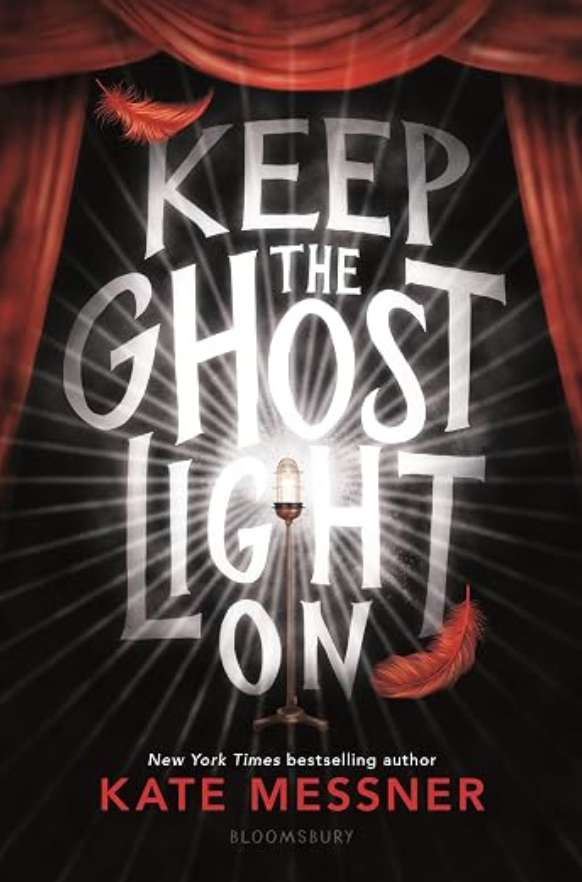
My new novel KEEP THE GHOST LIGHT ON comes out February 23, 2027 and is available for pre-order now! If you pre-order a signed copy from my local indie (or pre-order from another participating indie bookstore) you’ll automatically be signed up for my new Virtual Author-in-Residence program.
KATE MESSNER’S VIRTUAL AUTHOR-IN-RESIDENCE PROGRAM FOR 2026-2027
Best for grads 4-8 and offered at no cost with your pre-order one or more copies of KEEP THE GHOST LIGHT ON from Kate’s local independent bookstore, The Bookstore Plus in Lake Placid, NY or another participating indie before February 1, 2027.
Kate’s virtual author-in-residence program includes:
An exclusive pdf excerpt with the first 40 pages of KEEP THE GHOST LIGHT ON delivered to your inbox
Writing Scary Scenes – a 20-minute on-demand writing workshop for grades 4-8 with author Kate Messner
Songwriting is Poetry – a 20-minute on-demand workshop for grades 4-8 with author Kate Messner & Broadway music director and composer Haley Bennett, who wrote music to go along with the song lyrics in KEEP THE GHOST LIGHT ON.
A Live Virtual Author Visit on February 11th – A 45-minute virtual author visit sharing Kate’s research and writing process for her NYT Bestseller THE TROUBLE WITH HEROES and her new novel KEEP THE GHOST LIGHT ON, including live Q&A with readers. (Each pre-order provides access to the live webinar for one device. A recording will also be available after the live event, with unlimited access through the 2026-2027 school year.)
Preorder your copy here & you’ll automatically be signed up for the virtual author-in-residence program. You’ll get an email on October 1st with the excerpt and links to the on-demand writing workshops as well as your invitation to register for the live Zoom author visit.
Want to get your readers excited about writing everything from spooky stories to poetry and songs? I’m offering a FREE virtual author-in-residence program for the coming school year!
It’s our thank you gift fro everyone who pre-orders my new novel from a participating indie bookstore. KEEP THE GHOST LIGHT ON comes out in February 2027, and I’m wildly excited for this book. It’s a multi-modal Broadway ghost story, told through traditional narration as well as text messages, song lyrics, historical documents, and musical theater scenes directed by the ghost. If you’re a reviewer or librarian who would like a sneak preview, you can request it on NetGalley now!
I’ll be on book tour for KEEP THE GHOST LIGHT ON (and THE TROUBLE WITH HEROES paperback!) in February and March. If you’d like me to visit your school during that time, here’s a request form to fill out. It has all the information about book tour author visits, which are by their nature, limited by time and geography, but hopefully I’ll get to see some of you this winter! (Note: these are free in-person author visits with all travel expenses paid by the publisher. The school/PTO’s only responsibility is a minimum book order!)
Now…more about that FREE Virtual Author-in-Residence Program for 2026-2027. It’s perfect for classrooms, libraries, and homeschoolers who are excited about KEEP THE GHOST LIGHT ON as well as those reading and loving THE TROUBLE WITH HEROES (which has already made its way onto 23 state book award lists!) Here’s how it works…
KATE MESSNER’S VIRTUAL AUTHOR-IN-RESIDENCE PROGRAM FOR 2026-2027
Offered at no cost with your preorder of KEEP THE GHOST LIGHT ON from a participating independent bookstore below. (Booksellers! If you’d like to be on this list, please send me a note via the contact form on my home page – it’s super easy, I promise, and I’d love to add you!)
Kate’s virtual author-in-residence program includes:
An exclusive pdf excerpt with the first 40 pages of KEEP THE GHOST LIGHT ON delivered to your inbox
Writing Scary Scenes – a 20-minute on-demand writing workshop for grades 4-8 with author Kate Messner
Songwriting is Poetry – a 20-minute on-demand workshop for grades 4-8 with author Kate Messner & Broadway music director and composer Haley Bennett, who wrote music to go along with the song lyrics in KEEP THE GHOST LIGHT ON.
A Live Virtual Author Visit on February 11th – A 45-minute virtual author visit sharing Kate’s research and writing process for her NYT Bestseller THE TROUBLE WITH HEROES and her new novel KEEP THE GHOST LIGHT ON, including live Q&A with readers. (Each pre-order provides access to the live webinar for one device. A recording will also be available after the live event, with unlimited access through the 2026-2027 school year.)
Just preorder your copy today from one of the participating bookstores below, and you’ll automatically be signed up for the virtual author-in-residence program. You’ll get an email on October 1st (or on the first of the next month after you order, if it’s later) with the excerpt and links to the on-demand writing workshops as well as your invitation to register for the live Zoom author visit.
Hello, teacher/librarian/writer friends! It’s almost time for Teachers and Librarians Write, our free online summer writing camp for teachers & librarians. Have you signed up yet? If not, you can do that here. All of our writing camp materials go out via my regular email list, which also gives you book recommendations and news about free author visit offers throughout the year! If you’re a writer who’s not a teacher or librarian, you’re still welcome to sign up and get all the resources – please just note that our live Zoom workshops are just for teachers & librarians (everyone else is welcome to view the recordings later, though!)
If you’re a returning camper, welcome back! And thank you for your understanding when Teachers and Librarians Write went on hiatus last summer so I could process the loss of my dad, grieve with my mom, and help her with all of the work, both practical and emotional, that goes along with losing someone you’ve loved for sixty years. I so needed that space, but at the same time, I missed all of you, and I’m so happy to be back this summer.
For those who are new, this camp is all about writing in community. It’s about walking the walk and taking risks with our own writing so we can be more empathic teachers when we ask our students to take risks of their own, to be brave enough to put words on paper and maybe even share those words.
Every summer, we choose a focus, and this summer is a a deep dive into REVISION. This is where the best writing happens, but sometimes it can be hard to know where to start. We’ll be running things a little differently this summer – each week, you’ll get a 15-20 minute on-demand writing workshop delivered right to your inbox. Watch them with your notebook open and your work-in-progress handy, whenever it’s convenient for you. You’ll hear from award-winning authors and folks who teach in writing MFA programs, peeling back the layers of their revision process, sharing first-draft to final-draft transitions, and walking you through specific exercises and strategies that will make revising your own work feel less daunting and more doable.
Teachers and Librarians Write 2026 runs from July 6-August 7. You’ll get an email at the beginning of each week with writing lessons, prompts, and revision tips for you to work through on your own time, away from the screen if you’d like. Many will be lessons you can try out yourself and then bookmark to share with your kids later on. Join us, won’t you? Here’s the link to sign up. We’re looking forward to a great summer of writing!
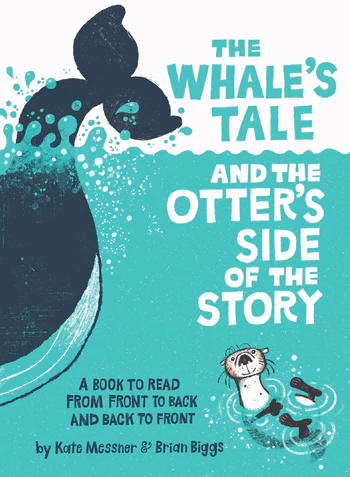
Happy April, friends! And happy (almost) book birthday to Whale and Otter! I’ve been waiting and waiting for this book’s release because it’s likely the most unusual picture book I’ve written. You see, you can read this one from front to back OR from back to front. And yes…you can imagine the consternation when I told my agent about this book. “How…exactly will that work?”
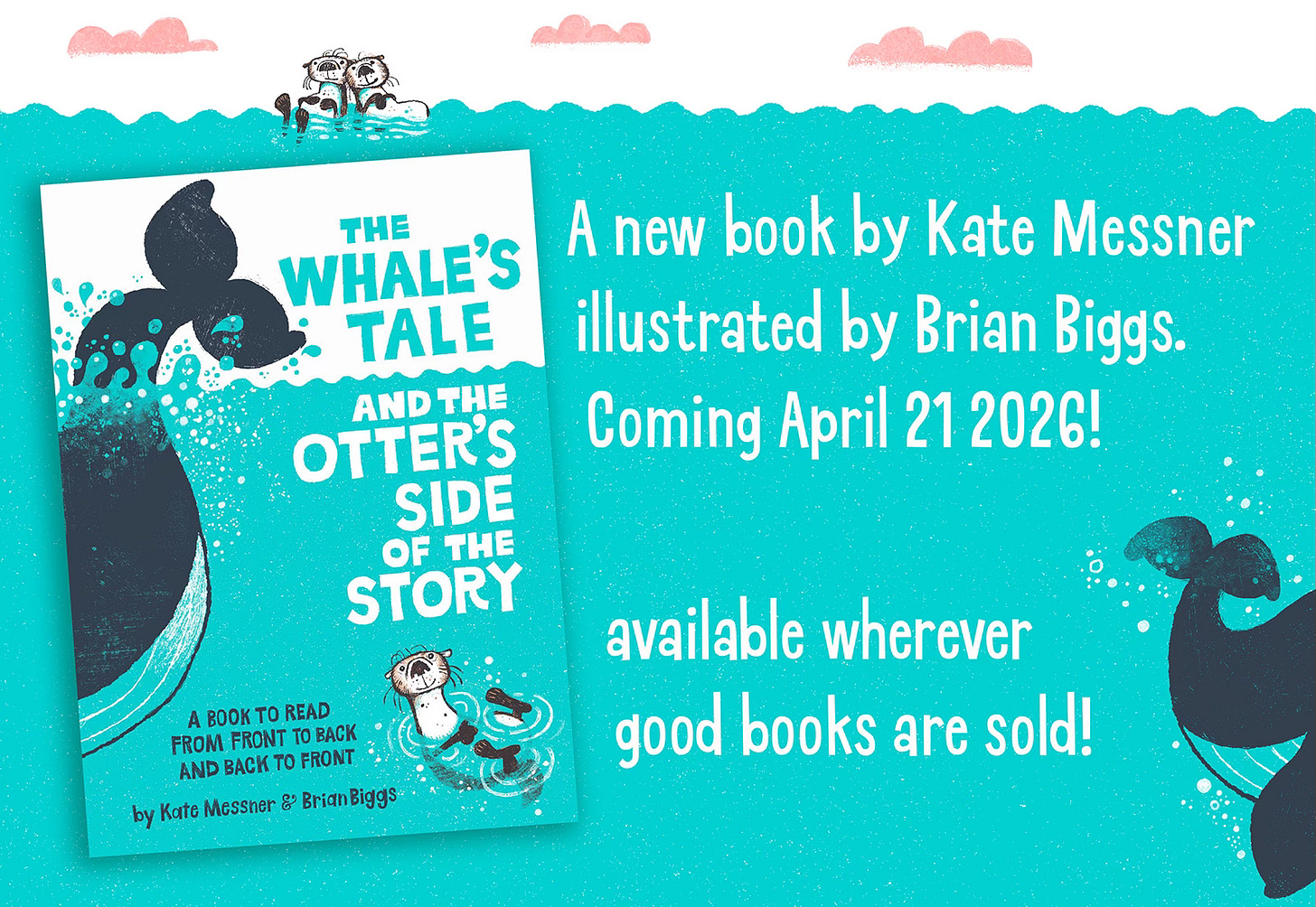
Never fear! We figured it out and THE WHALE’S TALE AND THE OTTER’S SIDE OF THE STORY comes out on Tuesday, April 21st! It’s already earned some stellar reviews, including a star from Kirkus. Our beloved indie booksellers voted to give Whale and Otter a coveted spot on the May/June Kids’ Indie Next list. And Amazon named it one of April’s Best Books for Children and Teens. And we hope that very soon, it’ll also earn a spot on YOUR personal Favorite Read-alouds list. You can order your copy here!
So remember that team effort I told you about? This book absolutely wouldn’t have worked without the talent, can-do attitude, and good humor of illustrator Brian Biggs. He suggested that we sit down for a two-way interview to pull back the curtain on how this quirky book came together. Here’s the conversations we had over Google docs, over about two weeks as we were both frantically chasing down pre-book-tour deadlines…
Kate: Hey, Brian! We’re just weeks away from our launch for The Whale’s Tale and the Otter’s Side of the Story: A Book to Read from Front to Back and Back to Front, and there’s one question I’ve been dying to ask you about this project.
As you know, this is a weird book. Read from the first page to the last, it’s about a whale who’s trash-talking an otter, explaining why whales are better. But read from the last page to the first? A different story – about an otter who’s insisting that otters are actually the superior marine mammal.
I’ll be honest – when I wrote this one, I wasn’t sure we’d find a publisher who understood what I was trying to do. Then, after our incredible editor Anne Hoppe acquired the book for Clarion, my agent and I were both keeping our fingers crossed that we’d find an amazing illustrator who got it, too.
I know now that you have a reputation for being an artist who’s always up for a challenge. When you first read this manuscript, could you imagine right away how it would work? Or did you have to sit with it a while before deciding that it was a project you wanted to take on?
Brian:I had no idea how it would work. Which is exactly why I took it on.
The message from Anne was exactly as you described. There’s this crazy manuscript, and we’re looking for someone who is just that kind of crazy. Well, flattery will get you everywhere, you know. But more importantly, here was this thing that came to me not because I had a hole in my schedule, or because something I’d made previously sold well or won some award. But because someone got me. This project started with “this is a puzzle, but we know you like puzzles.” It felt collaborative, and boy, has it been.
Kate: I love knowing this! And yes – Anne had told me that the book was a challenge (to put it nicely!) but she had just the illustrator in mind. I’m so glad she brought us together! So where’d you start with the project? It lands in your inbox and…?
Brian:Something you might not know is that you were instrumental to making this work, visually. When I first received the manuscript for Whale’s Tale, it was just the text. Anne and I had several conversations and emails about how this might work, and one day she mentioned that you’d included illustration notes and maybe she’d send them to me.
Author’s illustration notes are a mixed bag, as you might imagine. Some are pretty straightforward – just setting a stage, indicating intent, and so on. But my delight in drawing other people’s stories is to see where these weird texts – and picture book texts by themselves are always weird – take me. I don’t often want notes. I want puzzles.
Picture book texts are often such that, if a story begins with, oh I don’t know, “Kate and Brian were having the time of their lives,” then somehow even the illustrator needs to know who are Kate and Brian, what are they doing. A good author gives just the right amount of information to open the important windows into her imagination, so the illustrator at least knows where we are and what’s going on.
Illus note: Kate and Brian are two young bears, who live in separate forests, and are writing letters to each other about storytelling.
Okay, good. Because otherwise I might have imagined Kate and Brian to be two grownup humans riding bicycles. Whew. Glad I didn’t waste time with those sketches.
But waste time I did. Where is Whale, and where is Otter? Are they talking to each other? Are they talking to someone else? What’s the context? Why isn’t this working? Page turns are usually the first puzzle to solve, but in the case of this story, that was easy. There was only one way to do it. Everything else though… whew. It was a Rube Goldberg machine.
As I was running in circles, Anne kind of apologetically suggested that, hey, maybe, if you want, if they’re useful, but only if, you know, here are Kate’s notes. Feel free to ignore them.
You’d written something about a lectern, like a TED talk. I scoffed, until I didn’t. It gave me a stage, literally, to set these illustrations and anchor things. I have an email that basically screams “EUREKA!”
Wait, in fact, I have it right here, from April 2024:
I’m glad you sent that script with Kate’s notes. This isn’t my first rodeo, of course, and I have no problem totally ignoring author’s notes (and editor’s too at times!). But this is actually useful. If only because it gives a different POV for the narration. The presentation idea is interesting. I don’t think it’s what I’d want to draw on each page, but it allows me to think about it differently.
So what I want to know is where did this idea come from???
Were you just talking to yourself one day and a manuscript fell out? Did you set off knowing you wanted to be tricky? Or did you begin on the other side of the door, where you noticed these things that whales and otters do and don’t have in common, and just found a fun trick that allowed you to tell that story? Which came first, the egg or the chicken?
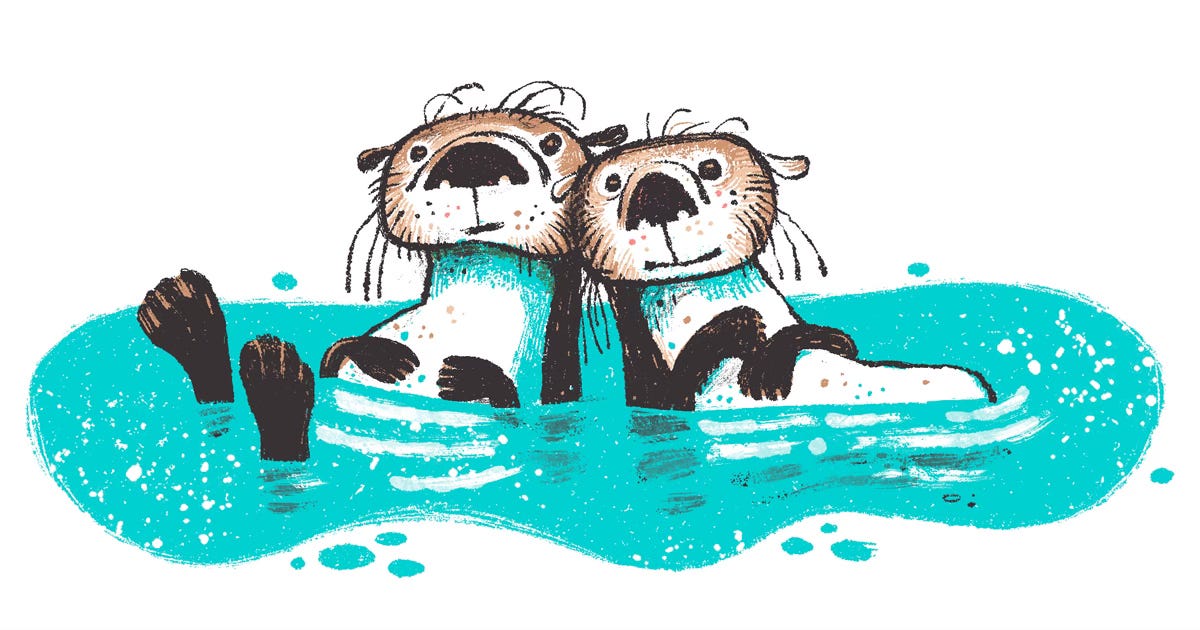
Kate: I didn’t mean to be tricky. Not exactly. This book is actually a mashup of two different ideas from my writer’s notebook. One lovely sunny afternoon years ago, we were sea kayaking with our kids in Elkhorn Slough on Monterey Bay. There were sea otters galore and somewhere along the way, I made a terrible mom-joke about waiting to hear “the otter’s side of the story.” And I realized it could be part of a fun book title! But in order to have another side of the story, you need two points of view and the idea of “the whale’s tale” came to mind (because if you’re going to have puns in your title, you might as well go all in). That title – The Whale’s Tale and the Otter’s Side of the Story – lived in my writer’s notebook for years.
Writing is very much an act of play for me; I craft some of my best books when I’m goofing off, and I like to give myself weird little challenges. One day I had the notion that it would be fun to write a picture book that could be read from front to back or back to front, using transitional phrases that allowed for two different points of view depending on how the story was being read. When I went to put this in my writer’s notebook, there was my earlier note – that punny title in search of a story – and the two ideas merged together: The Whale’s Tale and the Otter’s Side of the Story: A Book to Read from Front to Back and Back to Front.
Writing it was very much a mystery at first, but once I had cracked the story’s code – statement/transitional phrase/statement – it was so much fun to puzzle out.
What about you? Once you figured out how to approach the illustrations, were there any other challenges that came up?
Brian: Ah, so neither the chicken nor the egg, but rather a terrific title in need of a story! As a writer, which I am occasionally, my own books have often had the title long before the story or a main character. But as an illustrator, since this puzzle-solving is often mostly done by the time I see the script, the first thing I tackle is usually the character. Whether this is a dinosaur, or a robot, or a six-year-old kid, figuring out who it is that lives within these pages begins my journey with whatever words the author has given me. With Whale & Otter, things went a bit differently. By the way, Whale & Otter is how I’ve referred to this book since I began working on it. I have to remind myself that it has a longer, and a much more interesting title. I suppose shortening it to A Whale’s Tale would have made sense, but in my head it was never fair to Otter.
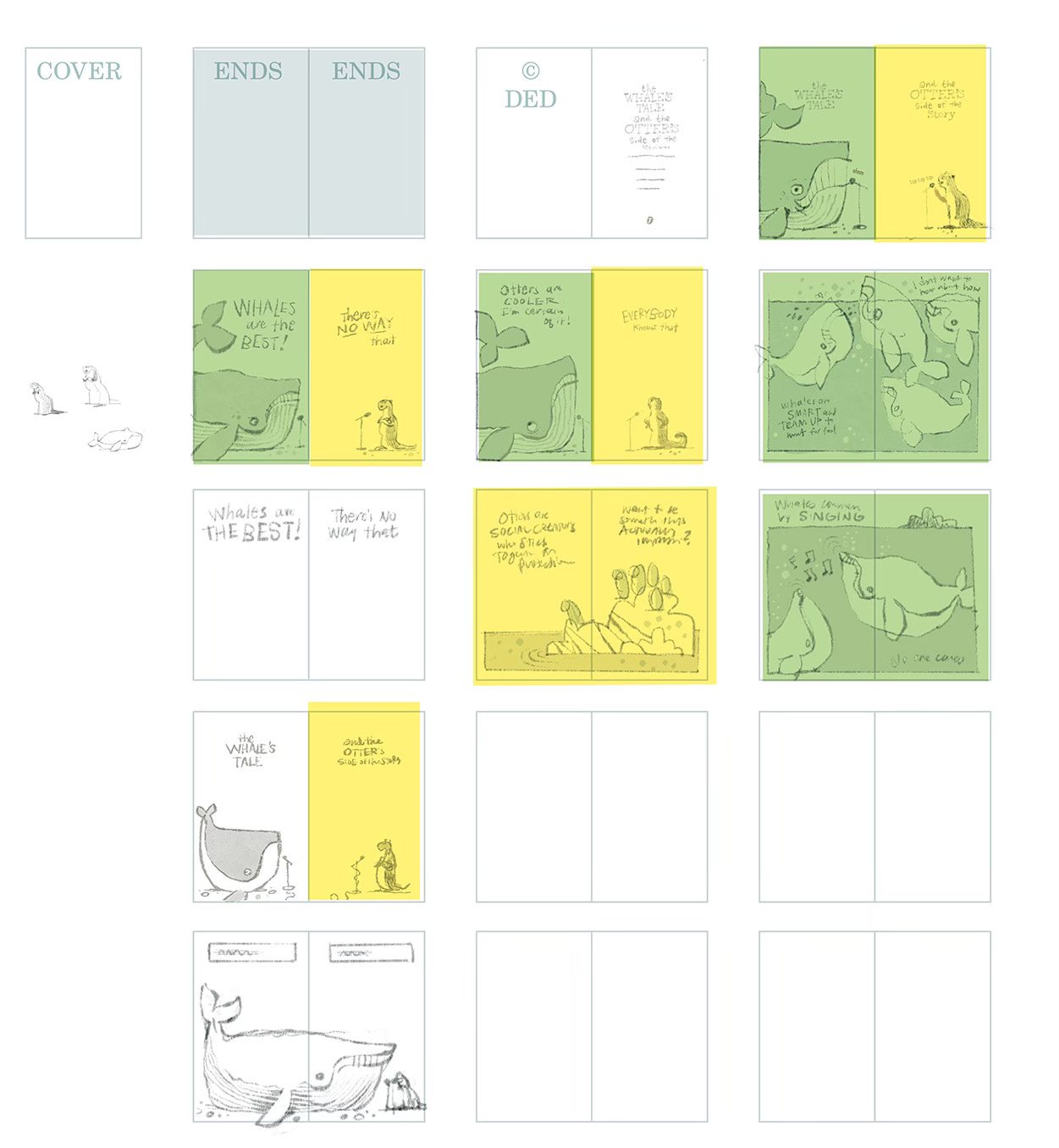
For the first several weeks that I worked on this book, I had no real Whale character or Otter character in my head. I was much more concerned with the mechanics of this story. Some books need what is basically engineering, and this was definitely one of them. I was working with colored grids representing the pages of the book with green representing whale and yellow representing otter, long before I had drawn an actual whale or an otter.
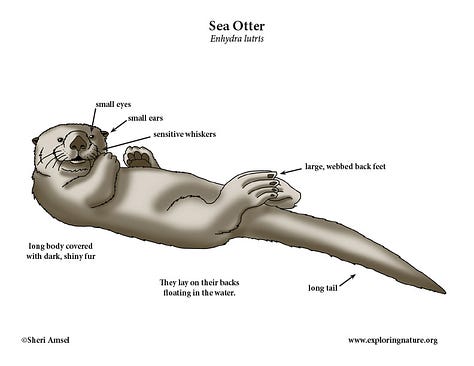
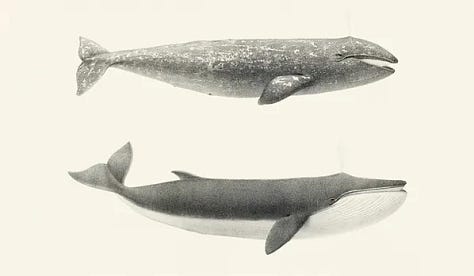
At some point either the puzzle was solved or I just needed to put it aside, and I began looking at whales and otters, and drawing them. Though I had to deal with the enormous disparity in scale between the two animals, the “characters” came quickly. These two drawings were, in fact, the first whale and the first otter I drew.
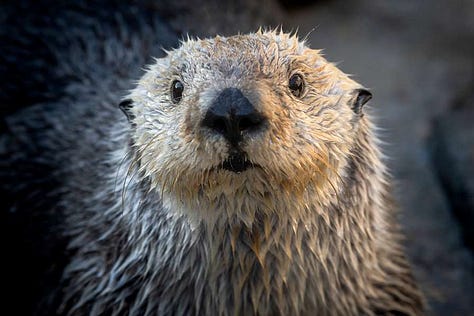
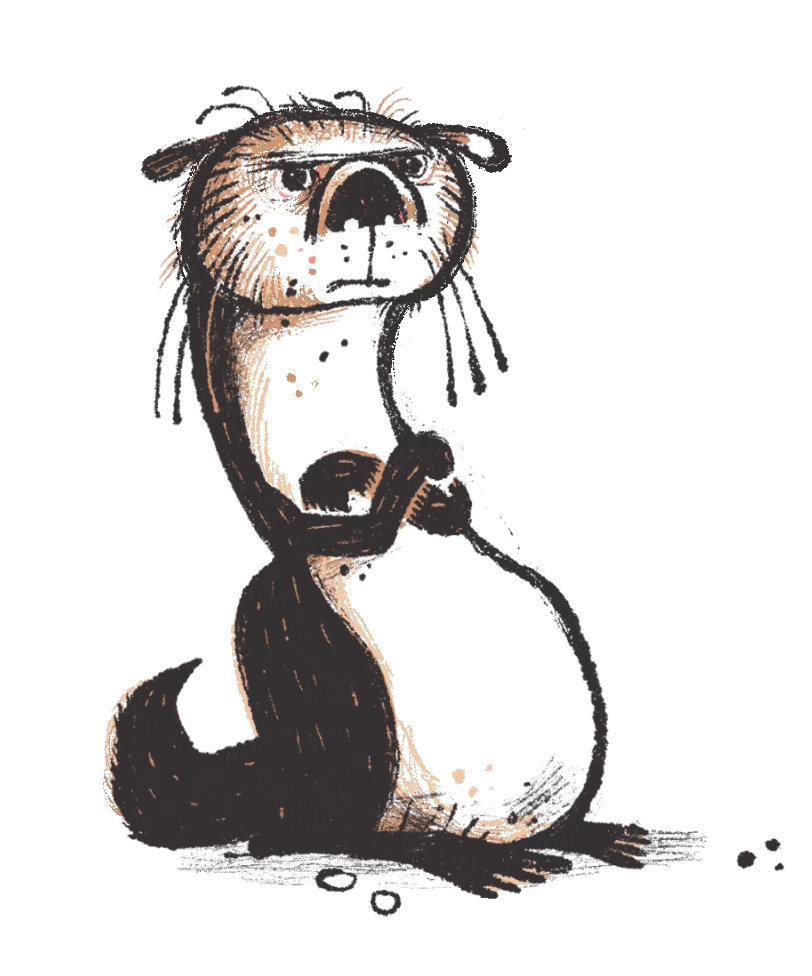
I sometimes send an editor and art director what amounts to a “mood board,” something like a Pinterest board, as I collect ideas and reference. In this case, these two drawings captured both the attitude of the whale and otter, and the graphic design of how I imagined the book. I sketched the entire book with these characters in mind, but something about Otter kept bugging me. Our otter needed to be very expressive, much more so than our whale, and this otter, while he looked like an otter, seemed more droll, less emotional. As I worked to figure out how to draw this guy, what to keep, what to change, I struggled to figure out what makes an otter look… otterish. And, more specifically, what makes the otter SEA-otterish. The tail, sure. The long torso, yes. But my otter faces kept looking like squirrels. Or sad, wet cats. It wasn’t until I noticed that an otter’s nose is, how do I put this, upside down, than it began to work. A cat, a squirrel, when one draws their noses, they’re often shaped like little triangles standing upright on their point. I spent an hour one day watching videos of sea otters, and I finally noticed that otter’s noses are, sort of, upside down. I flipped that triangle, and there was my otter!
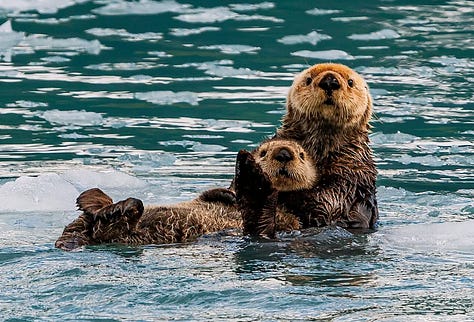
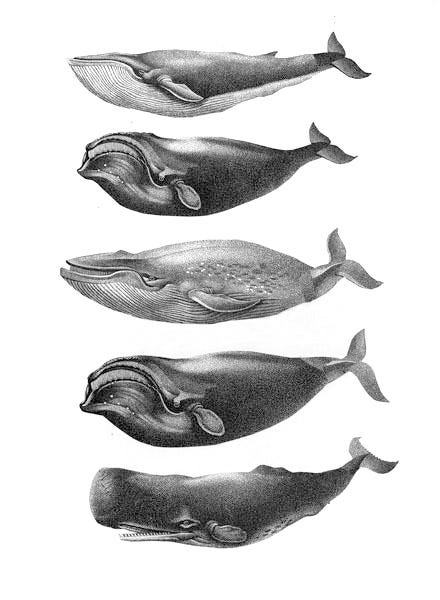
These are some of my favorite reference materials for this book.
As I drew these two characters, their personalities seemed very different to me. I think this was necessitated by the scale and possibly the shape of the characters, but Whale was sort of chill as she argued her case. While Otter seemed almost annoyed and frantic. They had distinct personalities even though they were speaking the exact same words! I was happy with my drawing and illustration chops here, but I secretly felt that you’d done this, not me. Did you aim to give them each a unique voice, even though they had the exact same dialog?
Kate: I did! And honestly, the whole time I was writing this book, I was imagining how much fun it would be at storytime – with librarians and teachers and caregivers doing their best Whale and Otter voices. This book is SO much fun to read aloud!
Okay – I have one more question for you and that’s about the cover. As the author, I don’t always get to see every iteration of a book cover, and I recall this one coming to me pretty much finished. It looked easy (but I bet it wasn’t that simple!) Can you share a little about how the book’s cover evolved? Because I love it so much (and don’t get me started on the case cover underneath the dust jacket!)
Brian:Yes yes, happily, because I love this cover.
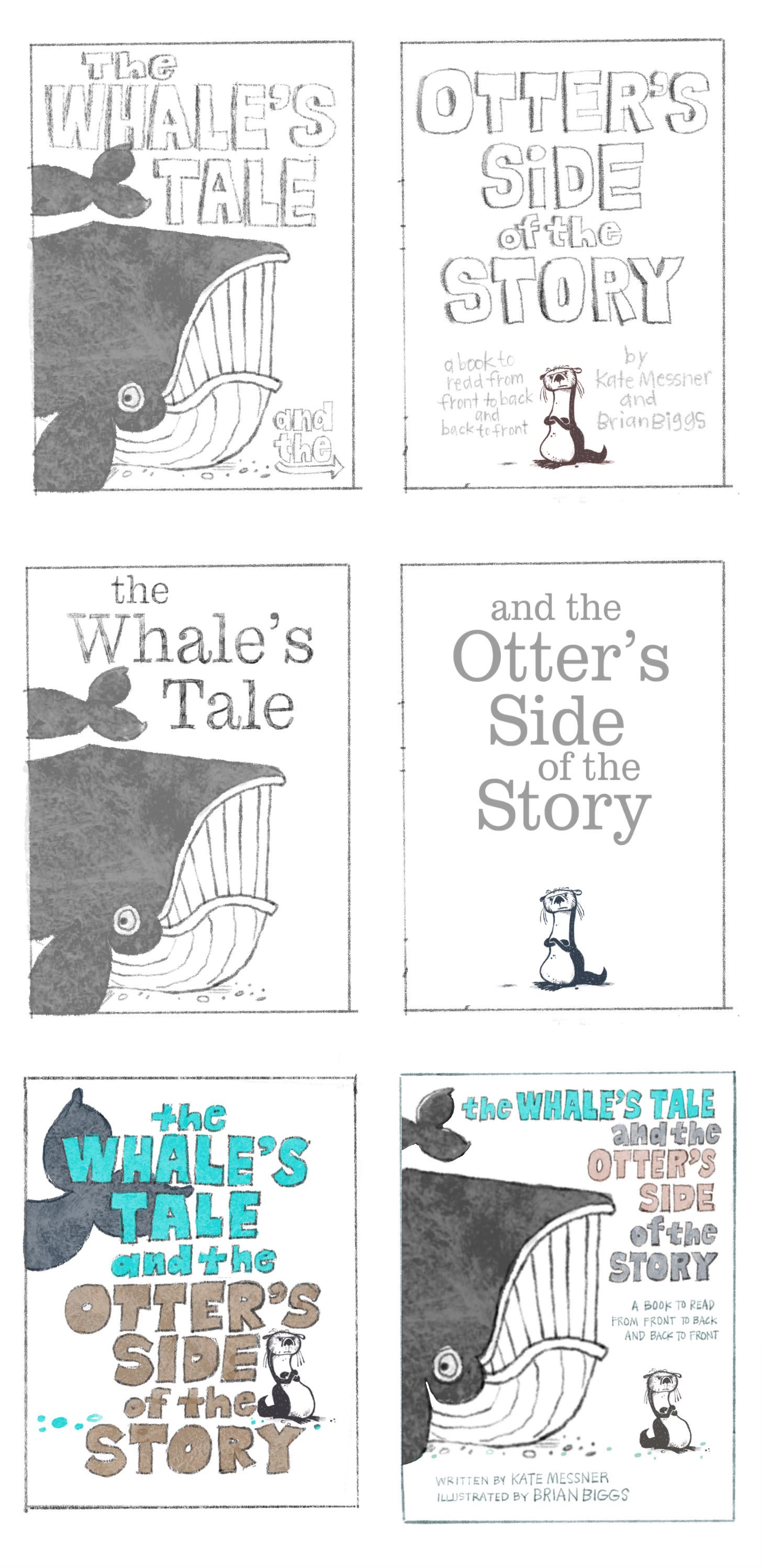
Book covers are odd ducks, in that they have to perform several jobs and must do them each very well. First, they have to sell the book. If a cover doesn’t grab someone’s attention and make them want open the book, then what’s the point? But they can’t do this without honestly representing whatever is inside the book, the story and the illustrations, and hopefully do this without any spoilers. Since you were able to get away with this back and forth trick in the narrative, my first inclination was to see what I could get away with with this cover. In line with the way the book reads, the first idea I tried was to split the title of the book in half. On the front cover we would see our whale, with “The Whale’s Tale…” as the cover. Then, if you flip the book over, we get our otter with “and the Otter’s Side of the Story.” I’ve designed enough picture book covers that I knew there was only a slim possibility that our wonderful publisher would go for this. My argument was that if one sees the book in a store, you flip it over and there’s the whole thing. If you’re seeing it online, the full title would be there in the text description anyway. I felt it was the best way to really stay true to the whole trick of the book.
Alas, my instincts were on the money and Clarion just sort of laughed as they collectively said “not a chance.” I guess there are sales and marketing reasons for these things out there, and whatever, it was worth a try.
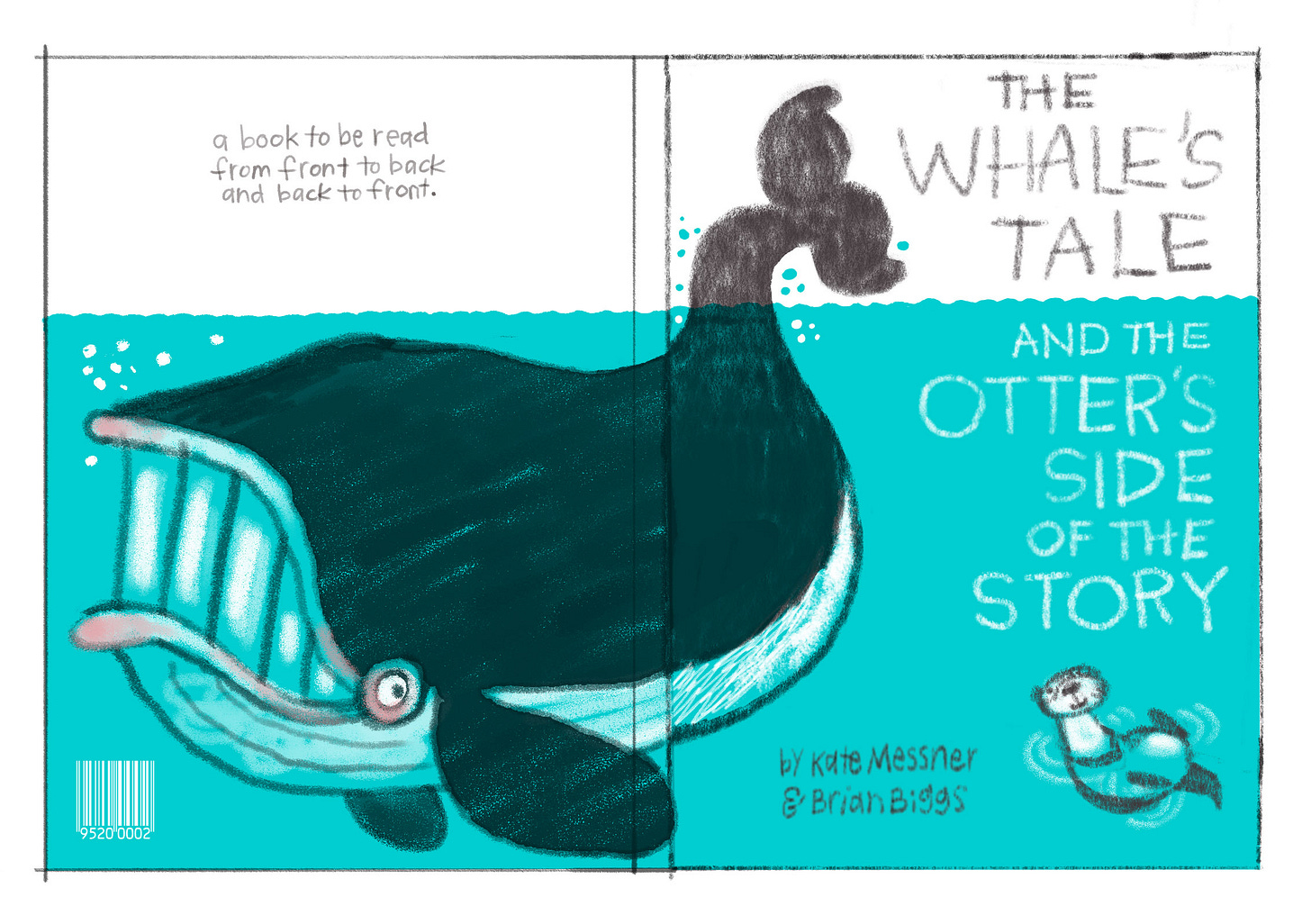
But the footnote to the sad news was from our editor, Anne, who suggested maybe we try playing some similar game with the case cover.
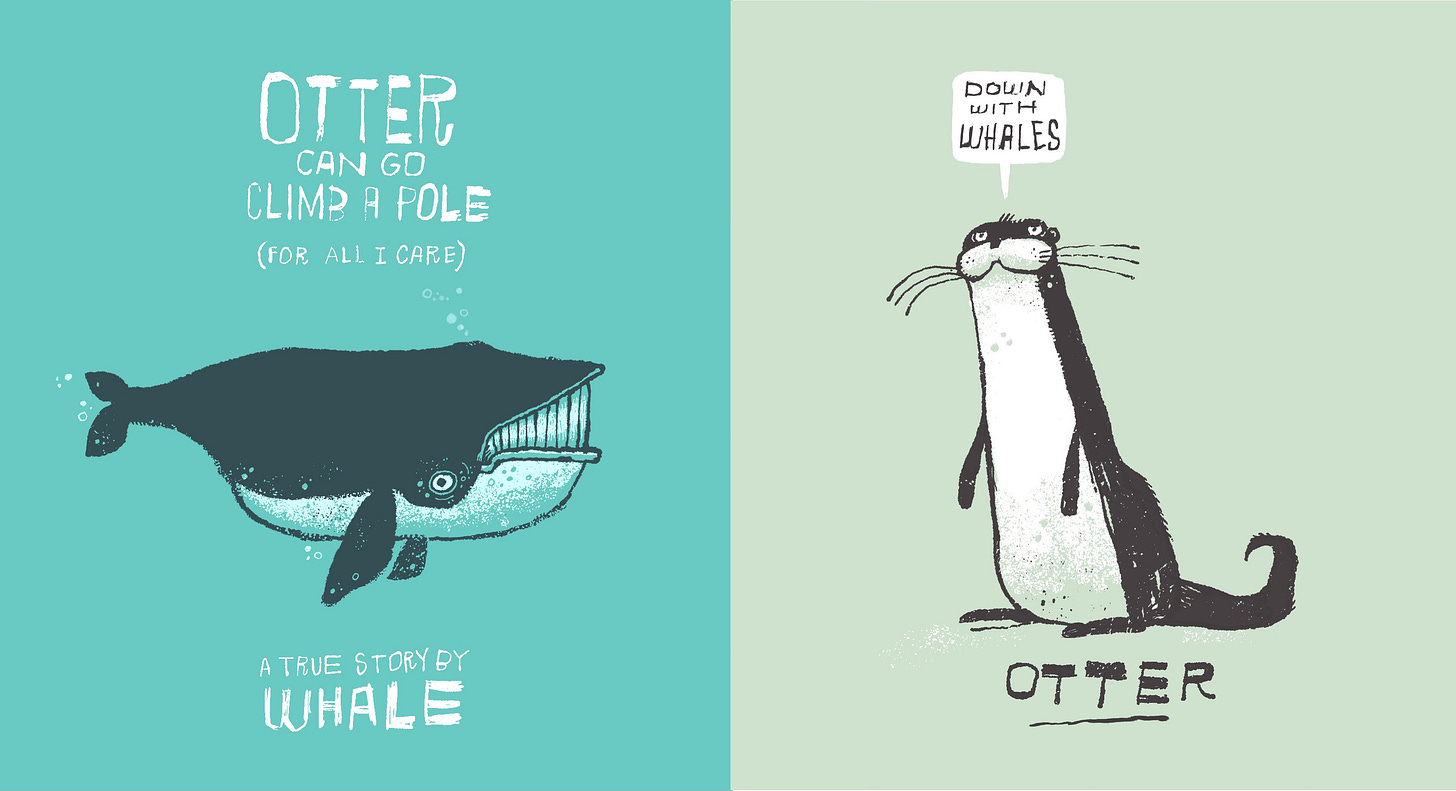
Now the goal with the cover became figuring out a way to get that long title on there, as well as our two characters, one of which is an enormous whale. A book jacket is only so big! But there was the answer, right there in the title itself! The Whale’s Tale. The whale’s TAIL! Yes that’s it! The whale is only visible through her tail on the cover, and she’s so big that she wraps around to the back cover. It didn’t take many sketches to get this right, and was approved quickly.
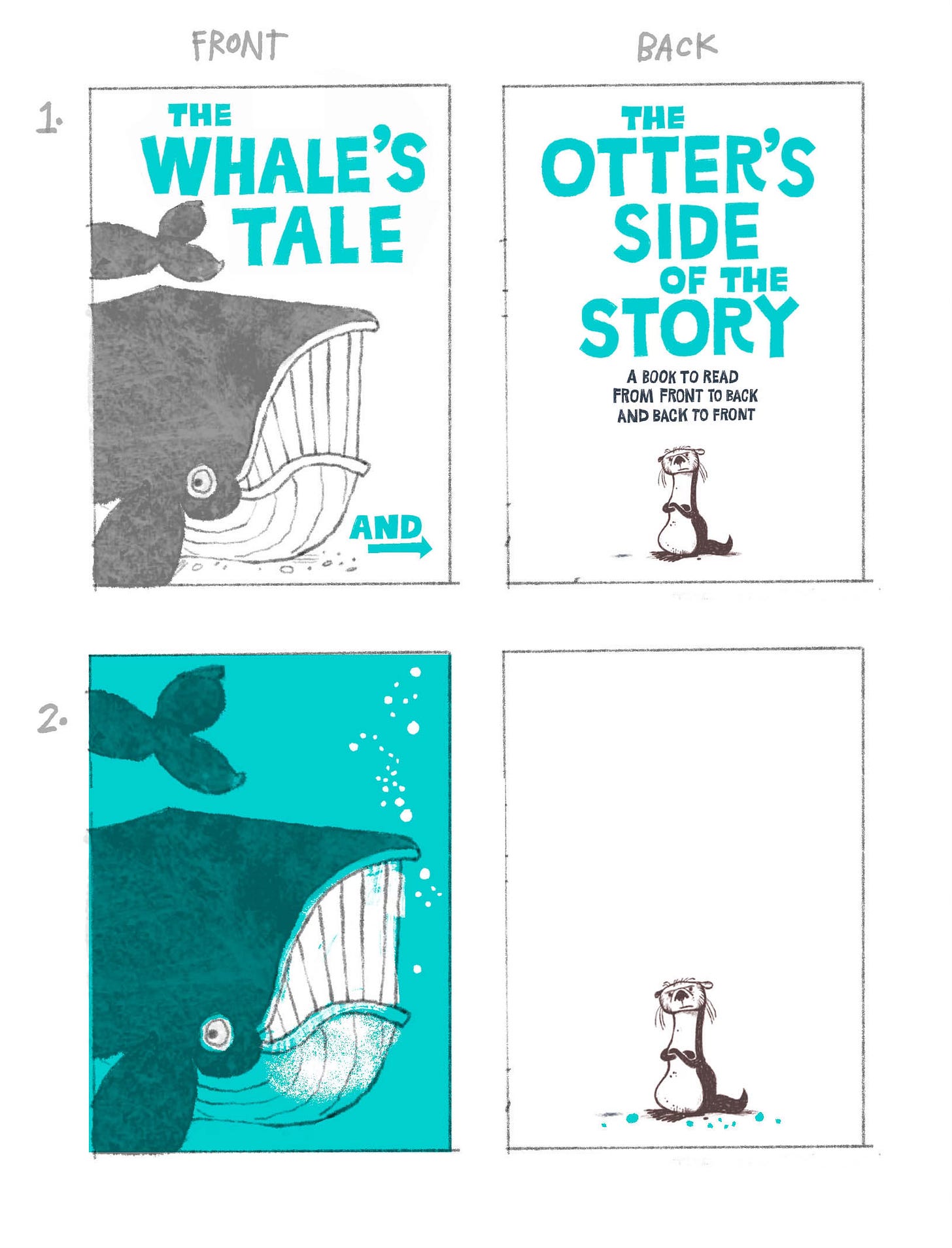
I gave two options with the case cover. One had the title split into two, as I mentioned. But, again, since the case cover doesn’t have to sell the book at all, I wondered if we even needed a title. Could we just represent the story with our grinning whale, and our grumpy otter?
(Number 2 is the winner!)
The answer was yes, and I was thrilled. That illustration of grumpy, annoyed Otter is my favorite drawing in the entire book and I was so so happy about this.
Kate, The Whale’s Tale and the Otter’s Side of the Story is a fun, tricky, and even a secretly educational book, and I am so happy to have been your collaborator on it. I can’t wait til we get to visit bookstores and schools in a couple of weeks and read it aloud. And I can’t wait to unleash it to the world and have readers and their parents do the same.
Kate: I’m so glad that when Anne reached out, you were up for the challenge! (But of course, I think we both know that she had a feeling you wouldn’t be able to resist the puzzle of this book, right?) At any rate, I’m SO excited that our book is making its way into the world.
Not long after we started this conversation, you might have noticed that I was absent from the Google doc for a few days. I was visiting schools in Dublin and New Albany, Ohio…and I couldn’t resist treating them to an early read-aloud of THE WHALE’S TALE AND THE OTTER’S SIDE OF THE STORY. Their librarian had told them about the book and they wanted to know HOW? HOW do you make a book that works when it’s read both ways? So we read it aloud together…from the first page to the last page…and then from the last page to the first page. I wish you could have seen the looks on their faces, Brian. They were amazed and immediately started trying to figure out how it worked. There was more than one request to “Read it again!” but alas, we were out of time and they had to go to lunch. But thankfully, their librarian already had a copy on order, so very soon, they’ll be able to read and puzzle out the HOW of it all to their hearts’ consent.
All this to say that Whale and Otter and I are all SUPER grateful that you were game to take on this project. It’s going to be so much fun sharing it with readers!
You can find Brian Biggs on Instagram @BrianBiggsStudio. You should probably also subscribe to his super-cool and artsy newsletter BrianBiggs.Substack.com, and visit his website BrianBiggs.com.
The Whale’s Tale and the Otter’s Side of the Story comes out April 21. You can order a copy (signed by both of us!) from Children’s Book World, in Haverford, PA. We’ll sign your book when we visit the store for our book birthday party on the evening of April 21. And if you live nearby, please come join us! (And be thinking about whether you’re #TeamWhale or #TeamOtter!) More info here:
Happy New Year, friends! I hope you’re finding moments of peace and joy even amid all that our first weeks of 2026 have brought. My go-to strategy for taking care of my mental health in times like this is walking in nature, always. In case you haven’t been able to get out lately, I’m sharing a photo from a recent birding hike in the Eastern Everglades.
Our graphic novel CAMP MONSTER comes out in just a few weeks! This is my very first graphic novel, illustrated by Falynn Koch. I love it so much, and I hope you’ll consider pre-ordering your copy from your favorite local bookstore. If you do that – and you’re one of the first 500 people to send Bloomsbury your receipt – you’ll get a free CAMP MONSTER baseball cap as a pre-order gift! The hat is seriously cute, so you’ll want to jump on this offer to make sure you’re one of the first 500 orders!
The book comes out February 3rd (hats will ship a little later) so it would make a pretty sweet Valentine’s Day gift for your favorite little monster.
Even if you can’t pre-order right away and aren’t one of the first 500 to send in your receipt to get a cap – if you order before February 3rd, you’ll get a limited edition CAMP MONSTER sticker sheet, which is also pretty great. Here’s all the info and a link to preorder now.
If you haven’t already signed up for my January virtual author visit, don’t worry – there’s still space for your readers to join us! I’ll be Zooming with readers at 1pm EST on January 29th to offer a peek behind the scenes at my upcoming graphic novel CAMP MONSTER, illustrated by Falynn Koch. Falynn will join us on video to share a look at her illustration process as well, and I’ll also lead kids in a mini writing workshop to create their own characters for Camp Monster. We’ll wrap up with live Q&A. It’s going to be so much fun! There will be ASL interpreting provided, as well as a recording, which all registrants will get via email 24 hours after the webinar ends. Here’s how to sign up!
In other news…
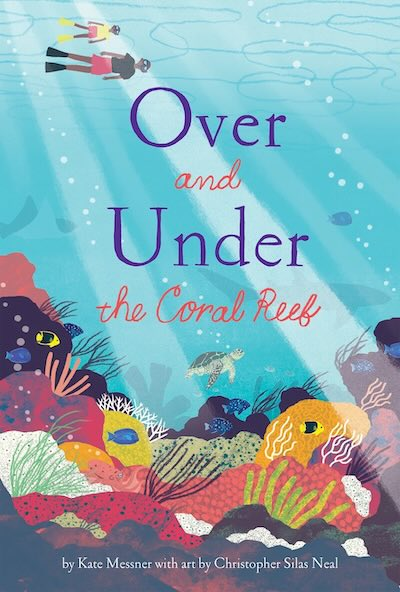
OVER AND UNDER THE CORAL REEF is a finalist for the SCBWI Golden Kite Award for Picture Book Nonfiction – AND it’s been named to the 2026 Texas Topaz reading list! This is book eight in our nature series that launched with OVER AND UNDER THE SNOW fifteen years ago. As soon as I sent that first Over & Under book to my agent, she warned me that it was a quiet story – loud, flashy picture books were popular at the time – but she believed in it. My editor at Chronicle Books believed, too. And then so did all of you. So many readers have shared this series over the years, and I’m beyond grateful. So thank you.
I’m headed to Nashville for a school visit this week and from there, I’ll be off to New York for the Society of Children’s Book Writers & Illustrators Conference. I’m leading a craft workshop called Nonfiction Glow Up, and I couldn’t be more excited to work with writers! We’re going to look at some of the most amazing recent informational picture books and what makes them work. Every time I teach a workshop like this, I learn so much from my colleagues’ books as I’m preparing. We’re going to have a great conversation, and I hope to see some of you there!
That’s all for today. I hope you have a wonderful rest of January. Take care of yourself, and I hope to see you and your readers at our virtual author visit on the 29th!
It’s almost time for another amazing World Read Aloud Day! It’s an annual celebration of sharing stories from the amazing folks at LitWorld. This year’s World Read Aloud Day will be Wednesday, February 4, 2025!
If you’re new to this page, I’m Kate Messner, author of more than seventy books for kids. I’m also a former middle school teacher and a forever reader. Each winter, I help out with World Read Aloud Day by pulling together a list of author & illustrator volunteers who have volunteered to spend part of the day doing quick virtual read-aloud visits with classrooms around the world to share the joy of stories.
This February, I’ll be on book tour for my new graphic novel CAMP MONSTER, illustrated by Falynn Koch, so I won’t be available for live Zoom visits, but I hope you’ll have fun reading this one aloud to your classes. (Have fun with all the monster voices!) The first in a planned trilogy, it’s about what happens when a family-run summer camp for Yetis opens its door to ALL different kinds of monsters, with hilarious and chaotic results. You can pre-order a copy for your classroom or library now!
I’ll also be gearing up for the release of two new picture books! THE WHALE’S TALE AND THE OTTER’S SIDE OF THE STORY: A BOOK TO READ FROM FRONT TO BACK AND BACK TO FRONT is illustrated by Brian Biggs and comes out in April. (And yes, it makes sense both ways! From front to back, it’s the whale’s point of view, and from back to front, it’s the otter’s!) This one’s also available for pre-order now, and will make a great spring read-aloud for your kids!
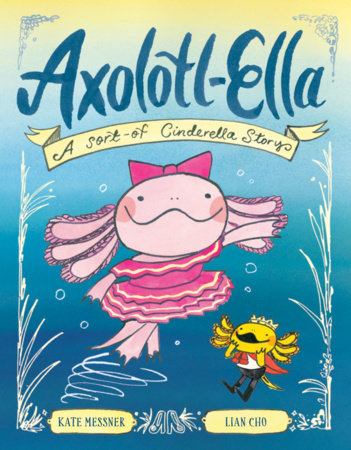
And AXOLOTL-ELLA (cover reveal coming soon!) is a reimagining of the Cinderella fairy tale…but with axolotls. Illustrated by Lian Cho, I promise you, it’s just as delightfully weird as it sounds. Pre-order this one to read aloud this spring – it just may inspire some fractured fairy tale writing, too!
VIDEOS FOR WORLD READ ALOUD DAY
Even though I’ll be traveling for this year’s World Read Aloud Day, I’ll still be celebrating ! I’m offering virtual read-alouds from several of my new & upcoming books! These will be available through the school year, so feel free to save them for World Read Aloud Day or use them as a First Chapter Friday any time!
A first-chapters read-aloud of WILDLIFE RESCUE: HOW TO SAVE AN OTTER, illustrated by Jen Bricking. Perfect for readers who LOVE animals,this is the first in our new early chapter book series about Ivy and Ezra, who work with their family to rescue injured and abandoned wildlife.
For readers in grades 4-8
A first chapters read-aloud from THE TROUBLE WITH HEROES, about a seventh grader who vandalizes a cemetery and finds himself sentenced to high all 46 Adirondack High Peaks in a single summer, with the world’s drooliest, smelliest Bernese mountain dog at his side.
And of course, there’s also an AMAZING list of authors and illustrators who have volunteered to Zoom into classrooms for World Read Aloud Day this year!
AUTHOR VOLUNTEERS FOR WORLD READ ALOUD DAY
WORLD READ ALOUD DAY IS FEBRUARY 4, 2026!
The authors & illustrators listed have volunteered their time to read aloud to classrooms and libraries all over the world. These aren’t long, fancy presentations; a typical one might go like this:
1-2 minutes: Author introduces himself or herself and talks a little about his or her books.
3-5 minutes: Author reads aloud a short picture book, or a short excerpt from a chapter book/novel
5-10 minutes: Author answers a few questions from students about reading/writing
1-2 minutes: Author book-talks a couple books he or she loves (but didn’t write!) as recommendations for the kids
If you’re a teacher or librarian and you’d like to have an author Zoom with your classroom or library on World Read Aloud Day, here’s how to do it:
Contact the author directly by using the email provided or clicking on the link to his or her website and finding the contact form. Please be sure to provide the following information in your request:
Your name and what grade(s) you work with
Your city and time zone (this is important for scheduling!)
Possible times to connect on February 4th. Please note authors’ availability and time zones. Adjust accordingly if yours is different!
A phone number where you can be reached on that day in case of technical issues
Please understand that authors are people, too, and have schedules and personal lives, just like you, so not all authors will be available at all times. It may take a few tries before you find someone whose books and schedule fit with yours!
If you’re lucky enough to book an author to visit for World Read Aloud Day, please honor that commitment. In years past, unfortunately, we’ve had some educators and librarians cancel when they found a different author, and that’s awfully demoralizing for folks who are volunteering their time. Please only schedule visit dates that you’re excited about keeping!
Authors: Once your schedule is full, please send a quick email via my website contact form, and I’ll remove your name from the list. Please note that due to deadlines and other obligations, it may take up to a week for me to update.
The stories we share aloud bring us together and inspire readers, so why not plan a whole day to celebrate? LitWorld’s fantastic World Read Aloud Day is scheduled for February 4, 2026!
Traditionally, authors and illustrators around the world have Zoomed into classrooms & libraries for short read-alouds. Since the beginning, I’ve helped out by compiling a list of author and illustrator volunteers so teachers & librarians can connect with them to schedule virtual read-aloud sessions on that day.
Authors & Illustrators: Are you a traditionally published* author or illustrator who would like to be listed as a WRAD virtual read-aloud volunteer? Please read the information & follow the directions below…
WRAD VISITS AREN’T LONG OR FANCY PRESENTATIONS. USUALLY, THEY LAST 10-15 MINUTES AND GO SOMETHING LIKE THIS:
1-2 minutes: Author gives a quick introduction & talks a little about their books.
3-5 minutes: Author reads aloud a short picture book, or a short excerpt from a chapter book/novel
5-10 minutes: Author answers a few questions from students about reading/writing
1-2 minutes: Author book-talks a couple books they love (but didn’t write!) as recommendations for the kids
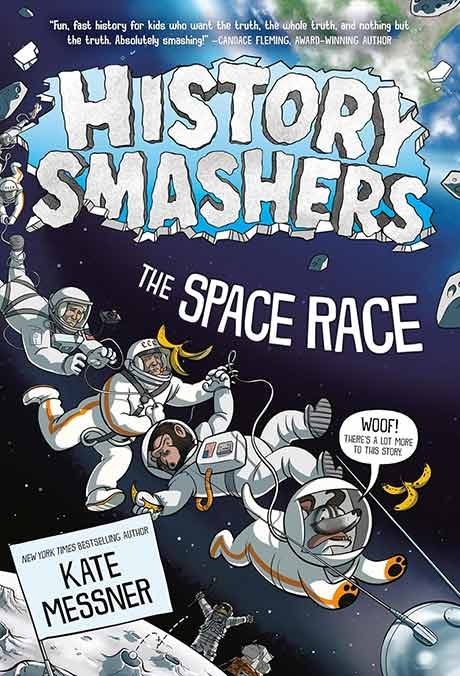
When October rolls around, I see a steep sales spike for History Smashers: Salem Witch Trials, the ninth book in our popular myth-busting series. The cover gives off some serious Halloween energy, which probably has a lot to do with that, and this book definitely offers some delightfully gross and creepy stories to go along with it.
Think your neighbor might be a witch? Have you tried feeding your dog a cake baked with the suspected sorceress’s urine? Believe it or not, that was one of the strategies of early witch hunters! Along with the wild stories, this installment of the History Smashers series offers up a healthy dose of more serious history, touching on colonization, Puritanism, America’s judicial system, separation of church and state, and more. And bonus: If you’re reading this one with kids this fall, don’t miss the History Smashers virtual author visit scheduled for October 7th!
Here are seven more great-for-Halloween-season books that offer great STEM and History content along with the scares!
History Smashers: Ancient Egypt – With a screaming mummy on the cover, this latest installment in the series comes out October 7th and is another easy sell for the Halloween season. Inside, readers will learn the history of Egypt’s kings, pyramids, and gods (including one that threatens to eat your heart if you’re not a good enough person!) and decide for themselves if the curse of King Tut’s mummy is real.
Spooky Lakes: 25 Strange and Mysterious Lakes that Dot Our Planet by Geo Rutherford – This book’s terrifically creepy cover features jellyfish, skulls, and…is that a disembodied hand sticking up from the seaweed? Spooky Lakes introduces readers to 25 lakes around the world whose scary claims to fame include creating lightning storms and mummifying any creature that touches the water.
When Plants Attack by Rebecca E. Hirsch – Venus flytraps might not be the usual stuff of nightmares, but the one on the cover of this book about strange and terrifying plants looks ominous enough to inspire a bad dream or two. (The insect legs sticking out of it do a lot to help with that bad-plant image!) Inside, readers will learn about everything from ravaging invasives to “vampire vines.”
Poison: Deadly Deeds, Perilous Professions, and Murderous Medicine by Sarah Albee – Hello, creepy skeleton on the cover! Don’t let the comic font fool you; this book is packed with history and science, along with the poisonous thrills. It chronicles the role that poison has played in the past, from the days of Socrates and Alexander the Great to more modern toxins.
The Haunted States of America – This anthology created by SCBWI features fifty two creepy legends, monsters, and ghosts from all fifty states, plus Washington, D.C. and Puerto Rico. The Crafted by fifty-two different authors, including Padma Venkatraman, Ellen Hopkins, Freeman Ng, and K.E. Lewis, these scary stories star everything from the Jersey Devil to La Llorona and will have readers up reading under the covers long after dark.
Death Eaters: Meet Nature’s Scavengers by Kelly Milner Halls has a great title and a genuinely creepy vulture on the cover to draw kids in. Once they start reading, they’ll discover how essential scavengers are to our planet’s ecosystem. Gross and fascinating!
I absolutely LOVE in-person author visits and have traveled to spend time with readers all over the world. But I understand that not all schools can afford to fly authors in for a visit.
That’s why each season, I set aside a few days for very low-cost virtual author visits for schools, libraries, and homeschoolers who may not have the budgets for an in-person visit.
My Fall 2025 virtual author visit dates are September 15th and October 7th. I so hope you and your readers will join us for these engaging, interactive events! Here are all the details:
Cost: $15 for each 40-minute virtual author visit includes live access for one device and a recording, available for 2 weeks after the event. ASL interpreting will be provided.
For Grades K-5
Over and Under: Reading & Writing Science Picture Books – Award-winning author Kate Messner will share the research and writing process behind her popular Over and Under nature picture book series, including the newest book, OVER AND UNDER THE CORAL REEF. She’ll also offer a sneak preview of upcoming Over & Under books and answer reader questions.
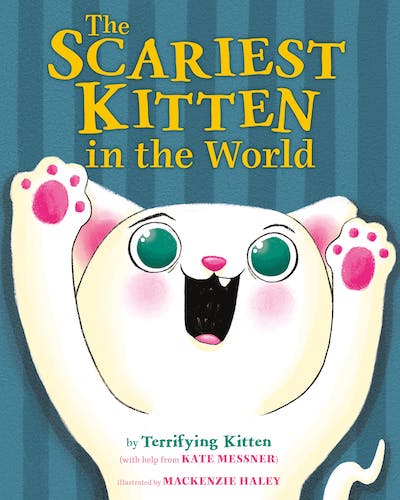
Not So Scary Stories – Award-winning author Kate Messner will share a read-aloud of THE SCARIEST KITTEN IN THE WORLD, give a sneak-preview of upcoming picture books (spoiler: there are whales, otters, and axolotls involved!) and answer reader questions.
The Trouble with Heroes – Kate will share the research, writing, and revision process behind her New York Times bestselling novel in verse THE TROUBLE WITH HEROES, including an interactive read aloud excerpt, and answer reader questions.
History Smashers – Kate will share behind-the-series secrets from her popular HISTORY SMASHERS graphic nonfiction books, which smash common myths about history. She’ll also challenge readers to a quick interactive history trivia quiz and answer questions.
Yes! We’ll have live ASL interpreting, which will be available on the recorded version as well.
Will there be Q&A?
Yes! At least 15 minutes of each webinar will be reserved for Q&A. That may not be enough to answer every last question, but Kate will respond to as many as possible.
How many students are allowed to attend with each registration?
Each registration is good for live webinar attendance on one device. The number of students attending is up to you. You can choose to purchase a registration for each individual classroom or stream the webinar on just one device and have 500 students watch together in an auditorium.
Will the webinar be recorded?
Yes! The recording will be available to all registrants after the event and will remain available through the school year. About 24 hours after the webinar ends, you will get an email with the link for the recording.
What if we sign up for the webinar but then can’t attend live? Can we get a refund?
Unfortunately, no. Because of the very low cost of these virtual author visits, we’re not able to process refunds unless you cancel before the day of the event. There will be NO REFUNDS after that. However, if you can’t to attend live, you’ll still be able to watch the recorded version!
Can we pay with a check/purchase order/etc. or do we have to use the Zoom link with Paypal?
The only way to register is to pay via Zoom/Paypal. (Paypal allows for the use of a credit card, though) The streamlined nature of this is what allows me to keep the cost so low, and that’s my priority for schools this fall.
Hi, Kate. I love that we both have verse novels coming out this spring with main characters learning about themselves via the natural world. Could you tell me a bit about The Trouble with Heroes? Would you describe it as a survival story or…?
It’s definitely a survival story – and in more than one sense of the word for the main character, Finn. On the verge of failing seventh grade, he gets caught vandalizing a cemetery. The headstone he kicked over belonged to one of the first women to hike all 46 Adirondack High Peaks, and her daughter makes Finn an offer. She’ll drop all the charges if he climbs all 46 mountains in a single summer. Also? He has to bring her mother’s drooly Bernese mountain dog, Seymour, along on every climb.
Oh my gosh. Bernese mountain dogs are the cutest. And I’m getting Peak vibes from this description. Remember that Roland Smith book? Loved it. So did my students way back when.
These mountains are rugged and remote, and the climbs involve everything from knee-deep mud to near-vertical rock climbs, so Finn has his work cut out for him. But his emotional journey may be an even greater struggle, as he begins to face the loss of his dad two years earlier and the legacy he left behind.
What about your new book? The cover immediately caught my attention because my oldest lives in California, so we’re constantly watching the wildfires.
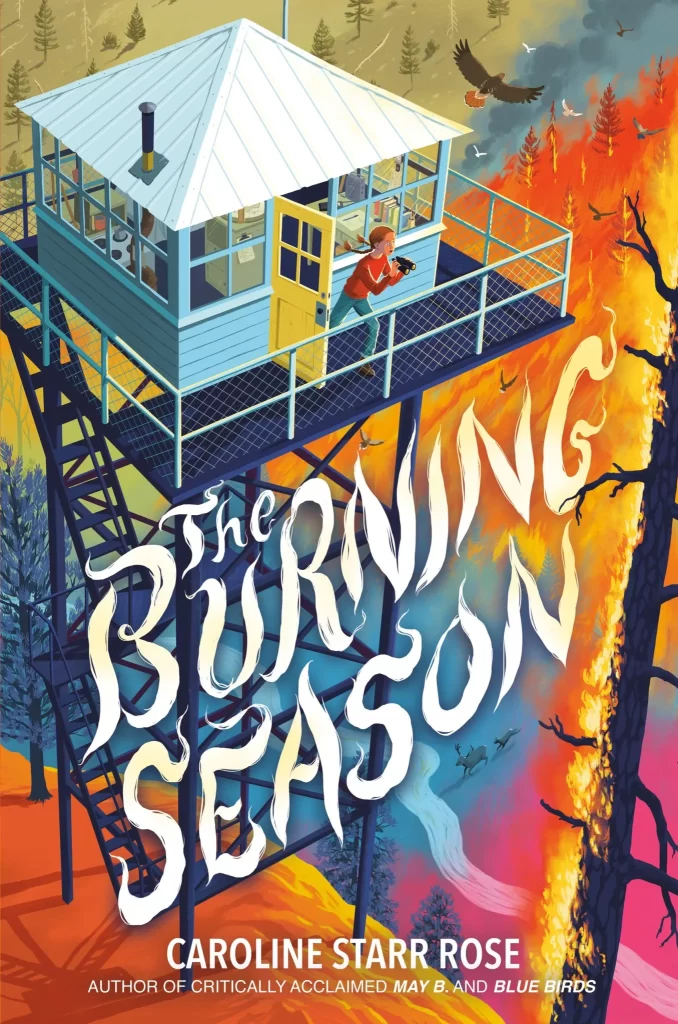
The Burning Season is about a girl named Opal who has been raised in a fire tower in New Mexico’s Gila Wilderness. She will one day be the fourth-generation woman in her family to serve as a lookout in the tower, and as part of her family’s tradition, she has started her training on her twelfth birthday. Opal is proud of her family’s legacy and work, but she longs to go to school in town and she’s keeping a secret: she’s afraid of fire. When her mom goes to town on a supply run and her gran goes missing, Opal is the only one left in the tower. Then she sees smoke in the distance. With the tower’s radio dead, Opal realizes she’s the one who will have to face the fire, and she’ll have to do it alone.
Like Finn, Opal has lost her dad. He died fighting a wildfire before she was born.
You’re a hiker, right? Is that how you came to this story?
One of the first questions readers ask about this book is “So have you climbed all 46 of those mountains?” And the answer is yes! But I didn’t climb them all in a single summer like Finn has to; it took me eight years to summit them all. I’d like to tell you that I loved every minute, but honestly, there were times out there when I’d be standing in knee-deep mud wondering, like Finn, why people climb mountains on purpose. The mountains become a part of you, though, and they call you back. And Finn learns along the way that his dad has a connection to those mountains, too. That becomes important to him. It’s fascinating to me that both of our characters live in the shadow of hero dads. (Finn’s father was a 9/11 firefighter who died later, during the COVID-19 pandemic.) What was the inspiration for Opal’s story?
First, I’ve wanted to write about my beloved home, New Mexico, for ages. And I wanted to write a “girl in a tower” story. I wasn’t sure exactly what that meant at the time I first thought of it, but I love working with limitations (a limited setting in this example). I thought perhaps my tower would be a lighthouse, but there have been a fair number of lighthouse books. Then I saw in Sunset magazine a picture of a fire tower that had been converted into a home and realized that was it! That was my tower. There are a number of fire towers still in service across the state (as there are in many Rocky Mountain regions). So there was my New Mexico connection. And wildfire is a huge, never-going-away issue we deal with here and in many places across the country. The idea felt relevant and important.
At the same time I knew I wanted to explore the ideas of solitude, nature, and survival as I had with my first verse novel, May B. (which is also a book with a limited setting). In a lot of ways I see The Burning Season as May B. 2.0. I never say it in the story, but I picture Opal as May’s great-great-great granddaughter. There are some fun parallels between the girls and some Easter eggs for astute readers to find. Opal’s Great Aunt Dor (her gran’s great aunt, actually), was modeled after Hallie Dagget, the first woman to serve in a fire tower for the US Forest Service in 1913.
Are Finn and Seymour out there alone? How does this time on the mountains help Finn see himself and his world?
We have fire towers in the Adirondacks, too! Sometimes they’re open during the summer and fall, so you can climb up after you summit for an even higher view of the surrounding peaks. There, though, wildfires are rare enough that we sometimes forget what the towers are really for.
Finn doesn’t do any fire tower hikes, but he does summit a whole lot of mountains and has more than the dog for company. Obviously, no one’s going to sentence a rising eighth grader to climb 46 mountains alone, so volunteer 46ers go along with him on each hike. They’re people who have already climbed the 46 High Peaks and are there in case anything goes wrong (though they’re under strict orders to let him figure things out himself!) These “trail nannies,” as Finn calls them, become unexpected mentors for him, each opening his eyes to something he doesn’t realize he needs in order to heal.
I love how timely both of our novels are, in different ways. What do you hope readers will take away from The Burning Season?
While Opal’s situation is unique, I think fear is a very real part of being a person. Learning to talk about it is the first step in lessening the power it can have on us. I’d also like readers to see the complex nature of fire and its role in the world. Fire can destroy but it can also heal. They’re necessary for forest growth and renewal.
And what do you hope readers take from The Trouble with Heroes?
I hope they’ll understand that they’re not alone. I’ve realized that this is actually the underlying theme of so much of what I write. At the beginning of this novel, Finn feels pretty isolated, and there’s a scene later on where he’s blown away by how many people show up for him, again and again, no matter how many times he screws up. I think you may know that I used to be a middle school English teacher, and I taught so many kids like this, boys especially. Kids who had kind of given up on themselves, and they were always surprised when you hadn’t given up on them, too. I loved those kids, and I hope a lot of them find this book.
I used to teach middle school, too. I adored my students – and I love readers this age. They are curious, open-minded, and fun.
Thanks so much for the conversation, Caroline. I can’t wait to read Opal’s story!