Teachers Write! 8/3 – Friday Writing Happy Hour

You’ve almost made it – just one week of our Summer Teachers Write Camp to go! How’s it going?

Friday Writing Happy Hour is a chance to relax and share comments about our progress, goals, accomplishments, and whatever else is on your mind.  And if you’d like feedback on a snippet of writing, head on over to Gae Polisner’s blog for Friday Feedback, where you can share a few paragraphs of your work and offer feedback to others, too.

Oh! And we have another book giveaway. Caroline Rose Starr is giving away a copy of her gorgeous historical novel-in-verse MAY B.

Just leave a comment by 11:30pm EST Saturday to be entered in the drawing, and I’ll announce the winner on Monday.

I’ll be MIA from comments again today because I’m at the SCBWI conference in Los Angeles (whee!) but I’ll check in when I can. In the mean time, talk amongst yourselves & have a great weekend!

Remember to check in at Jen’s Teach Mentor Texts blog on Sunday.  I’ll see you back here Monday morning!

Teachers Write 8/2 Thursday Quick-Write

Good morning, everyone!  I’m traveling this week into next week – first to the annual Society of Children’s Book Writers & Illustrators Conference in Los Angeles, where I’ll give a workshop on “The Magical Unexpected” in picture books and speak at the Golden Kite Awards Luncheon celebrating OVER AND UNDER THE SNOW and the other winners.  I’ll fly from there to the Millersville Writing Institute in Pennsylvania, where I’m presenting on writing and revision (and looking forward to spending time with amazing teacher-writers!) And then it’s on to St. Louis, where I’m speaking at a Scholastic Book Fairs event because CAPTURE THE FLAG and EYE OF THE STORM will both be featured in the fall book fairs, which delights me to no end.

Don’t worry – all your assignments and quick-writes and everything else are scheduled and will appear as if by magic on the right days, even while I’m gone. But I will be checking in more sporadically than usual and wanted to let you know that I haven’t dropped off the face of the earth.  I’m probably just stuck in some airport with a dead laptop battery.

Anyway…you will have some great guest authors in my absence, starting with Kristy Dempsey today!  Kristy is a teacher, picture book author, and poet whose books include MINI-RACER (Bloomsbury), ME WITH YOU (Philomel), and SURFER CHICK (Abrams). Her website is http://www.kristydempsey.com/

At the end of this school year the first graders were studying the elements of story through fairy tales. We talked about imagination, we talked about the cultural aspects of fairy tales from around the world, we talked about what gave these characters believable qualities even though the stories themselves might have magical elements.

Toward the end of our unit we watched the film, “A Little Princess”. I was rather amazed as the first graders identified that Sara’s locket and the importance it held for her made the story feel believable to them. One student even said, “It’s like her locket held everything her daddy had ever given her and when Miss Minchin took it away from her, Sara knew she still had all that in her heart.” These first graders understood the importance of emotional truth!

Think of the physical item that is most important to your main character. What does it represent? Now, imagine it being lost or taken away from your main character. How would he/she respond? Sara Crewe’s response, of course, was fairly noble. But what if your character pitched a fit? Or what if he/she embarked on a series of misadventures to try to recoup what was lost? (In fact, one of the funniest scenes in the movie is when Sara’s friends enter Miss Minchin’s office to try to get the locket back.)

Write a scene that shows the emotional importance of this physical item to your main character and then show us how he/she responds when it is lost or taken. I can’t wait to read the serious or funny or fantastical emotionally true scenes you come up with!

EDITING TO ADD THIS:  Sorry, everyone! I accidentally repeated Kristy’s earlier quick-write. Here’s her new one for today. Consider it a “Bonus Write” if you’ve already done the first one!

“Every story would be another story, and unrecognizable if it took up its characters and plot and happened somewhere else… Fiction depends for its life on place. Place is the crossroads of circumstance, the proving ground of, What happened? Who’s here? Who’s coming?…”

— Eudora Welty

I don’t know about you but setting is one of the last things I deliberately consider when crafting a story. Oh it sneaks in, of course – I usually have some sense of where my characters are when they’re doing whatever it is they’re doing. They aren’t just hanging in mid-air. And I usually know what part of the world they might be located, but truth be told, most of the setting is in my mind and not on paper until later drafts. Is it sunny or raining? Has the grass they’re standing on been freshly cut or is it tickling their ankles? Do they live above or below the Gnat Line? If the answer is “below,” how does that affect them every single time they step outside? (And if you don’t know what the Gnat Line is, ask me in the comments. And also, if you don’t know what the Gnat Line is, you must not be from the South. ☺ )

These are the kind of setting details that can add life to your story. The easiest way for me to add these details into my writing is to free write about something my character does often, some sort of ritual or habit that may not even be part of my story but that gives me more insight into who he/she is and how he/she relates to the world around her. These rituals could be simple things like walking to the mailbox to get the mail, washing and putting away the dishes, or riding a bicycle to the market to get a freeze pop. I add as many sensory details into this free write as possible. What does my character see, hear, smell, touch, taste? When doing a free-write like this, let your character be a little ADD. Let him/her get distracted and wander around a bit.

For me, these sensory details bring life to my setting. No longer is my character just riding her bike to the market but now her bike tires are squeaking with every rotation as she bounces along the dirt road. A mockingbird cries back in response from the maple tree up ahead. She stops to listen then squawks herself to see if the bird will mimic her own call. She hears the gurgling of a creek and lets her bike fall to the ground (the kickstand is broken) so she can investigate. Beavers have begun building a dam that has formed a pool of water deep enough to swim in. She wades in up to her knees and feels the cold clay bottom and creek stones worn smooth by years in the water stream . . . (At this point, I would continue, possibly writing about the smell of wet leaves and the water bugs that are flitting across the top of the pool of water. And on, and on until she finally makes it to the market for her freeze pop. And then I would describe the market . . .)

(As a side note, sometimes free-writes like this give me ideas for plot fixes. For example, that beaver dam could now play a key role in my story as the county moves in to minimize the damage to the land and wants to relocate the beavers. That’s just the sort of thing my character might get up in arms about!)

After finishing the free-write, I find places where I can sprinkle the details throughout my work-in-progress. (Like that broken kickstand. It had nothing much to do with the scene in the free-write but it could show up as a frustration in several places in my story.) Often, these details add more depth to my characters as I consider their responses to their surroundings. You may not even have a main character you’re working with right now. That’s okay. If you don’t, I want you to do this exercise about yourself. Take pen and paper with you as you go about one of your daily rituals if you have to. This will teach you to capture some of the details of your own setting that you might otherwise miss.

As a short example, one of my own rituals from when I lived in America was to sit on the front porch and watch for deer in the pasture in the morning. As I sat on a slightly damp cushion in the rocking chair, there was often mist rising from the ground in the quiet of the morning. Glints of dew shone in the sunlight on the peace lily at my feet. The sweet smell of honeysuckle hung in the morning air. A few sips of my warm cup of coffee and I was already sweating in the humidity. The slats on the back of my rocking chair creaked with each sway back and forth and the rails on the bottom bumped against the uneven tiles of the porch floor. It was a rhythm that matched the beat of my heart, slowed my breathing, focused my contentment. When I saw a deer in the distance, my breath caught in my lungs. I couldn’t move. Afraid to even exhale, I silently straightened my spine so I could see more of him over the rise . . .

I could continue on and on but I want you to get started! You’ll see from my very short examples above that this is not the sort of free-write that you will lift and put directly in a story. Since this free-write includes no dialogue (not that it can’t, but mine doesn’t), it’s not the kind of thing that will move your plot forward significantly.

When I free-write like this, my writing tends to involve my character wandering around in the woods or walking to school in the city or cleaning up his/her bedroom! It’s fairly boring as a whole, but the purpose of this is to give you the details of your character’s surroundings to use in your larger work-in-progress. You will likely write more details than you will be able to use.

Easy-Peasy Bottom Line:

1. Choose a habit or ritual or a daily event (your own or your character’s).

2. Describe what your character sees, hears, touches, smells and tastes while doing this activity.

3. If you want to expand the scene, add your own touches. (Broken doorknobs, the sniffles, dog poop, a spider web, etc. are all things that might make your character respond differently to their habitual daily event. And if you fear your writing seems simple or boring, remember this quote from John Wooden: “It’s the little details that are vital. Little things make big things happen.”

Teachers Write! 8/1 – Q and A Wednesday

Wednesday is Q and A Day at Teachers Write! Virtual Summer Writing Camp, so if you have questions about writing, ask away!

Authors are always welcome to drop by and answer questions (you never quite know who you’ll run into here!) But today’s official author volunteers are Gigi Amateau, Lynne Kelly, Lisa Schroeder, and Caroline Starr Rose.  They’ve promised to be around to respond to your questions today, so please visit their websites & check out their books!

Teachers & librarians – Feel free to ask your questions in the comments!


Teachers Write: Hummingbirds on a Wednesday

Guest author Amy Ludwig VanDerwater joins us today with a guest post on a very important part of writing: Inviting Hummingbirds!  Amy lives on Heart Rock Farm (The Poem Farm) in Holland, NY. Her first poetry book, FOREST HAS A SONG, will be published by Clarion/Houghton Mifflin Harcourt (Spring 2013) and her second book, READING TIME, will be published by WordSong/Boyds Mills Press (date TBA). In addition to poetry, Amy has written local NPR commentaries as well as a column for EDIBLE BUFFALO.

The other morning, as most of the house slept, our ten-year-old son Henry came running downstairs with wild eyes,

“There’s a hummingbird in my room!  There’s a hummingbird in my room!”

I followed him upstairs, rubbing his back, smiling about my boy and his hummingbird dreams.

When we reached Henry’s bedroom, I heard the truth before I saw it.  There, whirring against the inner screen of his skylight darted a little green beauty.  This was not a dream.  It was better than a dream.  As I gently caught Zippy in a polka-dotted sheet, Henry cranked the window above his headboard.  “I must have left it open all night.”  Laughing in wonder, we walked downstairs and onto the deck, opening this delicate sheeted gift to our morning, sending Zippy back to her life.

Writing is full of hummingbirds, surprises that we almost miss or think aren’t real enough to matter.  And these hummingbirds are whirring too; sometimes we just need to still ourselves enough to hear them.

When I get to a stuck spot in my writing, I invite a hummingbird. 

 How?

 I turn off all phones, lie on the couch, and close my eyes.  I breathe deeply and wait.  And you know what?   A hummingbird always comes.  It might be a memory of curling dandelion stems in dish soap or a memory of sweet Mr. Clark singing “Once in love with Amy.”  It may be the sound of a skipping stone or a recipe for cardamom bread or  the feel of milkweed silk or a word that’s fun to say…like flibbertigibbet.   A hummingbird.

When I am writing in rhythm, daily and with daily goals, there are days that my page and mind need to wander in colorful meadows before walking across a blank page.  And so I still my body and hold out my hands, trusting….always…in surprises.  And then, bird in hand, I go back to my desk.

Have I ever fallen asleep?  Yes.  And you may too.  But dreams, too, inform our writing lives. 

Whirr.

Teachers Write 7/31 Tuesday Quick-Write

Good morning! Today’s Quick-Write is courtesy of guest author Lisa Schroeder. She’s the author of five young adult novels including THE DAY BEFORE and the upcoming FALLING FOR YOU, all with Simon Pulse. She’s also the author of the middle grade novels IT’S RAINING CUPCAKES, SPRINKLES AND SECRETS and the upcoming FROSTING AND FRIENDSHIP (Aladdin). You can find her on the web at www.lisaschroederbooks.com and on twitter at www.twitter.com/lisa_schroeder.

My grandparents lived on a farm and I spent a lot of time there as a child and a teen. I have lots of wonderful memories, as you can imagine. It wasn’t a working farm, but a farm where they had goats for milk and to keep the grass down and mules for their annual hunting trips in Eastern Oregon.

There is a special place in my heart for the farm and for my dear grandparents who are no longer with us, and so, it’s always thrilling when I’m somewhere, not thinking about it at all, and I get a whiff of something that takes me back to that place. Have you ever noticed how smells have the ability to elicit strong memories? It’s pretty amazing, and I love it when it happens and brings up a happy memory from the farm. It might happen when our family visits the apple farm every fall or when or when I’m walking and the air has a certain grassy scent and I’m suddenly back there, hanging on to the tire swing that hung from the big, old willow tree.

Today I’d like you to think about smells and sounds. Adding in sensory details is often something you do as you revise, but here’s an exercise you can do anytime, that will help when you’re ready to read through your manuscript with an eye on the details.

 List three places your character visits in the story. For example: school, grandma’s house, and the zoo.

Now, with those three places, start brainstorming things your character might smell while there. Get creative! Imagine the people who are nearby as well as what that specific place may smell like. Don’t limit yourself to only good smells or only bad smells. Try and find both. At first, you may have trouble describing the scent in detail, and that’s okay. Don’t edit yourself, just write your thoughts down. When you have a bunch of possibilities, then you can start working on how you describe the various smells. It’s not always easy, I know. You probably won’t use the entire list, but if you can come up with one or two good descriptions, you’ll find it adds a lot to your scenes.

Also brainstorm sounds your character might hear. In some cases, you will struggle to get a couple. But in other places, you will be able to get a lot. It’s those places where you want to make sure you add in some of those details to make the experience as rich for your reader as it is for your character.

 This is a great exercise you can do just about anywhere – take a notebook along when you’re taking your kids to an appointment, and work on your lists while you wait.

 Have fun awakening your senses and happy writing!

65 Off-Draft Writing Prompts to Kick-Start Revision

Revising a book — or any piece of writing — can be messy work.

The word REVISION breaks down into re-vision…or seeing again. And in order to see something again, in a new way, we have to look away from it for a little while first.  Sometimes, the very best ideas for revising a piece of writing happen not when we’re staring at that piece of writing but when we’ve set it aside to write on a different sheet of paper or type in a new document.  Here are 65 off-draft writing prompts that can help writers of all ages get thinking in new directions.

65 Off-Draft Writing Prompts to Kick-Start Revision

1.  Describe your main character’s bedroom. Don’t forget to look in drawers and closets, and under the bed.
 
2.  Write a letter to your main character from another character who loves him or her.
 
3.  Write a letter to your main character from someone who doesn’t like him or her.
 
4.  Write a poem in your main character’s voice, using a metaphor to describe a secondary character who matters to him or her.
 
5.  Write a journal entry from your main character that starts with “I’m my own worst enemy because…”
 
6.  Write a journal entry from your main character that starts with “I’ll never share this with anyone, but the truth is…”
 
7.  Write a journal entry from your main character that starts with “Deep down inside, I’m afraid…”
 
8.  Complete this sentence in your main character’s voice. Everybody thinks my dream is _____________________, but really, it’s _____________________.
 
9.  Write a journal entry from your antagonist that starts with, “The best thing about me is…”

10. Write your main character’s obituary.

11. Take a blank piece of paper & doodle on it, as your main character

12. Write about your antagonist’s greatest regret in life.

13. If your main character could get a do-over on one day of his or her life, which day would he or she choose, and why?

14. Write a letter from your main character to you (the author!) Start like this: The thing you’re not understanding about me is…

15. If your antagonist were on trial, what would be his/her defense?

16. Describe a place where your main character feels safe.

17. Write a letter from your main character at the end of the book to your main character at the beginning of the book.  What advice, warnings, and words of wisdom would he or she give?

18. Writing as your main character, describe the setting of each scene, spending a few minutes on each sense exclusively – sight, smell, hearing, taste, touch.

19. Do the same thing – but as your antagonist. How might he or she perceive things differently?

20. Writing as your main character, look out your bedroom window and describe in detail what you see.

21. How does your main character feel when the phone rings?

22. What are some distinct body language cues, verbal habits, and quirks that your main character displays when he or she is angry?  Excited? Embarrassed? Nervous? Scared? Happy? Disappointed?

23. Create a music playlist for your main character.

24. Now create one for your antagonist.

25. If the two had one common song on those playlists, what would it be and why?

26. If your main character eavesdropped on his/her parents having a conversation, what would he or she hear?

27. What’s in your main character’s refrigerator?

28. What’s in the antagonist’s refrigerator?

29. Move your main character from where he or she lives to another state or country…a different landscape.  How would life be different?

30. What would the most minor character in your book have to say about the conflict?

31. What’s your main character’s favorite weather?  Least favorite? (and have you included both in the book?)

32. In your main character’s voice, write a poem about a place he or she loves.

33. What’s your main character’s favorite smell, and why?

34. Write about the rules of the society your main character lives in – the spoken, written-down rules and the unspoken ones, too.  What are the consequences when these rules are broken?

35. Describe a sunrise/sunset in your main character’s setting.

36. What would it look like, sound like, and feel like in your main character’s house/school/other favorite place in the middle of a huge storm?

37. Imagine the most uncomfortable situation your main character could possibly be in.  Put him or her there, and write everything going through his or her head.  What does the character say? What does he or she think but not speak aloud?

38. What happens when your antagonist sees a spider?

39. Make an imaginary Facebook wall for a character you need to understand better.

40. Make a list of everything in your main character’s closet. What should have been thrown out but wasn’t?  What’s right in front?

41. What’s in the newspaper in your main character’s home town. Front page news?  Classified ads?  Sports section? Weather forecast?

42. If your book’s characters could all vote in the upcoming presidential election, for whom would they vote, and why?

43. If all the characters in your book were in a running race, what would happen? Who would come in first?  Last?  How would they act at the end?

44. What’s on your antagonist’s bookshelf?

45. What plants/animals live in your main character’s part of the world? Choose three & describe them in detail.

46. Rewrite a scene from your antagonist’s point of view.

47. Rewrite a scene from a minor character’s point of view

48. What historical events happened in the community where your main character lived, and how have those events shaped the character of the community?

49. What was the worst day in your main character’s life? The best?

50. What was the worst day of your antagonist’s life? The best?

51. What kinds of pictures are in a character’s family album?  Family shots? Landscapes? Who took most of the photos, and who is featured?

52. What would your character’s Pinterest boards be about?

53. What’s your character’s favorite font and why?

54. Write a journal entry from a character, describing your earliest life memory.

55. If you chose a famous quote to represent your book, what would it be?

56. If you could choose one song to go along with your book, what would it be, and why?

57. If this book were made into a movie, who might play the main parts?  What body language, characteristics, and quirks do they have that might help round out your characters?

58. If your manuscript could talk to you, what would it say?

59. What’s the most boring part of your manuscript?

60. What’s the best thing about your manuscript?  How could you add more of the best stuff?

61. Why is your title your title?

62. You’re a book reviewer who LOVES this book but isn’t allowed to turn in a review without three critical comments.  What criticism will you offer?

63. What part of this book would a reluctant reader be tempted to skip or skim?

64. Fill in the blanks in this sentence. My book is kind of like ________ (title of another book) because __________ but it’s different in that ________________________.

65. Stephen King said that “Fiction is the truth inside the lie.”  What is the truth your book is telling, whether it’s fiction or nonfiction?

Teachers Write 7/30 Mini-Lesson Monday

Good morning & happy Monday! First, let’s announce the winner of OLIVIA BEAN, TRIVIA QUEEN from last week…and that’s Carol Osler! Please email me (kmessner at kate messner dot   com) and I’ll forward your name and address to Donna Gephart so she can send out your book. On to Mini-Lesson Monday now…

Next week, we’re going to spend some time talking about revision…how to do it, why you need to do it, and how it can be not only less painful but kind of awesome. On Sunday, I’ll be sharing a post offering some of my favorite revision strategies and inviting authors of all different genres to stop by and share a favorite revision strategy. (Bookmark that post to use in your classroom later on!)  Those of you who have read REAL REVISION can ask any questions you had while reading, and really, it’ll be kind of a revision free-for-all.

Today, we have a special guest author who is…okay…not only a guest author but a friend and one of my favorite people in the world. Linda Urban is the author of acclaimed middle grade novels A CROOKED KIND OF PERFECT and HOUND DOG TRUE as well as MOUSE WAS MAD, a picture book about finding the “right” way to be angry. Her website is http://lindaurbanbooks.com.
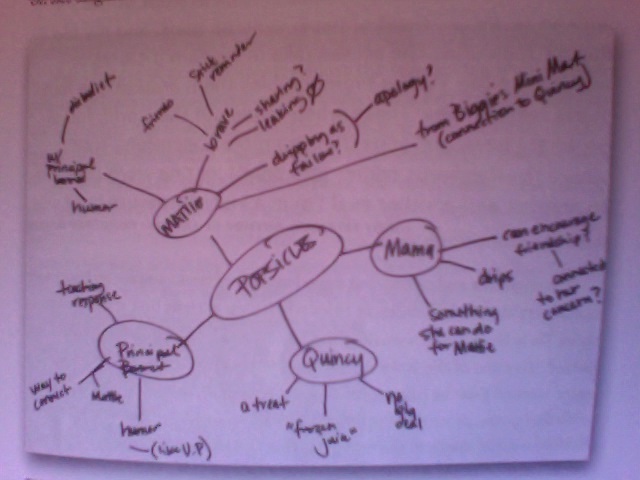
Today, Linda’s joining us to talk about one of her favorite revision strategies that involves returning to the brainstorming phase of the writing process to foster deeper thinking and connection building.


I like certain objects to have a different meaning for different characters in a book. Sometimes I start a web with that object in the center – Popsicles, for example – and then web from there the places that Popsicles occur in the story, the people who eat them or talk about or buy them, and then all the different associations that those people and places have in relation to the Popsicles.  Sometimes what I find surprises me.  Sometimes it gives me details that I can use in my revision.  For one character, I might find that sharing a Popsicle turns out to be a supreme symbol of friendship.  For another, it’s just a sticky mess on her fingers.


Note: This activity & photo originally appeared in Real Revision, courtesy of Linda.

Assignment: Think of an object from your work-in-progress. (If you don’t have a work-in-progress, try this with a book that you love as a reader.) Choose an object that might mean different things to different characters in the story, and put it in the middle of an idea web. Then brainstorm all the places that object appears in the story (or all the places it might be added!) and what it could mean in different settings, to different characters. Feel free to post a comment about what you discovered through this activity when you’re done.


Teachers Write! 7/27 – Friday Writing Happy Hour

So how’s it going this week? Friday Writing Happy Hour is a chance to relax and share comments about our progress, goals, accomplishments, and whatever else is on your mind.  And if you’d like feedback on a snippet of writing, head on over to Gae Polisner’s blog for Friday Feedback, where you can share a few paragraphs of your work and offer feedback to others, too.

We have a giveaway today, too! Donna  Gephart has offered up three copies of OLIVIA BEAN, TRIVIA QUEEN for our Friday drawing.

Just leave a comment by 11:30pm EST Saturday to be entered, and winners will be announced on Monday.

 Enjoy your weekend, and remember to check in at Jen’s Teach Mentor Texts blog on Sunday.  I’ll see you back here Monday morning!

Teachers Write 7/25 Thursday Quick-Write

Today’s Thursday Quick-Write is courtesy of guest author Lynne Kelly, whose debut novel CHAINED was published this spring from Farrar, Straus, & Giroux/Margaret Ferguson Books. Learn more at her website: http://lynnekellybooks.com/wordpress/

Before my manuscript of CHAINED was submitted to editors, my agent Joanna Volpe asked me to do some revisions. After a while, many of the comments started sounding familiar: “And how does he feel about that?” “How does that make him feel?” “And he feels…?”

I’d received similar feedback before. Sometimes the comments on chapters I’d brought to critique meetings showed that readers wanted to see more about how the character was feeling or what they were thinking. A couple of agents who were nice enough to send feedback with the rejection letters indicated the same thing– I wasn’t showing enough about what was going on in the character’s head. Maybe I was worried about the dreaded “telling” too much instead of “showing.” Sure, if I filled the story with internal thoughts like, “I was sad,” and “I was so angry,” that would be really boring, but there are ways of showing those feelings that help readers connect with characters more, and thereby root for them and keep reading the story to see how things turn out.

So it took some work, since for whatever reason the feelings thing doesn’t come naturally for me. Here are a few before-and-after lines, showing how I revised those parts of the manuscript using Joanna’s notes.

Before: I try my best to look brave.
Jo: But inside he feels…?
Me: Um…not brave?
Revision: I try my best to look brave, but I worry I’ll never feel safe again.

This is from a scene where Hastin surprises his mom with a visit after not seeing her for a couple of weeks, and he notices her smile seems forced:

Before: I run toward her, then stop. Doesn’t she want to see me?
Jo: How does that make him feel? Tie it to his elation, then being deflated in some way.
Revision: I run toward her, then stop. Doesn’t she want to see me? All this time, I thought she must be missing me as much as I’ve missed her, but not it feels like I’ve done something wrong.

I went through the manuscript and highlighted all the places where I could show Hastin’s reaction to what was happening. And there were a lot. Then I tackled each highlighted scene by doing a little freewriting about how he felt at that time, and how I’d feel if I were in his place–not just the emotion, but what it would feel like physically too. Is there a sinking feeling in his stomach? Does he hit something out of anger? Does he feel like things are so bad, he’ll never be happy again? I picked out my favorite words and phrases from the freewriting to add a concise description of the character’s feelings to the scene.  HYPERLINK “http://thebookshelfmuse.blogspot.com/”The Bookshelf Muse has an Emotional Thesaurus that helped tremendously. (It’s also great for setting descriptions, so bookmark it!)

In your own writing, look for places you can show more about how your character is feeling. Think about when you’ve felt the same way, and freewrite about that. Don’t worry about overwriting it– get everything on the page first, and the editing can come later if you need to scale it back. On the surface it might seem that you don’t have much in common with your character, but everyone has at times felt afraid, lonely, sad, desperate, or whatever else that character is feeling at the time.

After writing all you can about that feeling or experience, look over what you’ve written and see what you can you can apply to a scene you’re working on. Or, you may even want to start a new scene for a new character. Often it takes only one strong sentence or two to make an impact on your readers so they feel what your characters feel.

Teachers Write! 7/25 – Q and A Wednesday

Wednesday is Q and A Day at Teachers Write! Virtual Summer Writing Camp, so if you have questions about writing, ask away!

Authors are always welcome to drop by and answer questions (you never quite know who you’ll run into here!) But today’s official author volunteers are Diane Zahler, Jaclyn Dolamore, D. Dina Friedman, and Danette Haworth.  They’ve promised to be around to respond to your questions today, so please visit their websites & check out their books!

Teachers & librarians – Feel free to ask your questions in the comments.  Published author guests have volunteered to drop in and respond when they can.

Guest authors – Even if today isn’t a day you specifically signed up to help out, feel free to answer any questions you’d like to talk about.  Just reply directly to the comment.