
Now that we’ve been writing together for a couple of weeks, it’s possible that the shiny newness of writing camp is starting to wear off. Maybe you’re looking at your notebook, looking at some of the writing samples shared in comments, and having some doubts about your work. One great solution to that is checking in with Jen on Sundays at her blog Teach Mentor Texts, where you’ll find plenty of support and encouragement.
Today’s guest essay tackles that topic, too. Our visiting author is Kristen Kittscher, a former middle school English teacher and author of the tween mystery The Wig in the Window (Harper Children’s, 2013) which garnered a starred review from School Library Journal and was named to ten Best of the Year lists. Kristen lives with her husband in Pasadena, home of the Rose Parade—the inspiration for her most recent novel, The Tiara on the Terrace. She joins us today to talk about what to do when we’re doubting our work.


Battling—and Deafeating!—Your Inner Critic
Greetings! By this point in the summer, you are in the thick of things and have been soaking up much wisdom from Kate and her fabulous guest faculty. Hopefully the lessons have inspired you and, slowly but surely, you’re hitting your stride as you work toward your goals. If that’s the case—stop reading now! Wait for more brilliant words of advice tomorrow.
But if you are finding yourself having trouble gaining and keeping momentum as you write, I thought I’d share some of the usual demons that block my own progress – and strategies for shutting down those negative voices.
1. “I just don’t have enough time.”
When I first started writing, it took me a while to recognize that – more often than not – this lie was my self-doubt masquerading as a practical concern. To beat it, I followed the advice in Dorothea Brande’s brilliant book Becoming a Writer religiously. There’s not enough space to outline her technique here, but basically? Set a time each day – at first for just fifteen minutes – and write anything during that time, even if it’s to complain about not being able to write. Lock away the pages and don’t look back until a week or more passes. When you’ve done that successfully, increase the time and keep at it. It sounds like you’re doing nothing, but in fact, you’re training your unconscious to flow more readily when you need it to. It works. If you’re really having trouble, give it a shot! (Julia Cameron outlined similar techniques later in her The Artist’s Way, which might also be helpful to you.) Other tips: wake up a half hour earlier and write before you do anything else.
2. “My writing isn’t good enough.”
Maybe your writing isn’t good yet. Who cares? It’s not time to judge yet. No one asks a friend who just took up the oboe when she’ll be playing for the New York Philharmonic, but tell a friend you’re writing a novel, and a second later he’ll be breathlessly musing about your being the next J.K. Rowling. It doesn’t make any sense that writing would be different from any other craft, but culturally we (and others) seem to expect it will be. Whether or not you’re any good yet is immaterial. You can only get better – and it’s spending the time that will make you so.
3. “I’m not really very creative.”
Hogwash. Think of the last vivid dream you had. Your unconscious was capable of making all that up, wasn’t it? Writing is simply finding better ways to bring the rich reserves of your unconscious into your conscious mind – where you can give it cohesive form.
4. “How can I be sure this is even worthwhile?”
You’ll never be sure. Even when and if it’s published! Sharing a book with readers is a wonderful, magical experience—and of course our goal with any writing project is to communicate and connect with others—but you will never really know for sure how you are really connecting. The writing and process is the worthwhile part. If you don’t find it so—stop now. Really. You’ll be miserable otherwise.
5. “This will take forever. I’ll never finish.”
Maybe it will take forever. But time will pass whether you finish your writing project or not. It’s really up to you if you’d like to have a finished manuscript by the end of that time passing. If you wrote 500 words a day for five months, you’d have 80,000 words. That’s the length of a typical YA novel. No one’s saying they’ll be usable words, but they’ll be there for you to work with, no matter what. Your inner critic might offer up very different allegedly “practical” concerns, but as long as you remember that most negative voices are either others’ beliefs that you’ve internalized – or your own efforts to impede your unconscious – you’ll get better and better at shoving them aside.
A caveat: if, no matter what, you’re finding it hard to gain a sense of flow, consider that perhaps your unconscious knows something you don’t and that the resistance is serving a real purpose. You might be experiencing some life turmoil, grief, other changes that really make it impossible for you to create right now. And that’s all right. There’s more to life than writing. I think?
Hope you can shut off your critic, enjoy your writing, and absorb some more of the wise words of wisdom to come!












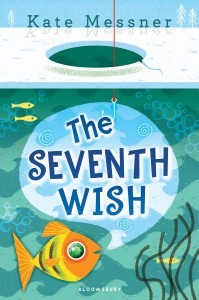 THE SEVENTH WISH is a story about wishes. I thought it would be fun to celebrate that theme at my book signings in Boston and Washington, D.C last month, so I asked people to share a wish on an index card. I promised to compile them into a community poem – and to take all of the index-card wishes home with me, to Lake Champlain, where THE SEVENTH WISH is set.