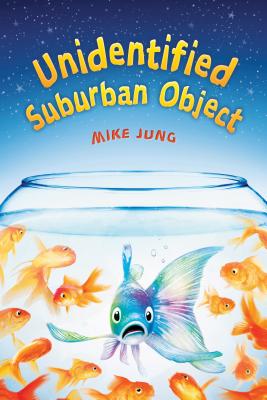
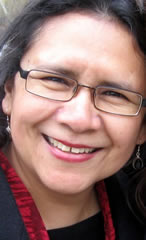
Good morning! Jo has your Monday Morning Warm-Up here, and we have guest author Mike Jung visiting with today’s mini-lesson! Mike is the author of GEEKS, GIRLS, AND SECRET IDENTITIES as well as UNIDENTIFIED SUBURBAN OBJECT. He’s also plays a mean ukulele, and he joins us today to challenge a bit of conventional writing wisdom…

Write About What You Don’t Know
One of the most common pieces of accepted writing wisdom is “write what you know,” meaning…okay, it’s pretty self-explanatory. Of course, every most common piece of accepted writing wisdom has its equal and opposite reaction, and for that one it’s “write what you don’t know,” meaning we should push ourselves, reach outside the comfortable boundaries of our current knowledge, and write about things we don’t know, but want to know, and are willing to learn about. Be diligent and respectful, do your research, have trustworthy people who can read your work with an informed perspective, etc.
Good advice, to be sure. However, HOWEVER, that’s not what I’m talking about in this post, as you can tell by the clever insertion of “about” between “write” and “what.” When I say “write about what you don’t know,” I mean something very different from the aforementioned “write what you don’t know,” because I’m not talking about approaching a story whose core is outside of our existing knowledge or life experience, using research/interviews/travel/etc. in order to fill those gaps of knowledge and experience to the greatest extent possible, then writing about that new knowledge with as much authority as we can muster. What I’m talking about is seizing upon a moment in which we discover a gap in our knowledge, experience, understanding, or worldview, and writing about how and why that gap exists.
I know, super-tricky! How do we write about something we don’t know about if we don’t know about it? Could you be any more confusing, Mike? What kind of writer are you? Maybe an example would be more illuminating. Yes, I’m thinking this blog post through as I write it, sorry. #notsorry
My mother and I have a complicated relationship. I love her, we’re very alike in more than one way, and we have a lot of difficulty communicating. I won’t go into all of the reasons for that difficulty, partly because I still don’t fully understand them all myself, but there’ve been some calamitously large gaps in our knowledge about each other, including my knowledge about her childhood and adolescence in post-WWII Korea. That’s changed to some degree over the past ten years, and the credit for that goes to my wife Miranda, because she’s somehow able to talk to my mother in a way I’m not, and as a result I’ve heard some stories about my family history that I don’t remember ever hearing before, some of them expected, some of them truly harrowing, all of them startling in their unfamiliarity. I knew my brothers were already more familiar with these stories than I was; like I said, it’s very, very complicated.
I really am enough of a creatively opportunistic troglodyte to have very quickly thought about these story fragments (because they did feel like haltingly conveyed fragments to me) as literary raw material. Miranda rightfully thought that those stories held the seeds of a compelling memoir, and that’s how I very briefly thought about them in terms of storytelling (“briefly” because collaborating with family members on any kind of project is a psychological minefield I’m not even remotely ready to walk through). Write what I don’t know, as they say. My mother’s experiences are not my own; would it be possible for me to learn about them to the point where I could write about them authoritatively in any way?
I didn’t know, and I still don’t know, because I ended up doing something quite different, albeit in a very diffuse, long-term, subconscious kind of way. I didn’t write anything that was directly about my mother’s very challenging experiences as a child and teenager in Korea; I thought about them, but I didn’t write about them. And I thought about other things. I thought about how and why it is that my mother and I have such intense troubles with communication; I thought about the shatteringly vast differences in our life experiences, and the equally shattering similarities in how we sometimes approach the world around us; I thought about the fact that there’s so much about my mother’s life that I didn’t know, and still don’t know.
Eventually, gradually, over years, I ended up writing about that lack of knowledge. It wasn’t a linear, A-to-B process, because sorting through the entire history of my relationship with my mother’s not something you do over the course of a couple of lattes, you know what I mean? And I didn’t take these psychological and conversational experiences with my mom in a direct, ripped-from-the-family-headlines kind of way, although there may very well come a day when I do exactly that. What I ended up writing about, years later, was a book called Unidentified Suburban Object in which a character (her name’s Chloe Cho) knows nothing about her parents’ pre-immigration life, tries very, very hard to find out, and then does, with surprising results. The story of Chloe’s parents bears only the most broad and nonspecific resemblance to my parents’ story, and the reason Chloe knows so little isn’t a reason that it’d even be possible to use as an explanation for my lack of knowledge.
Chloe’s emotional reactions are true to life, however. They’re distilled down to their essence in some ways, and my lifetime of pondering these questions gave Chloe a far greater degree of self-awareness and critical inquiry than I ever possessed as a tween-age kid, but there’s real honesty in the emotional underpinnings of that story.
My mini-lesson probably won’t provide any immediate solutions to problems in what you’re writing today. Or heck, maybe it will, but I think of it in longer-view terms than that. Maybe you could try it anyway? Writing doesn’t have to be a short term thing, after all, and actively building the ability to examine our internal selves is one of the most important aspects of doing this work. If we can engage in this kind of self-examination, which can feel so unresolved for so long, we can unearth a wealth of emotional honesty. I value emotional honesty; when it comes to doing the work of writing books for children, it’s probably what I value most. Maybe we can think of this as a way of laying groundwork for future work that’s more polished and more complete.
Today’s assignment: Is there some action, event, period of time, swath of history, or social arena that you didn’t know about, and jarred your sense of self when you learned more? Have you thought about why you didn’t know? How did you finally end up knowing more? Write about that. Don’t write about the thing you didn’t know about; write about the reasons you didn’t know about it. It may feel awkward. It may actually hurt. Write about it anyway. You can do it. You may find that this is one that wants to stay in your notebook for now, but as always, feel free to share a paragraph or two of what you wrote today in the comments if you’d like.