Starting with Setting


best tracker


So I was finishing up Elise Broach’s book MASTERPIECE last night, and the author’s note at the end talked about the spark of idea that led to this brilliant book – a contact lens lost in the sink.  That led Elise to wish for some tiny creature who could crawl down and get it for her, and that led her to imagine Marvin, a friendly, talented beetle who absolutely shines as a main character.

I love hearing about the whispers that start a story churning, so I thought I’d share the stories behind my two latest works in progress, both of which started with setting. 

Right now I’m working on a middle grade mystery that grew out of my editor’s travel troubles. (She has no idea about any of this, so if you are reading this, Mary Kate, thanks for the inspiration! *waves to Mary Kate* ) When bad weather stranded her in Atlanta this spring, I got thinking about airports and how much I like them and how I’d love to set a book in one.  And then I got thinking about being stuck in airports and how I often end up meeting the most interesting people, just because we can’t get to Tulsa or wherever for three more hours, and that’s where my middle grade mystery begins…with three kids, snowed in at a Washington D.C. airport, and a stolen treasure.  I’m in the early stages of this book, just a few chapters in and stalled until I get to D.C. for a research trip later this month, so it’s too early for me to share more.  But it’s interesting to me that the story started with setting.

That was the also case with SUGAR ON SNOW, the middle grade novel I worked on much of last year.  The whispers started here…

…at a sugar house on pancake weekend, where I crunched through the spring snow with my daughter, watched the sugar steam puff into the sky,  inhaled the sweet smell of sap being boiled down to syrup, and watched the hustle and bustle of the family that owns this farm.  For the next few weeks, I toyed with the idea of a character who lives on a maple farm near the Canadian border, and that’s when Claire showed up and started whispering in my ear. 

I’d talk back to her on my morning run.  "Well, sure…you’re a great kid and you have a fascinating life up there, skating on the frozen cow pond in the winter and everything. And sure, it would be fun to write the sugaring scenes, but what are you going to do? You have to do something. You can’t really have your own book until something happens, you know?"

Claire would sigh and go away for a few days, but she kept coming back.  I liked her, but I didn’t start to write about her until summer, when I spent a weekend with my daughter at a basic skills figure skating camp in Lake Placid.  She was excited to take different kinds of skating classes at the camp, and I was excited to sit in the coffee shop across the street and work on revisions for the first book in my MARTY MCGUIRE chapter book series with Scholastic. 

But it turns out I hadn’t read the fine print on the skating camp brochure.  When I signed my daughter up for camp, I had also signed myself up for a weekend of "parent education" workshops.  So instead of drinking mocha lattes with my laptop, I found myself in the Olympic Center Hall of Fame Room with a bunch of other skating parents, learning about figure skate blades that cost more than my car is worth.  Although they weren’t what I had planned, the workshops were fascinating, particularly the one that featured a sports psychologist who works with figure skaters and talked about the stress, the pressure to commit more time and money, the competitive nature of the sport.  What if my sweet Claire from the maple farm somehow ended up training here? I pulled out my notebook and started scribbling ideas.

After that, there was a whole lot of research and writing and revising, brilliant critiques from writing friends, more revising, an editorial letter from my agent,  and more revising.  And here’s what grew out of that pancake breakfast in the March sunshine and not reading the fine print about skating camp.  From yesterday’s Publishers Marketplace…

BRILLIANT FALL OF GIANNA Z author Kate Messner’s SUGAR ON SNOW, in which a farm girl is discovered by a charismatic Russian skating coach and thrown into the uber-competitive world of elite figure skating, where she must stand up to the mean girls on ice and find the courage to follow her dreams, again to Mary Kate Castellani at Walker Children’s, for publication in Winter 2011, by Jennifer Laughran at Andrea Brown Literary Agency.

How They Got Here: 2009 Debut Author C. Lee McKenzie

This post is part of a year-long series of blog interviews I’ll be hosting with my fellow 2009 Debut Authors, called "How They Got Here." 

It should be an especially helpful series for teens who write, teachers, and anyone who wants to write for kids.  2009 debut authors will be dropping by to talk about how their writing in school shaped the authors they are today, what teachers can do to make a difference, how they revise, and how they found their agents and editors.  (You’ll even be able to read some successful query letters!)  If you know a teacher or two who might be interested, please share the link!

Today…C. Lee McKenzie, author of SLIDING ON THE EDGE!
Shawna Stone is a heartbeat away from making the worst mistake anyone can. She’s close to taking her own life. Kay Stone is a grandmother Shawna has never known, and at sixty-four Kay feels there is little left in her life to look forward to. When they are thrown together they circle each other in a crucible of secrets and distrust until saving a doomed horse unites them and gives each a reason to live.

Welcome! Tell us about the first thing you ever wrote that made you think maybe you were a writer.

The first piece of fiction I ever wrote was a short story for an East Indian magazine. Now that I think of it, that was pretty audacious. I have no first-hand experience about India, but I won the $100 first prize! Naively, I patted myself on the back and decided I could publish just about anything. Not true!

Most writers admit that making time to write can sometimes be a challenge.  When and where do you write?   Do you have any special rituals?  Music?  Food & beverages?

I’m an early morning writer. I mean like sometimes 4 am if I wake up with a good idea. I write at my desk on my computer, sip a cappuccino, and work until sunup. Then I take a break, do chores, make my list and get dressed before going back to read what I’ve written and start the re-write or whatever.

Do you have a favorite strategy for revision?

I don’t have a specific strategy for revision. If I’m stuck I often do a printout and take a hard copy someplace away from my desk. Sometimes that gives me a new perspective on the critter that’s giving me problems.

What’s your best advice for young writers?

I guess I’d say, "Keep writing. You’ll only get better."

What’s special about your debut novel?

Well, obviously, the best part is I wrote it. Next, I don’t have to write it again. But if I were to be serious I’d have to say the best part is I think my book has appeal for younger and older readers. That’s what I’m hearing anyway, so I hope it’s true.

What were the best and worst parts of writing it?

The best part was when I wrote the chapters from two different points of view (pov). That is, I wrote what happened from my young main character’s pov; then I wrote the same set of events from her grandmother’s pov. That was interesting and fun to do.

The worst part was getting the opening paragraph. That took forever.

How did you find your agent and/or editor?

I always read the SCBWI Bulletin and WestSide was open to young adult submissions with edginess. "I’ve got one of those!" I said and sent off my query.

Thanks, Kate. Your questions were a challenge, but I enjoyed thinking about them.

You can read more about C. Lee McKenzie at her website.  You can pick up your copy of SLIDING ON THE EDGE at your local independent bookseller, order it through one of my favorite indies, Flying Pig Bookstore (they ship!), or find an indie near you by checking out IndieBound!

Up next in the "How They Got Here" Debut 2009 series… Deva Fagan, author of FORTUNE’S FOLLY, will be stopping by on Sunday!

Lake Champlain Book Club!

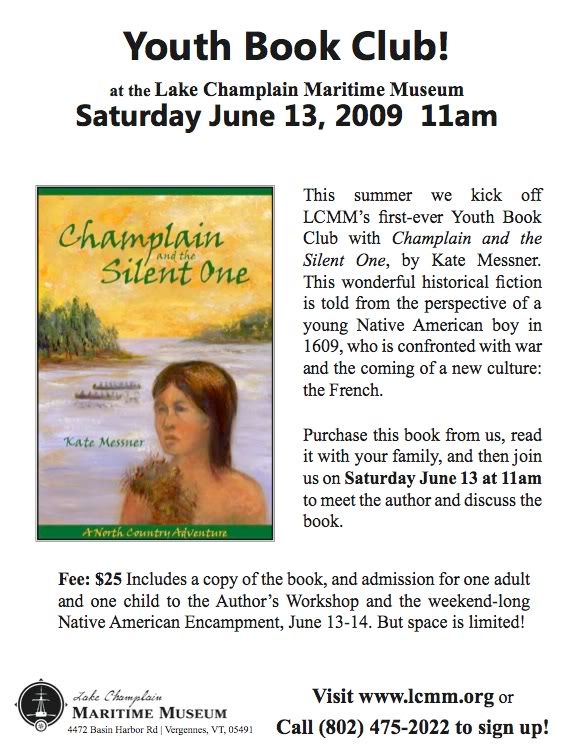
The Lake Champlain Maritime Museum is an amazing resource for lake history, so when their educators asked if I’d be part of a book club for families, I jumped at the chance.  I love the way they’ve scheduled the book club event to coincide with the museum’s Native American Encampment so kids will get to see and touch so many of the things they read about in Champlain in the Silent One — right down to a replica of a birch bark canoe.  Here’s the flyer… Feel free to share the link if you know families that might be interested!

Mouse Was Mad… What About You?

Linda Urban’s fantastic picture book MOUSE WAS MAD is officially out this week, and she’s hosting a contest on her blog.  If you visit  , you can win a signed copy, along with some Lake Champlain Chocolate Truffles.  As someone who has enjoyed both Linda’s book and Lake Champlain Truffles, I can tell you that both are darn close to perfect.

To enter, all you have to do is leave a comment on Linda’s blog, saying what makes you mad and how you feel better.  For example, yesterday, I had one of those terrible, horrible, no-good,  etc. etc. days…ala Judith Viorst.  Eating chocolate often makes me feel better, but since I’m trying to be healthy at the moment, I went outside and shot baskets.  I discovered that I am a remarkably good shot when I’m miffed, and I was wishing my husband had been there to play HORSE because we are competitive with things like that, and I am certain I would have beaten him without even racking up an H.

Anyway…share your story here for a chance to win!

An iPhone App for Gianna Z…

This is just too cool. 

In my upcoming middle grade novel The Brilliant Fall of Gianna Z, the main character has a monster leaf collection due.  It’s a project she’s put off to the last minute, and now everything that can possibly go wrong…does.  If only she’d had access to this iPhone application, I might have written a whole different story. The scientists developing this particular app say if all goes well, you’ll be able to identify a plant from a photo of its leaves that’s then uploaded to a database.  Ultimately, they say it could help researchers learn more about climate change and changes in biodiversity.  And of course…it would make those school leaf collection projects a walk in the park.  Thanks to  for the link!

How They Got Here: 2009 Debut Author Aprilynne Pike

This post is part of a year-long series of blog interviews I’ll be hosting with my fellow 2009 Debut Authors, called "How They Got Here." 

It should be an especially helpful series for teens who write, teachers, and anyone who wants to write for kids.  2009 debut authors will be dropping by to talk about how their writing in school shaped the authors they are today, what teachers can do to make a difference, how they revise, and how they found their agents and editors.  (You’ll even be able to read some successful query letters!)  If you know a teacher or two who might be interested, please share the link!

Today…Aprilynne Pike, author of WINGS!

Aprilynne Pike’s WINGS is the first of four books about an ordinary girl named Laurel who discovers she is a faerie sent among humans to guard the gateway to Avalon. When Laurel is thrust into the midst of a centuries-old battle between faeries and trolls, she’s torn between a human and a faerie love, as well as her loyalties to both worlds.

Welcome, Aprilynne! Tell us about the first thing you ever wrote that made you think maybe you were a writer.

I had a fiction instructor in college who would occasionally, at the end of a short-story critique, say, "Clean it up; send it out." It was the highest of compliments, and something she didn’t say often. I was part of an extremely talented class and I didn’t (still don’t) think my stuff was as good as theirs. But I had one story that I really liked and worked really hard on. And at the end of the class critique, my professor looked at me, met my eyes, and say, "Clean it up; send it out." That was the moment I thought it just might be possible to someday get something published.

What books did you love when you were a kid?

I loved way too many books to list here, but some of my most memorable ones were The Boxcar Children, anything by VC Andrews, The True Confessions of Charlotte Doyle by Avi, The Fairy Rebel by Lynne Reid Banks, and The Chronicles of Narnia by C.S. Lewis.

Is there a particular teacher or librarian who was a mentor for you in your reading and writing life?

Janet Cain; my junior English teacher. She taught me to love literature, Not just books, and not just modern texts, she taught me to love all well-written literature. I read more classic literature in her class than any other I’ve ever taken . . . and half of it was unassigned!:)

Moving on to the here and now, most writers admit that making time to write can sometimes be a challenge.  When and where do you write?   Do you have any special rituals?  Music?  Food & beverages?

I have three young children and–until recently–a husband in law school. So I write when I can. Ideally, I like to lock myself in my office and get comfy with my laptop, but that’s not always possible. I like drinks and snacks while working, because I’ve learned that writing takes a degree of physical stamina as well as mental. I don’t generally listen to music, because I find myself typing the lyrics instead of my story.:) But I am a Diet Root Beer junkie and often have a cup of tea at hand as well.

Do you have a favorite strategy for revision?

I know a lot of authors who save everything they cut out of their manuscripts, just in case. I have found that I do better revisions when I just delete stuff. After all, if I decide later that I really do need that paragraph that I cut, I can probably write it better the second time anyway. I have to just move forward and not dwell on what parts of my original baby aren’t there anymore. I don’t hang on to them. (Unless they’d make a really fun deleted scene; I give myself one of those per book. Everything else goes.)

What’s your best advice for young writers?

Read. You will never learn more about story and plot than by reading. I think that authors who either don’t read, or don’t read much, are missing out.

What’s special about your debut novel?

I have faeries like no faeries you’ve ever seen before. It’s one of the things I am proudest of!

What were the best and worst parts of writing it?

The best part of writing my book was discovering the perfect ending.

The worst part was discovering that the previous ending that I thought was perfect, well, wasn’t. Not being able to write the right ending on WINGS was the first time I ever cried about my writing.

How did you find your agent and/or editor?

I was lucky enough to have a recommendation for my agent, however, there was a mix-up in the office and she didn’t actually get it for over ten months. During that time, I did the query thing. I got rejections (lots of them) and several requests for partials and fulls . . . and more rejections.;) Even though I ended up signing with the first agent I sent stuff to, I feel like experiencing the full gamut of querying was really good for me. Every author should be intimately acquainted with the sting of rejection. Then they are less likely to forget just how sweet that first yes is.

Thanks, Aprilynne!

You can read more about Aprilynne at her website. You can pick up your copy of WINGS at your local independent bookseller, order it through one of my favorite indies, Flying Pig Bookstore (they ship!), or find an indie near you by checking out IndieBound!

Up next in the "How They Got Here" Debut 2009 series… C. Lee McKenzie, author of SLIDING ON THE EDGE, will be stopping by on Thursday.

Vermont DCF Conference

My Friday started early, with a rocky, bumpy ferry ride to Vermont for the Dorothy Canfield Fisher Conference.  I don’t think I’ve ever been on the lake when it was this rough.


This is my windshield.  There was no fog & It was not raining…just a sheet of lake water coming over the front of the boat.

Truth be told, it was kind of fun and exciting.  Part of me wanted to get out of the car, cling to a railing and shout, "Batten down the hatches!!"
But I’m not sure they have hatches on the ferry and I would have gotten my conference clothes all wet, so I refrained.

The conference was held at the Lake Morey Resort in Fairlee, Vermont.  This has to be one of the prettiest views I’ve ever had from a workshop room.

I loved visiting with the teachers & librarians in my workshop, and one of them made me laugh at the end, when I shared the news that the nice folks at Bloomsbury/Walker had sent along ARCs of my new book, The Brilliant Fall of  Gianna Z, for everyone who attended my presentation.

"Oh!"  she said.  "It’s just like Oprah!"

Not quite…but there was a celebrity on hand, of near-Oprah status.

Caldecott Medalist David Macauley, who gave the morning keynote address, was gracious enough to sign books for my kids.

We had David’s new book, The Way We Work, out at the Messner house just last night.  We were talking about the swine flu, and my son was trying to explain to my daughter how a virus isn’t really a living thing.  "Hold on," I said…and sure enough, we found a fantastic illustration of an influenza virus, along with a great explanation of why it needs a host cell to reproduce. 

Vermont’s DCF Committee did a phenomenal job with this conference, and it was lovely to spend the whole day talking about books with people who love them so much.  Thanks, Vermont teachers & librarians, for a terrific day!

Happy Reading, Peru Intermediate School!

May just might be my new favorite month.  Not only are my tulips about to burst into bloom, but it’s also Reading Celebration Month at Peru Intermediate School. I’m their guest author, which means I get to spend time talking books with a crew of excited kids who love to read. 

This poster in the front hallway made me smile.  I’m so glad I could visit on an outdoor recess day! 

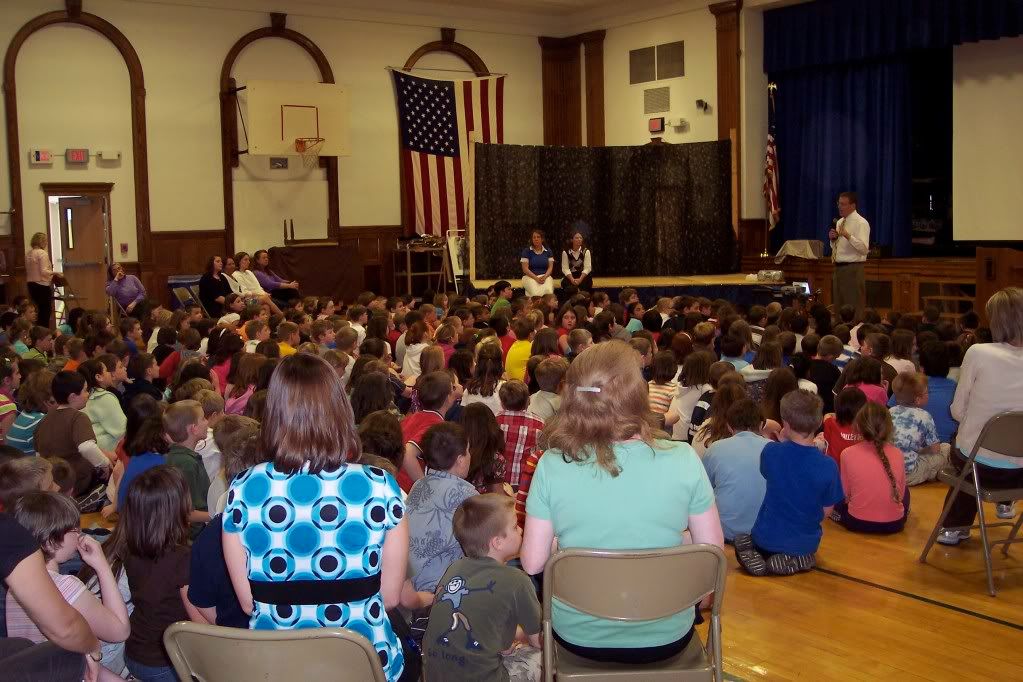
What could be better?  More than 500 enthusiastic Peru kids were at the assembly where I spoke this afternoon to kick off their May reading extravaganza.


Note: That’s not me up front.  It’s Mr. Storms, the principal of Peru Intermediate, who chose David Wisniewski’s GOLEM as his favorite book for the faculty/staff slideshow.  This is, in my book, solid evidence that he is a very cool principal.

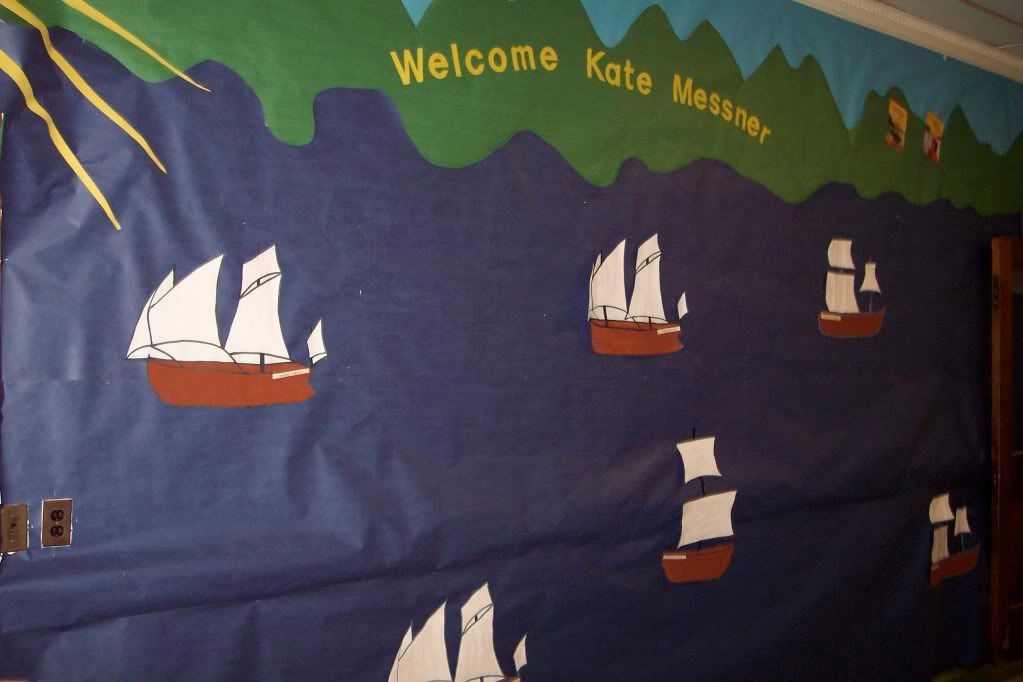
I love how this school has set up its reading incentive program, making room for all kinds of readers.  Students are meeting with their teachers to decide on their own individual reading goals.  When they meet their goals, which they can choose to make public or keep private, they get to put their names up on one of these way-cool ships in the front entrance display.

Why ships?  The theme for this year’s reading incentive program is Lake Champlain. Since my historical novels are set on the lake, all of the classes are reading at least one of them.  I’ll be spending a full day with the 3rd, 4th, and 5th graders later on this month to talk about the research and stories behind Spitfire and Champlain and the Silent One.   They’ll also get a super-sneak preview of my new book, The Brilliant Fall of Gianna Z (Walker, Fall ’09), which is set near the lake in modern times.

Today, though, it was all about the reading.  After a slideshow of their teachers’ favorite books, I talked about some of my favorites, past and present.  We talked about how books let us travel through time, show us ourselves, and bring us together. And I shared my own reading goals for the month of May.  I’m planning to read a mix of picture books, poetry, novels for younger kids, high school novels, and books for adults.

Mary Anning and the Sea Dragon
by Jeannine Atkins (I have a shiny new, signed copy from the NESCBWI Conference!)
Masterpiece by Elise Broach (I’ve been wanting to read this for ages – can’t wait!)
Border Songs by Jim Lynch (I loved his novel The Highest Tide and was happy to pick up this advance copy of his latest.)
The Amaranth Enchantment by Julie Berry (I read an early draft of this book and can’t wait to dig into the final version!)
Bug Boy by Eric Luper (Is it cheating that I’ve already started reading this ARC?  I was going to save it, but it just didn’t work out.)
Nine Horses by Billy Collins (This is the book of poetry that I was so excited to find on the library book sale cart for fifty cents.)

I’ll be sure to post some thoughts as I finish each one.  And if you’re a Peru student reading this…know that as I work my way through my pile of books, I’m cheering for you to meet your goal, too!

Places to Go, People to See

Tomorrow, I’m the author guest at Peru Intermediate School‘s Reading Celebration Kickoff for the month of May.  (That’s Peru, NY…not Peru, South America. If you want to hear about the South America Peru, you should visit  , who just had a school visit there!)  I’m excited to meet the kids, talk about some books I loved when I was younger, and share our reading goals for the month.

Friday, I’m presenting a workshop at Vermont’s DCF Conference:

Celebrating 400 Years on Lake Champlain:  Author and English teacher Kate Messner discusses her two historical novels set on Lake Champlain as well as her upcoming book The Brilliant Fall of Gianna Z (Walker, Fall ’09).  Kate will share her research and writing process as well as strategies for using her books in the classroom to help celebrate the history and natural landscape of Vermont.

I’m looking forward to spending the day at the conference. I’ll get to hang out with cool librarians and hear talks from David Macauley, whose new book The Way We Work is just so cool, and Beth Kanell, whose historical YA novel The Darkness Under the Water is wonderfully haunting.

And now, some places you might want to go and people you might want to visit…

First of all, have you read Winnie’s War by Jenny MossThis historical novel, set during the 1918 influenza epidemic, is terrific and suddenly feels very timely.  I’m on a panel with Jenny at the 2009 NCTE conference, talking about pairing fiction and nonfiction in the classroom, so we chat online from time to time.  She was telling me that she has a school visit coming up soon, and I can just imagine the questions she’ll be getting.  It’s a great title for teachers who want to explore the changes in medicine, disease preparedness, and technology over the past century.

Kristy Dempsey’s picture book  Me With You is on its way to bookstores as we speak, and if you’ve had a peek at the book trailer on her website, you know how cute this one is.  The illustrations by Christopher Denise are just charming. Kristy is running a contest where you can win a copy over at  .

Linda Urban is reading and signing copies of her new picture book Mouse Was Mad, illustrated by Henry Cole, at Flying Pig Bookstore in Shelburne, VT Saturday morning at 11.  I already have my signed copy and have read it at least a dozen times since Saturday.  I’ve laughed every single time.

And finally, my friend   has a new hedgehog.  Seriously.  Go visit and help her name the prickly critter.

NESCBWI Conference Panel Handout

At the request of some folks on Twitter, I’m posting the handout from last weekend’s NESCBWI panel discussion, "Everything You’ve Always Wanted to Know About Agents…But Were Afraid to Ask."  I participated in the panel, along with my agent Jennifer Laughran of ABLA,  author Jo Knowles and her agent Barry Goldblatt, and author/illustrator Carlyn Beccia and her agent Tracey Adams.  We talked about many elements of the agent-author relationship Saturday afternoon and promised more on how to query an agent in the handout.  Some of it will seem obvious, but believe it or not, agents see query letters that don’t follow guidelines all the time. 

Tips for Querying Agents

1. Do your homework. Make sure you know what kind of work the agent generally represents.  Spell the name correctly.  Make sure your manuscript is ready to submit. Then follow the submission guidelines exactly. 

Why is this important? Because you’re asking someone to represent you as a professional in a career where you will frequently need to follow directions and do things a certain way.  Prove that you can do it up front.  Don’t give an agent a reason to say no.

2. When you write your query letter:

a. Address the agent by his or her name, i.e. Dear Mr. Goldblatt

b. Write a very brief first paragraph explaining why you are writing (to see if the agent is interested in representing your project) and why you chose that agent in particular.  Did you read that the agent was looking for paranormal romance? Does he or she represent an author you love? 

c. It’s fine to say you’ve met one of the agent’s clients or admire their books, but don’t make it sound like you were referred to an agent unless an author specifically referred you and offered to contact the agent to say so. Agents will check on this, and you’ll look unprofessional if you’ve stretched the truth.

d. In your next paragraph or two, give a brief summary of your book.  This summary should read more like jacket copy than a book report.  It’s meant give a quick overview to entice the agent to request your manuscript and does not need to include every little plot element.  It does need to be clear, concise, and well written.  If your book is funny, it helps if your query is funny, too.

e. In your last paragraph, give a brief closing.  You might say to whom your book would appeal or how you think it fits into the market.  Thank the agent and offer to send your manuscript along at his or her request.
 

3. Give it time.  Agents are incredibly busy and may take weeks or months to respond to your query.  Status query only after three months or whatever the agent’s guidelines suggest.

Keep in mind, there’s a lot of advice out there on querying, and this is just one take on the process. There are no magic query potions.  If you’re interested in learning more about what to do and especially what not to do, you’ll want to check out this post from Scholastic editor Cheryl Klein.