Welcome to writing camp!
Teachers Write is a free virtual summer writing camp for teachers and librarians. Please click here to sign up if you’d like to join us and haven’t already registered. If you’re on Facebook & want to also join our group there – here’s the link. Then click “Join Group.”
A quick note about blogging your Teachers Write experience: There will be daily opportunities for you to share and interact with one another in the comments section of each post. Usually, our guest authors will stop by to be part of the conversation, too (though not always – some will be on deadline or traveling for book tours or research). In addition to commenting, it’s great if you also want to set up a blog where you share all of your writing from this summer. One important request: Our guest authors have given permission for their lessons & prompts to be shared on the Teachers Write blog only. Please do not copy and paste any mini-lessons or writing prompts – publish only your own writing on your blog. If you’d like to reference the ideas shared here, providing a link is the best way to do that. Thanks!
Four quick things before we get started…
1. Teachers Write is an online summer writing camp with author-mentors who donate their time to work with us. It’s free. There’s no charge to participate, but we do have a request. Kate, Jo, and Gae all put many hours into preparations for this summer camp. Much of the time we’d normally spend on book promotion is going into Teachers Write instead, so we’re asking that everyone who participates try to purchase one of each of our books this summer. That’ll run you as little as $25 – which is the cheapest professional development around (and you get to keep the books!) We also ask that everyone try to buy at least one book written by one of our daily guest authors. We don’t check on this – it’s all honor system – but if you can, we’d truly appreciate it if you’d support our books in this way. If you truly can’t swing the expense right now, we’d still love for you to participate and would ask that you support our books in other ways – by requesting them at your local library, borrowing them, and writing online reviews. Thanks!
2. Our weekly schedule will look like this:
Monday Mini-lesson, and a Monday Morning Warm-Up on Jo’s blog (check it out!)
Tuesday Quick-Write
Wednesday is Q and A day – authors will be here to answer your questions! We’ll have some other Wednesday features, too.
Thursday Quick-Write
Friday Feedback on Gae’s blog, and some great Friday revision features here, too.
Sunday Check-In on Jen Vincent’s blog – a chance to check in with everyone, reflect on the week, and share encouragement.
3. I’ll be popping in to comment, and I know many of our guest authors will, too, but since this community has grown so much (we’re more than 2500 teacher-writers strong now!) you’ll also need to commit to supporting one another. When someone decides to be brave and share a bit of writing in the comments, or when someone asks for advice or feedback, please know that you are welcome (and encouraged!) to be mentors to one another as well. Watching this writing community grow is one of the best things about being part of Teachers Write.
4. The first time you comment, I will have to “approve” your comment before it appears. This is to prevent us all from being besieged by trolls. So when you comment, it will not show up right away – sometimes, it may be later in the day when your comment appears. THIS IS OKAY. I check in regularly to approve comments, but I also spend uninterrupted writing and family time in the summer months, so please be patient with me, and resist the urge to post more than once if your comment doesn’t appear right away.
Now…let’s get started!
Looking Through Someone Else’s Eyes
One of the best ways to share a character’s heart and soul is to let your readers see how that character perceives the world. And our perceptions of the same setting can be wildly different, depending on who we are, what our past experiences have been, and what’s going on with us right now.
Imagine, for example, a rainy night in the country. There’s thunder and lightning and water pouring down from the clouds. Can you see it? Can you feel it?
What you experience in that moment depends on who you are and what situation you envisioned. Are you someone who loves storms? Or does thunder make you want to hide under the bed? Some of you probably longed to be on your porch with a cup of tea, watching the lightning. Some of you probably thought of a child or dog who might be scared.
Were you imagining the storm from the point of view of an observer who’s warm and safe inside? Consider how that same thunder might sound to someone whose car is disabled at the side of a quiet road. Or someone who’s trying to sleep on a cardboard box in a park. What if you were someone whose farm has been struggling with drought? Or someone living on a river that’s likely to flood? Someone who just lost a loved one? All of those elements can change how we see our setting.

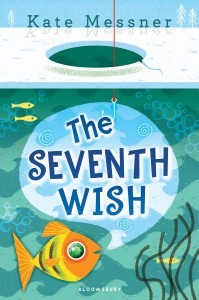
When I was writing THE SEVENTH WISH, I spent some time out on the winter ice of Lake Champlain, where I live, writing about it from different perspectives. One of my characters in that book is an experienced ice fisherwoman. One is a twelve year old who’s always felt a little nervous about walking on frozen water, even as she sees its beauty and magic. I took my notebook out on the frozen lake on several cold January and February mornings and spent time in each of their boots, experiencing the sensations and sounds of the ice and reflecting on that in messy mittened handwriting in my notebook.
The same character can see a setting in different ways, depending on the day. The magical frozen lake that Charlie experiences when she’s out searching for “ice flowers” with her beloved older sister Abby changes completely by the end of the story, when Abby is struggling with addiction and Charlie is desperate to catch the wish-granting fish that she wants to believe can fix everything.
That’s an example of a person’s emotional state affecting their perspective on setting, but this is a writing exercise that can have a lighter touch, too.
When I was writing FERGUS AND ZEKE, the story of a classroom mouse who stows away in a backpack to go on the school field trip to the natural history museum, I spent a day wandering around the American Museum of Natural History in New York, notebook in hand, imagining how everything would look if I were a mouse. I’d still be impressed with the huge dinosaur skeletons, but instead of simply staring up at them, I might be able to scamper up one and climb around those T-Rex teeth!
When I was teaching middle school, I liked to take my students on setting-writing field trips. We’d either go out back to the soccer field, or on rainy days, simply stand at a long row of windows in the hallway to write for a few minutes about what we observed. Then, I’d give each student a slip of paper with a new identity.
“You are a lost five-year-old who can’t find her mom.”
“You have just robbed a bank and are searching for someplace to hide the money.”
“You are a hungry seagull.”
“You are a 90-year-old visiting your home town after 70 years away.”
We’d write for another five minutes or so, and then share our reflections aloud, noting how point of view and perception change the way we see a place and what we choose to notice and share. This is an incredibly powerful way to explore your character’s state of mind and to write in a way that does double-duty – using setting descriptions not only to paint a picture of a place but to reveal character as well.
TODAY’S ASSIGNMENT: Go outside or look out a window. You can do this at home in your neighborhood, or you can go somewhere else – the park, the farmers market, the mall…whatever you like. Spend a few minutes writing what you observe – everything you notice. Write down what you see, hear, smell, and feel.
Then, look through someone else’s eyes and spend a few more minutes writing from that perspective. If you’re working on a story right now, take on the role of your main character during a particular point in the story. How are they feeling in that chapter? How might they observe the same setting differently than you did? What details would they notice? What would they like? What would bother them? And based on that, what kind of language might they use to describe it? We choose our figurative language based on the world we know, so a modern-day figure skater will choose different words and metaphors than an 18th century farmer.
If you’re not working with a particular main character in your writing life right now, here are some identities to try on for this assignment…
An elderly woman with limited mobility
A teenager who’s being bullied
A dog (Be sure to choose a particular breed before you write. Dachshunds don’t see the world from the same perspective as Greyhounds.)
A dragonfly
An imaginative and energetic five-year-old
In the comments today, feel free to share a snippet of what you wrote, but please also write a few lines introducing yourself. Let’s get to know one another – we’re going to be writing together for four weeks, starting right now!