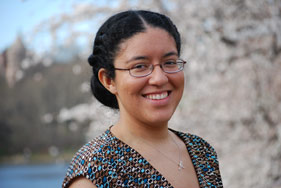
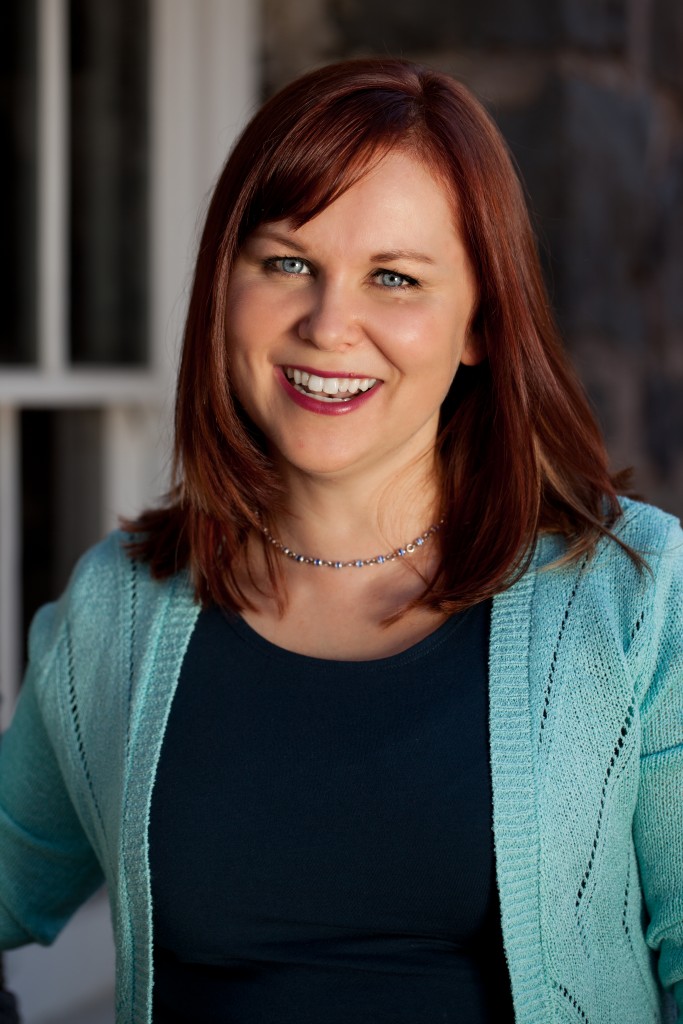
I’m super-excited about today’s guest author, not only because I love her books but also because she’s tackling a topic that’s going to be perfect to share with your students – writing memoir and personal narrative. Olugbemisola Rhuday-Perkovich is the author of EIGHTH GRADE SUPER ZERO and the forthcoming TWO NAOMIS with Audrey Vernick. She lives in Brooklyn, and today, she’s here with us to talk about writing from personal experience…

Where are you from?
I get that a lot.
Mostly, because of my name.
Olugbemisola Rhuday-Perkovich.
My father is Nigerian – that’s where my first name, Olugbemisola comes from. It’s a Yoruba name, and it means “God has brought me a gift, or God has brought me honour. My mom was Jamaican, and the “Rhuday” part of my pen name comes from her. That was her middle name, and it’s also my daughter’s middle name. The Perkovich part, my husband is of Croatian descent. I was born in the Bronx, NY. I live in Brooklyn. We traveled a lot. So there you go. I can tell you about my name, where I’ve lived, where I live now. That’s where I’m from.
Sort of.
I tell students not to be afraid of the word “memoir.” It sounds a little grand, yeah? A bit presumptuous? Sometimes it can lay a weight on your writing before you start. Famous people write memoirs. Politicians. Entertainers. Athletes.
Yeah, yeah. And so do you and I.
It’s likely that we’ve all had to write personal narratives at some point, perhaps under a different name. Writing a personal narrative, loosely defined as “telling the story of something that happened to you” can actually be a great first draft of a memoir.
To move into memoir, we can infuse our personal narratives with three things:
Memory + Meaning
“Retrospection and reflection are crucial elements of the memoir genre,” writes Katherine Bomer in her wonderful Writing A Life.
When I think about writing memoir, that question, that “Where are you from?” gets at the beginning of moving a piece from personal narrative to memoir. As a writer, I take all of where I’m from — the people, the places, the things that I love, the things that I hate, the things that I don’t understand…I discover and examine what Donald Murray and Nancie Atwell encourage me to think of as my “writing territories”, the ones that I return to again and again, and then I just tell stories.
So, we moved a lot. Most of the time when we moved to another country, my mother had to put her career on pause. My sister and I were ecstatic because it meant that she was home, and she baked a lot. Let’s say I write an essay or personal narrative about the birthday celebration the year we were in Kenya when she was mixing the cake and a giant praying mantis appeared on the wall and we all screamed and ran around and spilled the batter and it was wacky and funny, etc. It was a fun, funny day. And there was cake.
Or I could use that as a springboard for a memoir about the different ways that I saw my mother during each of those moves, how her different ‘forms’ of motherhood at different times (WOHM, WAHM, entrepreneur, etc.) inform my own motherhood. How, reflecting back on our relationship over time, I see how those moves affected it. How that day with the cake batter made me see that my mom was sometimes as frustrated and frightened and feeling out of place as I was as a child going from school to school, community to community, no matter how much I tried to just smile and act nice, and think of it all as wacky and funny.
Writing memoir is about taking the small things and asking big questions. Thinking about the people, places, and ideas that mean a lot to you. About writing where you’re from. I think all writing works when you go back to what gives you strong feelings, what you’re passionate about…and ask: What’s the Big Idea? We write memoir to make meaning, to understand, to record.
Look at your personal narrative. Does it remind you of another story you could write about? Are there clues that reflect a recurring pattern in your life? With a personal narrative, we are primarily writing about what happened and how it made us feel. With memoir, we add another layer: what does this mean?
Do a fifteen-minute freewrite on your best day last year. What you did, how it felt, etc. And then read it over and think. Why was this what came to mind as your best day in the last year? Was it reminiscent of another experience? What elements of it evoked the strongest emotion?
Now do another, on your best childhood memory. Do you see any connections? Parallels? Contradictions? What do you think they mean?
A personal narrative is about a point in time, a moment, and emotion and feeling of that snapshot; it helps the reader feel what the writer was feeling at the time. For example: “The Time My Aunt Veronica Dropped The Thanksgiving Turkey On The Kitchen Floor.” You can tell a very funny and detailed story of that event – what everyone said, how you felt when you saw the turkey slide across the floor, the family deciding what to order instead, the hodgepodge dinner that resulted, etc.: personal narrative.
RELATIONSHIP
While a personal narrative is generally focused on an event, a moment, maybe even a thing or person. A personal narrative is about the present, helps the reader see and feel what the writer was seeing and feeling at the time. A memoir points to Past, Present, and Future.
Memoir hones in on the relationship between the writer and that person, place or thing. It connects what happened “outside” with what happened “inside” in a way that offers little points of light along the path of who you were, who you are, and who you think you might be.
Back to the Dropped Turkey Story: You can talk about how that event, and perhaps one or two others — maybe even other Thanksgiving adventures, changed or deepened your relationship with your aunt: memoir.
THINK THEME
Memoir is often writing that describes the Big Idea or Theme of a memory. A memoir, usually written in first person, doesn’t include everything; it’s not a total slice of the author’s life, but rather, you select events for meaning that relates to your big idea or theme.
Look at your personal narrative. Why was this event (or person, or place) of particular significance? (Using the Thanksgiving example, you might see that it was the first time you realized your uptight aunt had a sense of humour that was similar to yours, but she only showed it at certain times. How did that affect you? How does that affect you now?)
Then look for patterns – are there other, similar moments or stories?
Ask: What does all of this mean? (In our Thanksgiving story, maybe you start to examine what role humour plays in your life, or in your relationship with your family, etc.)
A couple of years ago, I took a ride on the Coney Island Cyclone. It had been a long time since I’d been on a roller coaster. I grew up LOVING roller coasters. ADORING them. I was so excited to be getting on after all this time, I was going to take my daughter on her first coaster ride, I was going to feel all of the things that I used to feel – the exhilaration, the rush, the invincibility – of my youth.
Instead, I almost didn’t make it on. And as I was strapped into the seat, every single What if? disaster possibility flashed through my brain.
I could write a personal narrative about this night, and just write about how, trembling, I got on, I was more nervous than I’d expected to be, it was so much fun, I was terrified, the feel of the wind as we went downhill, the lights of Coney Island, I was proud of myself for overcoming those initial fears, I was all “Woo hoo!” and then we went home.
Preparing to write as memoir: I’d go back and think about some of those roller coaster rides of my younger days – why did I love them so much? Was it because I was a careful kid, and they seemed like this one reckless thing to do? I’d wonder whether or not I’d do it again, or if this Cyclone ride was my swan song. And if so, what does that mean? I’d think about how I developed my relationship with roller coasters and how it affected my relationship with my parents, and with strangers (my parents wouldn’t go on with me, so they said I had to find an adult to do that. I was a very shy kid, but wanted to ride so badly that I overcame my shyness because I really, really wanted to get on. I was also angry at my parents for “forcing” me to do that. And then here I was, years later, getting on cyclone, and as the ride started, I wasn’t excited, exhilarated, or any of those good “ex” words. I WAS TERRIFIED.
And this time I was the parent, and as my daughter weighed the decision whether or not to ride with me, I really, really didn’t want her to. I was terrified for her own safety; I didn’t want her to see the fear that I had for myself. I might revise a personal essay about this day into a memoir about parents and children, how our fears change when our roles reverse, etc. Or about how I still approach my discomfort with approaching strangers, dealing with my shyness, in that “roller-coaster-deep-breath-way” – it’s terrifying, but I know that more often than not, the result will feel or even be transformative.
ASK QUESTIONS
“Why is this important to me?” “How did/does it make me feel?” “What did/does it mean?” “What did it change in my life?” “What does this say about me?” “What do I wonder about because of this person/place/event/thing?” “How does this connect to me, how can I connect to you?”
Ask questions. Listen to the answers. Realize that there is often not just one right answer, sometimes there’s no answer at all. Especially to the why questions, but you should still ask those a lot.
In your piece, you might be asking questions about what happened and come to some kind of new understanding or lesson learned by it. Your writing might show us how you were affected by this experience, how it has profoundly transformed the way you see the world. And maybe, possibly, probably, reading your piece will change your reader’s world, transform their story, add to where they’re from.
Note from Kate: Want to chat more about personal narrative & memoir? Feel free to continue the conversation in the comments!