Teachers Write 7/10/13 Q and A Wednesday

It’s time for this week’s Q and A Wednesday – a chance to ask your questions about writing to an all-star cast of author volunteers.  This week’s guests are Donna Gephart, Cynthia Lord, and David Lubar!

Teachers & librarians – Feel free to ask your questions in the comments.  It’s fine to ask a general question or to direct one directly to a specific guest author. Our published author guests have volunteered to drop in and respond when they can.

Guest authors – Even if today isn’t a day you specifically signed up to help out, feel free to answer any questions you’d like to talk about.  Just reply directly to the comment.

Got questions? Fire away!

Sea Monster is Back!

I’m thrilled to share the news that someone has a birthday today. It’s Ernest the Sea Monster!

SEA MONSTER AND THE BOSSY FISH is out today, a follow-up to my picture book SEA MONSTER’S FIRST DAY with Chronicle Books. I’m super-excited about this book because:

1) Like the first book, it’s illustrated by the talented and hilarious Andy Rash.

2) I really love Ernest. I want him to live in my lake.

3) I’ve already heard from quite a few teachers and librarians that this book will be kicking off their school years when the subject of bullying and inclusion come up. In SEA MONSTER AND THE BOSSY FISH, there’s a new fish in town, and he hasn’t learned how to be a good friend…yet. The book takes a constructive look at bullying and will get kids thinking and talking about their own responses and responsibilities when it comes to bullying and exclusion in the schoolyard.

4) Along those lines, the fantastic Chronicle Kids team has created a “Friend Fish Pledge” handout and poster that you can display in your classroom and pass out to students during the first week of school. I think it’s a great reminder of what good citizenship looks like, for sea monsters and kids alike. You can download the pdf file here.

SEA MONSTER AND THE BOSSY FISH is available from your favorite bookseller. I support independent bookstores and hope you will, too.

Teachers Write 7/9/13 Tuesday Quick-Write with Amy Ludwig VanDerwater

It’s time for your Tuesday Quick-Write, and guest author Amy Ludwig VanDerwater joins us with a little writing of gratitude today…

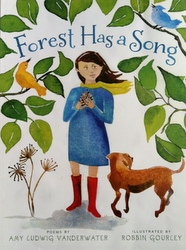
Amy is the author of two poetry books for children: FOREST HAS A SONG (Clarion, 2013) and READING TIME (WordSong, date TBA).  She is also co-author (with Lucy Calkins and Stephanie Parsons) of POETRY: BIG THOUGHTS IN SMALL PACKAGES (Heinemann, 2013).  You can find Amy at her blogs, The Poem Farm, a site full of hundreds of poems and mini lessons and Sharing Our Notebooks, a site celebrating notebooks of all kinds.


TUESDAY QUICK-WRITE: THANK A STRANGER

Look around.  Wherever you are, strangers have touched your life: pioneers cleared the land, a faraway soul designed those shoes, someone unknown to you raised your puppy during his first weeks.  Invisibly, strangers bump against and through our lives.  Today stop to thank one.  Write a letter.

The style of your letter does not matter.  You may write a formal letter or you may simply write notes.  You may write a poem or a story or a list.  You may share or never share.  But thank.  And begin with a stranger.  It will not be hard to find one. Just look around.

This is a snip from a letter I recently wrote to a stranger.  Glancing atop my desk, I saw two dolls sewn by our daughters.

Two Friend Dolls

One quick glance reminded me of my own long-ago doll:

Dear Stranger,

When I was six years old, you sewed something for me.  You did not know me or my family or what would land me in the hospital (tonsils), but still, you sewed.  You sewed a doll by hand, a doll about seven inches long, her head the size of a silver dollar.  My doll had yellow yarn hair and a full-skirted kelly green and white checkered dress.  She was a post-surgery gift, given to me by a nurse. 

In the 1970’s, you were a hospital gift-sewer, a hidden volunteer, my doll’s mother.  You created this doll with simple peach hands and bits of lace on her collar and sleeves.  You made her bright green satin legs.  And I never said, “Thank you,” because I never knew who you were…

We are touched daily by those we will never know.  As Margaret Tsuda writes in her poem Commitment in a City, “If we should pass again/within the hour,/I would not know it./Yet –/I am committed to/love you.”  In his poem Candles, Carl Dennis encourages us, “But today, for a change, why not a candle/For the man whose name is unknown to you?”  Why not?  And as we sit in candlelight, why not write a few lines of gratitude too?

 Note from Kate: Thanks, Amy!  Campers, as always, feel free to share a few lines of what you wrote today in the comments!

We’ll be giving away a copy of Amy’s FOREST HAS A SONG to one commenter, drawn at random.

Teachers Write 7/8/13 Mini-Lesson Monday with Donna Gephart

Hi there! I hope everyone had a fantastic holiday weekend and is back, ready to write this morning!  Today’s guest author is Donne Gephart!

Donna’s humorous middle grade novels from Random House include:  As If Being 12-3/4 Isn’t Bad Enough, My Mother Is Running for President!, How to Survive Middle School and Olivia Bean, Trivia Queen.  Her new novel, Death by Toilet Paper, comes out August 2014.  Many resources for student and adult writers are available at:  http://www.donnagephart.com


Making Sense of Sensory Writing

Did you know 80% of our brain’s energy is used to process what we see?  80%!  If you ever want to rest your brain, close your eyes.  (But not while driving!)

While writing, we tend to rely mainly on our sense of sight and ignore our other four senses.  We should pay attention to all our senses when writing, especially during the most important scenes – the ones we want to slow down for our readers.

Here are examples of writers using sensory description other than sight: 

TOUCH:  From Holes by Louis Sachar – During the summer, the daytime temperature hovers around ninety-five degrees in the shade—if you can find any shade.  There’s not much shade in a big dry lake. 

(Temperature and texture are good ways to use the sense of touch.)

TASTE:  From Crystal Allen’s How Lamar’s Bad Prank Won a Bubba-Sized Trophy:  . . . to be nice, I take a handful and stuff them in my mouth.  Man, these peanuts are off the chain!  They’re sweet and salty and remind me of Mom’s snack mix.

She holds the bowl up.  “Take some more, baby.  Aren’t they good?”

SOUND:  From Saint Louis Armstrong Beach by Brenda Woods:  Almost like a whisper, I heard someone calling out my name. . . . Then, four times in a row, “Saint, Saint, Saint, Saint,” each time louder, a girl’s voice, until finally she stood right in front of me.  “Saint!” she screeched.

SMELL:  From Small as an Elephant by Jennifer Richard Jacobson:  Clothes dryer – that’s what the tent smelled like:  a trapped-heat smell that filled his nostrils and told him the sun was high.

Smells, in particular, are a powerful way to access memories.  The scent of your mother’s favorite flower.  The odor of your father, after a day’s work.  The smell of grandma’s soup bubbling on the stove.  The sharp stink of a science experiment gone wrong. 


Time to write:  Think of a memory triggered by a smell, sound, taste or touch and write about it.   Use as many sensory details as you can while writing.  Those sensory details will help your readers experience your scene more deeply.  Those will help recreate the mood of your memory.

 Every time I do this exercise, I’m brought back to my childhood kitchen with my mother cooking at the stove or to our holiday dinners, brimming with aunts, uncles and cousins and smells by the dozens.  Someone once wrote about the taste of blood and sweat at his local boxing gym.  Another young woman wrote about the smell of her school lunchroom, where as a kindergartener, she was made to sit until she finished her lunch.  (She sat through every single lunch period — as every grade from K-8 sat, ate and left — before being allowed to leave, her lunch still uneaten.)

 Who knows what YOU will come up with?  And who knows where it might lead? 

Happy writing trails . . .  

Note from Kate: Feel free to share a little of what you wrote today in comments – and remember that even when Gae and I aren’t around to respond, you can cheer one another on with replies!

Need more inspiration? Check out Jo’s Monday Morning Warm-Up.

Today, we’ll be giving away a copy of Donna’s funny book OLIVIA BEAN, TRIVIA QUEEN to one person who replies to someone else’s writing!


Friday News & Giveaways!

Good morning! As we wrap up this second week of Teachers Write virtual summer writing camp, I want to say two things before I announce giveaway winners and send you off to give/get critiques with Gae.

1. You rock. Seriously. So many of you have come here nervous to write and terrified to share, and you’ve taken deep breaths and done just that. You are mentors for your students, not only when it comes to reading and writing but also when it comes to courage – and that is being a Mentor in the most capital-M, Dumbledore-like sense of the word. I’m cheering for you.

2. Remember that it’s summer and you are human. I’m getting lots of notes/emails/tweets saying things like, “Well, I’d love to do Teachers Write, but I have a dentist’s appointment on the 12th, so I won’t be able to write that day and oh, well, I guess I’d better call the whole thing off.” No. You should write with us whenever you can write with us. If you took yesterday off to watch fireworks and eat s’mores, that’s fine. Don’t beat yourself up over missing a day. Just wash the marshmallow out of your hair this morning  and get back to work.

Friday Feedback is at Gae’s blog today, so head over there.

Drawing winners for this week:

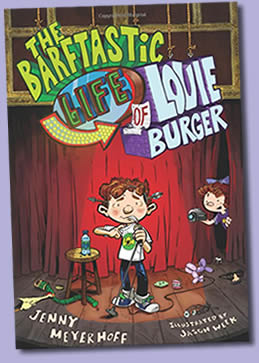
THE BARFTASTIC LIFE OF LOUIE BURGER by Jenny Meyerhoff goes to Kimberly Mach.

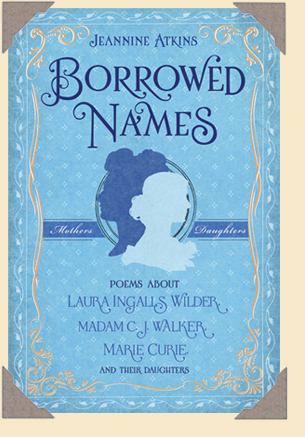
BORROWED NAMES by Jeannine Atkins goes to Jen Howe.

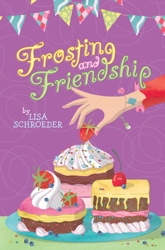
And Lisa Schroeder’s ARC of FROSTING AND FRIENDSHIP goes to Kerri Schegan.

If you’re one of our book winners (sorry…U.S. addresses only, so if you’re overseas & you win, you can have it sent to a friend/relative) email me your mailing address via my contact form and we’ll get your book sent out. Have a great weekend, everyone!

Teachers Write 7/4/13 Thursday Quick-Write with Jenny Meyerhoff

It’s time for your Thursday Quick-Write! I know it’s a holiday, so no worries if you’re too busy setting off fireworks and eating s’mores to write before bedtime. You have the weekend…

Our guest author today is Jenny Meyerhoff. She’s the author of a young adult novel, Queen of Secrets, and three books for young readers–Sami’s Sleepaway Summer, Third Grade Baby, and most recently, The Barftastic Life of Louie Burger, a story about an aspiring stand-up comic with an unusual catch phrase. Unlike Louie, Jenny is not a comedian, but she does know a lot about barf. After all, she’s a mom. Her three kids love fluffernutters, comedy and reading. Jenny lives in Riverwoods, Illinois with her funny kids and her delightful husband. For more information, visit her website:  www.jennymeyerhoff.com.


Setting a Mood

When I am writing a short story, a picture book or a novel, I believe one of my main goals is to make the reader feel something. In fact, this may be my most important goal, but often I get caught up in the plotting, the clever wordplay, the characterization, and I forget about the mood. When the writer isn’t deliberate about mood, the reader is often left emotionally cold.

The way I define mood, it is the overall emotional resonance of a piece of writing.  While a novel as a whole has a mood each scene will also have its own mood as well, but that mood will relate to the overall mood. For example, if the overall mood of a novel is sad, then the moods of scenes may vary from heartbreaking to bittersweet but will likely not extend as far as giddy excitement, unless there is a great reason for it.

Often when I’m writing a first draft, I forget to think about mood, and while this is okay, at some point I need to go back and check that what I’ve written isn’t at odds with the mood I meant to create. Maybe I wrote about the desolation of gray snow and bare trees in the same scene that my character got up the nerve to ask for what she wanted and got it. My reader is going to have a hard time knowing what to feel. When I revise, I pick details that echo what my character is feeling and describe them in ways that evoke a certain feeling.

Get a blank paper and in a few sentences, write a bare bones factual description of the room that you are in right now, for example, one brown desk, a wooden bookshelf, a rectangular window.  Use all five senses if you can. How does the room smell, feel, what sounds do you hear. Get up and walk around. Pick thinks up, touch them.

 Okay, now imagine you are creating a scene in that room with a character who is feeling terrified. What would that character notice about the room? How would it be different from the emotionless factual description. Perhaps the way the clock ticks? The way the door sticks? The fact that the door doesn’t lock. Write a paragraph describing the room from this character’s point of view. Don’t tell us that s/he is terrified, but make it clear from the description.

Now write from the point of view of a character who is in love.

Now from the point of view of a character is impatient, sad or angry.

Extension: if you have a work in progress, pick a scene, and write the emotion you want your reader to feel at the top of the page. Now read through and notice all the details you’ve included that evoke that emotion, all the places you could add detail that would add layers of emotion, all the places you’ve created an emotional response at odds with the mood you intended.

Thanks for writing with me!

Jenny

Note from Kate: Feel free to share a few lines of what you wrote  in the comments.

Jenny’s giving away a signed copy of her newest book THE BARFTASTIC LIFE OF LOUIE BURGER to one lucky commenter today!


Teachers Write 7/3/13 Q and A Wednesday

Wednesday is Q and A Day at Teachers Write! Virtual Summer Writing Camp, and we’ll have some great guest authors answering – today’s official author guests are Lynda Mullaly Hunt, Jenny Meyerhoff, and Lisa Schroeder.

Teachers & librarians – Feel free to ask your questions in the comments.  It’s fine to ask a general question or to direct one directly to a specific guest author. Our published author guests have volunteered to drop in and respond when they can. Please say thanks by sharing their books in your classrooms and libraries!

Guest authors – Even if today isn’t a day you specifically signed up to help out, feel free to answer any questions you’d like to talk about.  Just reply directly to the comment.

Note from Kate: Please be patient with me if you’re a first-time commenter – I’m traveling this week, so it may take a little while for me to approve your comment before it appears.

Got questions? Fire away!

Teachers Write 7/2/13 Tuesday Quick-Write with Jeannine Atkins

On Tuesdays & Thursdays during Teachers Write! Virtual Summer Writing Camp, we’ll be sharing quick-write prompts, designed to get you free-writing for a few minutes in response to a question or idea. Some of these will feel like writing memoir, some will focus more on fiction or nonfiction or poetry. Some of them will just be hard to categorize. Many will be prompts that you can bookmark and share with your student writers later on.

Our Tuesday-Thursday quick-writes can be used as a simple free-write, brainstorming, warm-up activity OR as a way to deepen your thinking about a work-in-progress.  So feel free to approach the prompt in whatever way works best for you, even if that means ignoring it and writing about the other thing that sprouted in your head when you sat down to do the quick-write. Okay… got your keyboard or pencil ready?

Tuesday Quick-Write with Guest Author Jeannine Atkins

Jeannine Atkins writes books about history for children and teens, including Aani and the Tree Huggers (Lee and Low) and Borrowed Names: Poems about Laura Ingalls Wilder, Madam C. J. Walker, Marie Curie and Their Daughters (Holt).  She teaches Children’s Literature at UMass-Amherst and a graduate course in writing for children at Simmons College. You can learn more on her website at http://www.Jeannineatkins.com.

In the Garden

If we were all together in a room, I’d give directions for this three-part exercise pausing for everyone to write one section before beginning the next. If you’re disciplined, and like surprises, please try responding to the first prompt, then going on to the next. Since reading is usually quicker than writing, personally I’d have a hard time not skimming all the prompts, but writing always surprises me more than thinking, so the exercises should still lead you someplace new.

1. Interesting characters have problems. Creating a character on the spot or taking one from a work-in-progress, state a major problem for your character.

2. Leaving that conflict behind, take your character and imagine her or him as being young enough to find her face near at least some flowers and blooms. For older characters this may be a memory of a garden where she feels free to roam around and peer close into blossoms. Write what she sees, smells, and touches? Are there particular plants, trees, or bugs that capture her attention? Describe them. She might stop to have a tea party with leaf plates and acorn cups. Does she talk to any birds or animals? Do they talk to her? Write down the dialogue! When she looks up, does she feel rain or sun? Describe the sensation. Does she find secret messages among rocks, violets, beetles, or the shade of an oak?

3. Please write what your character learned from her time in this garden. Can she use this to help solve the problem you described at the beginning of the exercise? Try writing a scene that brings the problem and the old garden together.

Note from Kate: Thanks, Jeannine!  Campers, if you’d like to share a few lines of what you wrote today in the comments, we’d love that – and promise that all our comments will be friendly and supportive.

And today, we’ll be giving away a copy of Jeannine’s beautiful book BORROWED NAMES to one person who replies to someone else’s writing in the comments. 🙂

Teachers Write 7/1/13 Mini-Lesson Monday with Lisa Schroeder

Welcome to Teachers Write Week 2!  The winner of last week’s HIDE AND SEEK signed book drawing is Beth Shaum! Beth, please send me your mailing address via my website contact form and I’ll get your book in the mail.

If you’re new here, Teachers Write is a virtual summer writing camp for teachers and librarians. Click here to sign up if you’d like to join us! If you’re on Facebook & want to also join our group there,here’s the link. Then click “Join Group.”

A quick note about blogging your Teachers Write experience: It’s GREAT if you want to set up a blog where you share all of your writing from this summer. One important request: Please do not copy and paste the mini-lessons or writing prompts – publish only your own writing on your blog. If you’d like to reference the ideas shared here, providing a link is the best way to do that. Thanks!

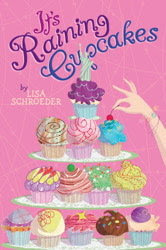
Today’s guest author is Lisa Schroeder, who is the author of four teen verse novels including I Heart You, You Haunt Me and its companion, Chasing Brooklyn, Far From You, and the Oregon Book Award finalist, The Day Before. Her latest book for teens is a combination of prose and poetry, titled Falling For You.  She’s also the author of the middle grade novels It’s Raining Cupcakes, Sprinkles and Secrets, and the forthcoming Frosting and Friendship (9/2013, Aladdin). Her books have been translated into several languages and have been selected for state reading lists. She lives in Oregon with her husband and two sons. You can learn more by visiting http://www.lisaschroederbooks.com.

Creating micro-tension in your novel

by Lisa Schroeder

 You know the drill. When you’re writing a story, you have to figure out what your character wants and then put obstacles in his/her way (i.e. create conflict) in an effort to create an interesting journey for your readers to follow. Simply put, conflict = story. Of course, in great stories, there’s an internal journey as well as the external one.

 So we try our best to keep that ultimate goal out there and keep our protagonist reaching for it. But according to agent and author Donald Maass, conflict must be present in small ways too. In his book, The Fire in Fiction, he says, “Keeping readers constantly in your grip comes from the steady application of something else altogether: Micro-tension. That is the tension that constantly keeps your reader wondering what will happen, not in the story, but in the next few seconds.”

 Did you catch that? “Next few seconds.” I don’t think enough authors keep this in mind. I’d argue it’s even more important when writing for kids and teens because if they put a book down out of boredom, there’s a good chance it won’t get picked up again.

 So, let’s take a look at my middle grade novel, It’s Raining Cupcakes, because it’s one I obviously know well. The main character, Isabel, has never been out of the state of Oregon and she dreams of traveling. That’s her goal. But there are a few things keeping her dream from coming true. First of all, she’s a kid with limited income. Second of all, she has a mother who is afraid of flying. And finally, her parents are opening a cupcake shop, so travel is really the last thing they want to do. And yet, Isabel wants to travel. Badly. And she goes about trying to earn money and also enters a baking contest for kids because the finalists earn a trip to New York City for the bake-off.

 In each scene where Isabel is trying to either raise money or come up with a recipe for the baking contest, I tried to create that magical and wonderful micro-tension. Let’s look at a couple of examples.

 In one scene, Isabel is babysitting three-year-old twins in an effort to earn money. Of course, I let the little boys be boys, so it’s fun to read. But I knew I needed more than that to keep the reader engaged. Isabel notices some travel books in the house, and while the kiddy pool is filling up with water, Isabel decides she wants to read those books. She knows it’s not wise to leave the boys alone with the water, and tries to persuade them to go inside with her, but they refuse. So she tells them to stay out of the water, and off she goes. Here is an example of micro-tension. Suddenly, the reader is nervous. Will the boys get in the pool when Isabel steps away, even though she tells them not to? If they do get in the water, will one of them get hurt? And what if she gets caught?

 In another scene, Isabel decides to try out a recipe for the baking contest she wants to enter. Her mom has told her she thinks she should enter a cupcake recipe. After all, if Isabel makes it to the finals, it could be good exposure for the new cupcake shop. But Isabel worries people might think her mom helped her. She really wants to do something different. But she doesn’t exactly tell her mom that. So one day, while her parents are both out running errands, Isabel attempts a recipe that isn’t a cupcake one. When Mom and Dad come home earlier than expected, Isabel panics. She grabs the dessert she’s just made and without thinking, runs out to the fire escape. Why the fire escape? Because as the author, I knew this was a great way to create some tension. I could have just had them come home and catch her in the kitchen, but why miss out on an opportunity for conflict? Once she’s on the fire escape, then what? Does she try to climb down? Does she throw the dessert out on the street? Will her parents catch her out there, hiding from them? And what happens when she realizes she just drank not one, but two root beers, and she suddenly has to go to the bathroom really, really bad? I put Isabel in a pickle, and that’s what me must do over and over again in our stories to keep the tension high.

 One of the reasons The Hunger Games has been so successful, I’d argue, is because Suzanne Collins is a master at creating micro-tension. Of course, she set up a story that would be ripe for it, and kudos to her for doing that, but think how different the story would have been if it were just Katniss hiding in the woods, all by herself. With every character she encountered, there was tension.

 Ask yourself, with each scene, what can you do to keep readers on the edge of their seat. Brainstorm a few different things, and then try them out and see how they play out on the page. As one author put it in this great blog post by Sarah Callender at “Writer’s Unboxed” (which I encourage you to read, because it’s another way of looking at micro-tension), “My characters must feel torn. Often. That’s right. We must create a massive game of tug-o-war within our characters by throwing choices in their direction. Even better, we might give them only lousy choices. Or, let them be torn and then let them make a wrong choice. We must make them squirm as a result of their choices. Squirming characters = engaged readers.”

 Go on then. Have some fun. Make your characters squirm!

 One lucky commenter today can win an Advanced Review Copy of Frosting and Friendship, a companion novel to It’s Raining Cupcakes and Frosting and Friendship.

Note from Kate: Thanks Lisa!! Remember, campers, in the comments, feel free to share a few lines of what you wrote today! Please note: If you’re a first-time commenter, I’ll have to approve your comment before it appears. This may take a while if I’m not at my computer, but don’t worry – I’ll get to it and it will show up later on!  As we continue in writer’s camp, Gae and I are traveling on and off, so we won’t be able to reply to comments every day. But your guest authors may be stopping by, and you should most definitely read & reply to one another, too. Remember that it’s the community that makes this place so much fun!

And one last thing…Monday Morning Warm-Up is today, too!

Teachers Write Special Guest Donalyn Miller, on “Writing Where You Are”

Happy Friday! Congratulations on wrapping up your first week of Teachers Write 2013 – it’s been amazing to read your brave ideas and to watch writerly relationships growing. Many thanks to all who shared this week or commented to cheer on other writers.

Every Friday this summer, the party moves over to Gae Polisner’s blog for Friday Feedback, a chance to share your writing, get some feedback, and give feedback to others, too. Wondering how to do that in a helpful, supportive way? You may want to check out this essay I wrote for the Stenhouse Summer Blogstitute last year:

How to Critique Writing

It includes excerpts from the real editorial letter I received from my kind, smart Walker/Bloomsbury editor,  Mary Kate Castellani when we were working together on THE BRILLIANT FALL OF GIANNA Z. and offers specific ideas for how you can use Mary Kate’s strategies to encourage writers and to help them think more deeply about their work. So check this out, and then head on over to Gae’s blog to give it a shot.

But before you do…I promised some surprises this summer, and I’m thrilled to share an extra special guest post today from none other than The Book Whisperer herself…Donalyn Miller.

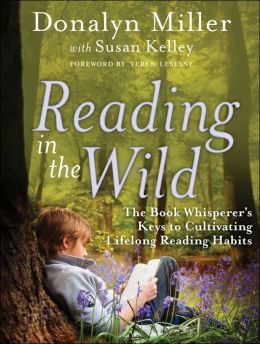
Donalyn is a classroom teacher, blogger, and author. Her first professional title, THE BOOK WHISPERER, has encouraged teachers around the world to set aside the worksheets and dioramas and focus on real, authentic reading in their classrooms. Donalyn’s next book, READING IN THE WILD, comes out in November.

I think READING IN THE WILD will be one of the most important books you’ll read this year. It focuses on what makes a Reader… not a lower-case school reader who goes through the motions, but a lifelong Reader with a capital R, who lives and breathes words and loves to learn and inhabit new worlds. Can teachers help kids become that kind of Reader? Donalyn says yes and shows us how, with vivid examples from her own reading life and classroom.

Today, she’s sharing a bit more of her writing life with us in a special guest post that explores how you might get started writing about your own classroom, too.

Write Where You Are by Donalyn Miller

When I was a kid, writing well was part of the school game. I never wrote outside of school. I was told that I was a good writer. I earned high grades on my writing from teachers—the only audience who saw my writing. In high school, I wrote my assignments in the car on my way to school, while my best friend, Larry, navigated his Ford Pinto around potholes. I dodged my English teachers when they asked for my rough drafts. I never wrote any; it seemed like a waste of time. I don’t think I was ever taught how to write. I was a student of what my fellow Texan, Gretchen Bernabei, calls the “Ass/Ass” method of writing instruction: assign the writing, and then assess it. For me, writing was an obstacle course of grammar, mechanics, and formatting. I wrote the papers my teachers assigned, earned my A, and gave my papers to my mom to hang on the fridge.

Even after I became a language arts teacher, I didn’t write outside of school. I wrote in front of my students as a model—because my mentors told me I was supposed to—but that was it. Writing for the sake of writing held no relevance for me. I didn’t have a clue about how to teach writing. I knew that something was missing, and I was at a complete loss to figure out what it was.

During my fifth year of teaching, I enrolled in grad school. Every week that fall, I sat with colleagues, Audrey Wilson and Jennifer Isgitt, listening to them talk about the National Writing Project and how much it changed their professional lives. The fire I saw in their eyes when they talked about what they had learned about writing and teaching during the Summer Institute compelled me. I wanted that fire, too. I applied to the Writing Project that spring.  I wasn’t entirely sure what I was getting myself into, but I didn’t care. I only wanted to be a better writing teacher.

Spending a month that summer surrounded by other teachers as we wrote and shared our stories changed me. I finally understood that to be a better writing teacher, I needed to write. I began keeping a notebook and jotting poems and essays about my daughters. When school started, I recorded anecdotes about my students and our days together as readers and writers, too. Showing my real writing efforts with my students terrified me, but I discovered that sharing my writing life with my students helped them write better. Writing outside of school for the first time, I began to see myself as a writer.

Early that school year, I received a call from Elizabeth Rich, an editor at Teacher Magazine. Elizabeth had worked with my principal, Ron Myers, a few years before and she contacted him to see if he had any teachers who could write a one-shot “Ask the Mentor” column for the magazine. Ron told her, “I have one.”

After introducing herself, Elizabeth asked, “I hear that your students read 50 books a year without any rewards or incentives. Is that true?”

I replied, “Isn’t reading its own reward?”

She responded, “Well, how do you do it?”

Put on the spot, I realized that this was not an easy question to answer, “I don’t know. It’s like I’m some sort of whisperer. I talk to the kids about books and they read them.”

The moniker “The Book Whisperer” stuck as did Elizabeth’s original question, “How do you do it?” Through my writing, I have been trying to answer that question ever since—both for myself and for the people who read my writing. That first “Ask the Mentor” column turned into three. Teacher Magazine invited me to write a blog. I remember thinking at the time, “I won’t tell them that I don’t know the first thing about blogging.” When several publishers approached me about writing a book, I thought, “I wonder how long it will take them to figure out that I am not a writer?”  Whenever I receive an invitation to submit an article or write a blog post, it still surprises me. Don’t they know that I am still trying to figure out how to be a good writer? Don’t they know that I struggle with writing and hate it some days?

Dorothy Parker famously said, “I hate writing, I love having written.” I relate. I do. Discovering that I am able—in spite of crushing insecurity and my complete lack of discipline—to write something worthy amazes me.

I think it is OK to admit when we have a love/hate relationship with writing. The most important thing is to keep writing. We are writers because we write—nothing more, nothing less.

Penny Kittle talks about Writing Territories—topics that writers revisit again and again. My territories include my daughters, my love for nature, and my childhood stories. Mostly, I write about my students and our shared lives as readers and writers. As teacher writers, recording our classroom stories can be a great place to start writing. For teachers, writing about our classrooms is the ultimate reflective practice—we see how our daily interactions and observations inform our thinking about teaching and learning. We also capture our remarkable students, their experiences, and how they shape our lives.

Think about your classroom and your students. What moments stick with you? Record your daily anecdotes in your notebook. Start with what happens in your classroom each day. What did your students say and do? How did you respond or feel about what happened? What did you notice that was funny or insightful or poignant? After recording an event as well as you can, dig deeper into what this moment reveals about your teaching and your interactions with your students. Did this moment move your students forward somehow? What did you learn? How did this moment build community among your students and you? What did you discover about your students that you didn’t know?

Look back through your school stories occasionally to see what threads emerge. Is there an over-arching theme about your teaching that emerges? Perhaps, you can shape your anecdotes into an article and submit it to a professional journal. Is there a particular student that you write about often? Perhaps, this child can be the protagonist in a fictional story. For every teacher, our classroom stories provide powerful writing territory that fuels our writing and our teaching.