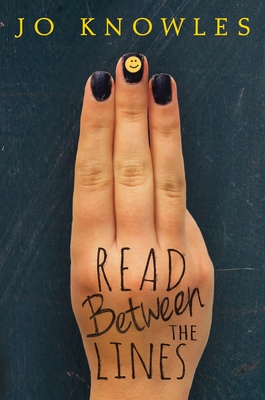
Nora: A poem about a story (with thanks to Jo Knowles)

This is the first week of Teachers Write, the online summer writing camp I run for teachers & librarians. I started doing this to help people create a writing community, so people who work with young writers could practice their own craft in a safe, supportive place. But the truth is, I learn so much more than I teach in these summers. This is our fourth year, and launch week is always busy – posting lessons, scheduling guest blogs, responding to comments, welcoming everyone. It’s wonderful and joyful, but chaotic, too.

So I’m late in slowing down to really think about the Monday Morning Warm-Up that Jo Knowles shared this week, as she does each Monday. Jo has a gift for inviting us to poke around in our own story worlds in ways that open up doors and shine lights. Her prompt was just what I needed this week because I’m about halfway through drafting a new book that’s real and honest and risky enough to scare me every time I sit down to write.

But sitting down is what I need to do. So today, I sat down and wrote in response to Jo’s prompt – “White Page Day” – is an invitation to list and reflect and pull ideas into a poem.


Nora


This is a story about a girl

Whose world was safe

Until it wasn’t.

It’s about sirens that stayed silent,

Police on the school bus,

And killers in the woods.

Good guys and bad guys

And people who don’t fit in categories

And that’s a problem

Because Nora always knew

Before.


It’s a story about the moment you realize

That your world is not as safe as you took for granted

With your unlocked doors and tree fort sleepovers.

The moment you realize it’s bigger,

More complicated,

That your good guys are not all as good

As you want them to be,

And your bad guys weren’t always that way.

Hearing their stories

Makes it hard to tell the difference

Between the two.

It’s a story about what we cheer for

And who that makes us.


It’s about small towns and mountains

And the monsters that hide there,

Some flesh.

Some shadow.

And some that aren’t out in the mountains at all.


It’s about ugly things

Living in beautiful places,

Lines that divide us –

And how two people crossing one

Made all the others go wavy and unsure.


One time an author came to our school –

He had a black t-shirt and sunglasses on his head –

And said the secret to selling lots of books

Was just writing cool stuff.

But things that are cool in a story

Are different when the characters aren’t made of paper.


So this is about looking more closely

At a place you love.

Seeing the beer cans and cigarette butts in the high grass

Loving it anyway,

And putting on work gloves.


It’s about happy endings

And whether you can have one

Even if you finish the story

More unsettled than when you began.

——————————————

And now it is time for me to get back to that story. Thank you, Jo!! xo

Teachers Write 7.8.15 – Q and A Wednesday & guest author Melanie Crowder

Traditionally, Wednesdays are Q and A days at Teachers Write – a chance to ask published authors questions about the writing process, from brainstorming to outlining to revision. This summer, we have so many amazing guest authors with so many great lessons that we’re also going to have lessons along with our regular Q and A sessions on Wednesdays. Excited about that? Me, too!

Today, we welcome guest author Melanie Crowder. Melanie’s debut novel, Parched was one of Bank Street’s Best Books of the Year and a Junior Library Guild selection. Her second book, Audacity, has received three starred reviews and is an Editor’s Choice at BookBrowse and a Top Pick from BookPage. Her third novel, A Nearer Moon, releases September 8 from Atheneum Books / S&S. Melanie holds an MFA from Vermont College of Fine Arts and lives in Colorado with her family. Her mini-lesson today is all about image systems…

Melanie Crowder Author Photo

To get started, if you haven’t already, draw up some sketches for a few of the characters in your story. I don’t mean actual drawings; brief descriptions will do. (What they look like, their hobbies, their habits, their flaws, their nervous tells.)

That’s done? Good. Now look back through what you’ve got. Anything particularly visual standing out to you? If not, add a few more details until you find something you like.

I’ll give you an example of what I’m talking about. One of the characters from my work in progress is an eight year old girl named Pilar. She collects things like empty snail shells, dropped moth wings, desiccated leaves, and abandoned chrysalises. All the discarded things.

Why? I don’t know—it started out just as a thing she did. But I liked it, so I expanded it. The discarded things became an element of the physical descriptions I wrote for her: the shadows on her skin like whorls on a snail shell or the wind tossing her hair like a leaf ripped from the tree.

When I want to show her emotions, I put those discarded things into a metaphor. Rather than saying she’s lonely, I describe the hollows and creases of the empty nutshell in her palm. And you know what—it turns out that there is a very good reason why she collects all those discarded things. It’s how she processes the fact that her mother left. So much thematic resonance there!

Okay, let me give you some more examples. This afternoon, I popped in a DVD of the 2005 film Pride & Prejudice and turned on director Joe Wright’s commentary. He talks about things like the symbolism of the birdsong in the opening scene, or the way the swan with its head stuck in the water is like Lydia (Ha!), or the way the film opens and closes with the sunrise. (I find a huge amount of inspiration in listening to artists working in other media talk about their process, but that’s a post for another day.)

Here’s one thing he has to say about the actress who plays the eldest Bennett sister:

“[Jane] is obsessed with ribbons. She carries two or three ribbons with her wherever she goes.”

Why? What does that detail reveal about her as a character? What potential is there in that image for description, metaphor, or theme?

Here’s another quote from the director about Lizzie’s aunt and uncle:

“[I] love the Gardeners. Their relationship is based on pies. In every scene, they’re eating and they have a very happy marriage in their shared admiration of the great English pie.”

Hilarious. And so telling, right? If you were writing those characters, with the image system of the great English pie, just think of all the different directions you could take it!

Today’s assignment:

Pick one character, and one image connected with that character. Either as you rewrite an existing scene, or as you draft a new one, bring that image with you. Use it when you describe your character or when it’s time for a metaphor to reveal your character’s emotion, and hey—if all else fails, throw that object into the scene with them and see what happens.

I’d love to hear what you come up with if you’re feeling brave enough to share in the comments. Good luck!

Note from Kate: And of course, today is also Q and A Wednesday, so feel free to post any questions you’d like to ask our guest authors, too. In addition to our “official” guests, we tend to have a wide variety of guest authors popping in from social media on Wednesdays, so you never know who might answer your question!

Teachers Write 7.7 Tuesday Quick-Write with Phil Bildner

It’s time for your first Teachers Write Tuesday Quick-Write! Today’s post is courtesy of Phil Bildner, the author of the New York Times bestselling Sluggers! series, the Texas Bluebonnet Award-winning Shoeless Joe & Black Betsy and its companion, The Shot Heard ‘Round the World, both illustrated by C. F. Payne; and Twenty-One Elephants, illustrated by LeUyen Pham. Phil’s new picture book, Marvelous Cornelius: Hurricane Katrina and the Spirit of New Orleans, comes out this month from Chronicle.

Here’s Phil’s prompt for today…

People make wonderful prompts. Sometimes when I’m building characters, I’ll go to a place public — a coffee shop, a park, the library — and I’ll people watch. When I taught middle school in the New York City public schools, on my way to school, I would sit with my journal in my lap (when I got a seat) and make up stories and build characters based on those around me.
Find a fresh place to write. People watch. Create characters or character traits based on those you see. You’ll be amazed at how quickly the ideas develop.
Note from Kate:  This is a really great prompt to do with your kids in the first weeks of school, too. Take those notebooks and pens out of the classroom — outside, or even just to the front hallway or cafeteria — and get them writing!
We’d love to hear about who you watched (and wrote about!) today, so if you’d like to share, feel free to post a snippet of your writing from today in the comments!
And just to remind everyone… I tried to reply to every comment yesterday to say hello to everyone, but that probably won’t be the case with all of our guest authors. Most try to pop in to say hello and chat a bit, but many folks are traveling or on deadline and can’t reply to all of your comments. That makes it even more important for you to build this community and talk writing with one another, too. 🙂

Teachers Write 7/6/15: Mini-Lesson Monday – An Invitation to Wonder

Hi there! Happy Summer! And welcome to writing camp!

Teachers Write! is a free virtual summer writing camp for teachers and librarians. Please click here to sign up if you’d like to join us and haven’t already registered. If you’re on Facebook & want to also join our group there – here’s the link. Then click “Join Group.” And please click here to sign up for my email newsletter so that you’ll get updates throughout the year.

A quick note about blogging your Teachers Write experience: There will be daily opportunities for you to share and interact with one another in the comments section of each post. Often, our guest authors will stop by to be part of the conversation, too (though not always – some will be on deadline or traveling for research).  In addition to commenting, it’s great if you also want to set up a blog where you share all of your writing from this summer. One important request: Our guest authors have given permission for their lessons & prompts to be shared on the Teachers Write blog only. Please do not copy and paste any mini-lessons or writing prompts – publish only your own writing on your blog. If you’d like to reference the ideas shared here, providing a link is the best way to do that. Thanks!

Four quick things before we get started…

1. Teachers Write is an online summer writing camp with published author-mentors who donate their time to work with us. It’s free. There’s no charge to participate, but we do ask that you buy a few books over the summer as a way to support the authors who are supporting you. Our request: choose one book from each of our three main “all summer long” authors – Kate, Gae, and Jo – and at least one book from one of our daily guest authors. If you truly aren’t able to do this financially, we understand that and still want you to write with us. We’d love it if you requested these books at your local libraries & signed them out.

2. Our weekly schedule will look like this:

Monday Mini-lesson, and a Monday Morning Warm-Up on Jo’s blog
Tuesday Quick-Write
Wednesday is Q and A day – authors will be here to answer your questions! We’ll have some other Wednesday features, too.
Thursday Quick-Write
Friday Feedback on Gae’s blog, and an occasional Friday feature here, too
Sunday Check-In on Jen Vincent’s blog as well as an occasional weekend essay here.

3. I’ll be popping in to comment, and I know many of our guest authors will, too, but since this community has grown so much (we’re more than 1400 teacher-writers strong now!) you’ll also need to commit to supporting one another. When someone decides to be brave and share a bit of writing in the comments, or when someone asks for advice or feedback, please know that you are welcome (and encouraged!) to be mentors to one another as well. Watching this writing community grow is one of the best things about being part of Teachers Write.

4. The first time you comment, I will have to “approve” your comment before it appears. This is to prevent us all from being besieged by unpleasant rogue comments. So when you comment, it will not show up right away – sometimes, it may be later in the day when your comment appears.  THIS IS OKAY. Please don’t post more than once.

Now…let’s get started!

new teachers write 2015

Today, I’m inviting you to wonder. Because that’s where authentic writing starts – at least for me. I’ve written books because I wondered what goes on under the snow in winter, because I wondered what it would be like to have a magic pencil that answers questions, because when a rainforest guide told me that a thousand different organisms depend on one species of tree that grows in Costa Rica, I wondered what those animals were and how they needed it. You get the idea. Wonder is essential for writers, but sometimes, we don’t leave time for it in our daily task-finishing, dinner-making, laundry-sorting lives.

So today, your assignment is to wonder for a while. Take 15 or 20 minutes and make a list of things you wonder about. Here’s mine for today:


I wonder what would happen if a kid stole his mom’s notebook & changed stuff.

I wonder what role women and girls played in Viking Iceland.

I wonder how the California earthquake of 1906 affected Chinatown and the people who lived there.

   (Those last two are questions I’ll be researching soon for future books in my Ranger in Time series.)

I wonder about water bears.

I wonder about women mathematicians in history – how come we usually hear about men?

I wonder how we can channel anger for good.

I wonder how much we can control what we dream.


There are a dozen story possibilities here, but I won’t know for sure if any of them can grow until I take some time to explore those wonderings. I’m going to start with the women mathematicians and do a little reading tonight…

What about you?

Your assignment: Spend some time daydreaming. Think about the things that fascinate you, the things that scare you, the things that are important to you. Make a list of things you wonder. And choose one or two of those that you’d like to explore a little more in the days and weeks to come.  If you’d like to share some of your list in the comments, please feel free to do that and please feel free to leave a short introduction today, too. We’re all going to be writing buddies this summer, and it will be nice to get to know people.

Also, remember that Jo Knowles always kicks off our week with a Monday Morning Warm-Up, so you can drop by her blog for another writing prompt.

More for our historical fiction study folks…

If you’re reading the Ranger in Time books & want to participate in my focus on historical fiction this summer, you may be interested to know how that idea of “wonder” plays out in author research once a topic has been selected (or assigned!). When I first sold the Ranger in Time series to Scholastic, I’d given the team there a list of possible stories. They responded with a list of suggestions for the first four books — two that came from my list and another two they added based on teacher and library requests for those topics. One of those titles – RANGER IN TIME: RESCUE ON THE OREGON TRAIL – ended up being our very first book in the series. When Scholastic asked for this topic, I had to ask myself, “Are you interested enough in the Oregon Trail to spend months researching and writing about it?” The answer was yes – I wondered about a lot of things during that time period!

I read stacks of books and visited websites, but the best part of my research came during a field trip to the National Frontier Trails Museum in Independence, Missouri, which was one of the jumping off points for the Oregon Trail. There’s a whole library here, filled entirely with books about the Oregon Trail (research geek heaven!!), and I was excited to spend time there, reading and researching.

I knew there were many diaries here – some of them never published, so they were original manuscripts, scrawled in dusty leather journals. And I wondered if any of those diaries had belonged to children, since I hoped for a glimpse into the mind of a kid my character’s age who made that journey. When I asked the library director about this, he said, “No, we don’t really have any from kids.”

“None?” I said.

“No,” he answered. Then he paused. “I mean, there’s Lizzie, but…” I could hear the dismissal in his voice, even over the phone. He did not care for Lizzie. When I pressed him, he explained more. “We have Lizzie Charleton. She was a teenager, but her diary’s terrible.”

“Terrible how?” I asked..

“She just complained the whole time. Lizzie didn’t want to go.”

Think about that for a minute. Lizzie didn’t want to go. If you’ve ever taken a long car ride with a kid, you understand why this diary is a perfect source. I knew I needed to see it.

Lizzie

Here are some excerpts from Lizzie’s diary, shared with permission from the museum library:

April the 19th last night it rained & made the roads so muddy that we did not start until noon we travailed 14 miles to day & it rained all day & is so cold we like to freeze to death

April the 20th This morning it is still cold enough for winter we travailed until 2 o clock today & it was so disagreeable & cold we had to stop the rest of the day

May the 14th Camped for to night on the bank of Platte River it looks verry much like we might have a storm to night came 18 miles to day through sand & mud holes till there is no name for it & I am vary tired a walking

May the 16th Camped again this eavening on Platte came over bad roads to day & are verry tired came up too Hills half mile long & sand there was no end to it & was so warm we could hardly get up

 May the 27th Camped this eavening on Labonte creek came 24 miles to day it rained & snowed a bout 4 hours it was 3 inches deep.

Monday May the 28th Camped this eavening out on a hill & cold enough to freeze us came 20 m

 Tuesday May the 29th Camped again this eavening out on a hill & still cold enough for winter came 32 miles today & killed one Antelope

 Tuesday June 5th Camped this eavening out in the Bluffs our stock stampeded last night we did not get started till 10 oclock we came 15 miles in the fore noon we Started at noon took the rong road travailed a bout 5 miles out of our road then started a cross the Bluffs came a bout 4 miles a cross came to the road a bout 7 oclock in the eavening went back a bout a mile after water so we did not get but 18 miles to day Charley Killed an Antelope we will have a mess of Antelope for supper then we will be all right again if we dont freeze to death the snow was a bout 2 inches deep this morning.

When I read Lizzie’s diary, I have to confess that I fell in love with this grumpy teenager right away. I appreciate the much more detailed and descriptive diaries that other women travelers left behind, but Lizzie’s voice rang true to me. She’s cold, she’s tired, and she probably didn’t want to come in the first place. The whole time I was reading, I half expected the next line to be “Aren’t we there yet?” To those of us reading Lizzie’s diary more than a century later, it’s easy to appreciate the overland journey as a grand adventure. But to Lizzie, it was long, cold, and kind of boring, too. Stepping into her shoes, it’s easy to see why she’d use the same lines over and over and complain about the cold. Her voice struck a chord with me because it felt real. I ended up using Lizzie Charleton as the model for Sam Abbott’s older sister.

If you have the first Ranger in Time book, take a look at Chapter 5 (pp. 34-45) and you’ll get a sense for how that initial “wondering,” followed by some research and note taking, ended up developing into one of my favorite characters in the book. We’ll talk more this summer about how to incorporate historical details into a project without losing the sense of story, but this should give you some ideas to start.

I’ll be around today to chat more about our first historical post, as well as to greet people and say hi, so if you have questions, please feel free to fire away in the comments!

~Kate

Meet your Teachers Write 2015 Guest Authors!

Teachers Write 2015 kicks off two weeks from Monday! (That’s July 6th, for those of you who are already on summer vacation and don’t know what day it is today.)

If you haven’t signed up yet, you can read all about Teachers Write 2015 here… or just go right to the sign-up form here.

Gae and Jo and Jen and I are all busy getting ready, and so are your other amazing guest authors for this summer! Here’s who you can expect to hear from in the weeks to come…

Phil Bildner

Melanie Crowder

Tracey Baptiste

Sarah Albee

Megan Frazer Blakemore

Linda Urban

Laurel Snyder

Liz Garton Scanlon

Elana K. Arnold

Christina Diaz-Gonzalez

Kim Baker

Kristen Kittscher

Anne Nesbet

Sarah Prineas

Steve Sheinkin

Heidi Schulz

Ammi-Joan Paquette

Elisabeth Dahl

Mike Jung

Olugbemisola Rhuday-Perkovich

Kekla Magoon 

Erin Dionne

 Please remember that Teachers Write is free and happens thanks to the grace and generosity of volunteers. We don’t charge anyone to participate, but we do ask that you purchase some books to read and share with your students – one book each from Kate, Jo, and Gae. Here are our latest titles:

 We also ask that you purchase at least one book from one of our guest authors above. Please check out their websites, get ready to learn from them, and share their work with your colleagues and students. We’ll be back July 6th to launch Teachers Write 2015 and start our summer of writing together!

Announcing Teachers Write 2015!

Announcing Teachers Write 2015!

 Our fourth annual Teachers Write Online Summer Writing Camp will run from July 6th to August 2nd, 2015 – four weeks of daily writing lessons, prompts, opportunities to talk with favorite authors, and inspiration. It’s hosted right here, and we’re focusing on a one-month period this year because that’s when we’ve had the most participation in the past. Also, your feedback from last year suggests that you really need August to get back into full-time teaching mode.

Teachers Write is a free online summer writing camp, especially for teachers and librarians. It’s a chance to practice your own writing in a warm, supportive environment so that you can go back to your students with new ideas and (in many cases) a new sense of empathy for the courage involved in writing and sharing one’s work. We offer daily inspiration and assignments, including mini-lessons, writing prompts, and Q and A sessions with authors whose books you and your students love.

Our plans for Summer 2015 will be familiar to returning campers, but with some surprises, too. The inimitable Gae Polisner will be back with Friday Feedback, a chance to share your writing and get feedback. The amazing Jo Knowles will have your Monday Morning Warm-Ups each week. And teacher-writer Jennifer Vincent will be hosting Sunday reflection times again on her blog. Daily lessons & writing prompts will be on my blog, as always, and I’ll be sharing a list of amazing guest authors in a few weeks.

This summer, in addition to our usual guest author posts, I’ll be sharing an in-depth series on writing history and historical fiction. If you’d like to participate in that, you’ll want to pick up the first two books in my Ranger in Time historical chapter book series and read them before we begin on July 6th. They’re short and quick – and both are in paperback, so it’s just a $12 investment. The second book comes out in late June but can be pre-ordered now at your local bookstore or online, so you’ll still have time to read before we begin.

Ranger in Time -- Rescue on the Oregon TrailRANGER #2 Final Cover

 You’ll want to keep both books handy so you can mark them up & reference pages as I share the research techniques, organizational tools, writing, and revision strategies that went on behind the scenes. I’m using both as mentor texts because book one is set on the Oregon Trail, during a time period for which we have a great wealth of written primary source material, and book two is set in ancient Rome, a time for which we rely largely on archaeological evidence. I hope this will be a helpful series not only for those of you who write nonfiction or historical fiction but also for everyone who reads & teaches history with kids. The posts will stay up & available for you to share with student writers later on.

That’s a basic introduction of Teachers Write, but we know that you may have questions or be nervous about diving in to join us. Our wonderful Gae Polisner has put together a list of Frequently Asked Questions & answers on her blog with more information and encouragement. Especially encouragement. Gae is our head cheerleader around here.

So will you be joining us for Teachers Write this summer? We hope so! You can sign up here, any time between now and July 6th. Please follow us on Twitter (@KateMessner, @MentorTexts, @GaePol, & @JoKnowles) and join our Facebook group, too. Over the next three months, we’ll be busy getting ready for all of you to arrive at our virtual camp, so you’ll get lots of updates, including exciting news about this summer’s guest authors.

If you’d like to get warmed up now, you may want to pick up a copy of 59 REASONS TO WRITE, a collection of our writing prompts, mini-lessons, and Q and A sessions from the first two summers of Teachers Write.

59 Reasons to Write

And if you’d like to get to know your camp counselors a little better before we begin, the best way to do that is by picking up some of our books to read from your local bookstore or library.

Have a great end of your school year…and we’ll see you to kick off Teachers Write 2015 in July!


~Kate
Found: A February poem in photos

Found

by Kate Messner (Copyright 2015)
 

My head was too noisy for stories today

The clang and clatter of email-invoice-taxes

Scared them all away.

So I went to the woods to find them.

They were skittish at first,

But after a while,

Morning thoughts slipped away

In the whisper-swish of skis,

And the song of chickadees in sumacs.

I ducked low through some brush

And a branch snatched my hat as I passed,

Dangled it, teasing, over the trail

(The old hemlocks think they’re so funny)


The stories laughed at that.

And I saw one lift its head

From behind a slab of buckled lake ice,

Lit impossible, lovely blue.

Another peeked out from the snowy trees.

And soon they were everywhere.

“I’ve missed you,” I told them.

“Let’s go home,” they said.

So we did.


Thank you, Freeman-Kennedy School!

One of my last school visits of 2014 was at the wonderful Freeman-Kennedy School in Norfolk, MA. When I first arrived, I wasn’t sure about which door to use, but this sign was a great clue that I’d found my way…

These signs, it turned out, were all over the school. It’s tough not to feel welcome in a place like this!

After my morning presentations, Harper and Anthony interviewed me for their school’s morning show.  Here’s their video!

 And here’s a photo of me with super-librarian Sharon Lavallee, who coordinated the visit.


Thanks so much, Freeman-Kennedy School, for a great day of talking reading & writing!

Bullet Journaling (Children’s author version!)

I’ve seen a lot of social media talk lately about the concept of bullet journals, an organizational tool I’ve been using since October.  It’s basically a monthly calendar, notebook, and daily to-do list all in one. If this is a new idea for you, you might want to watch the official bullet journal video here. Thanks to Gwenda Bond for linking to it this fall & getting me started.  Recently, some writer friends have asked me how I use my bullet journal, so here’s a glimpse inside the pages…

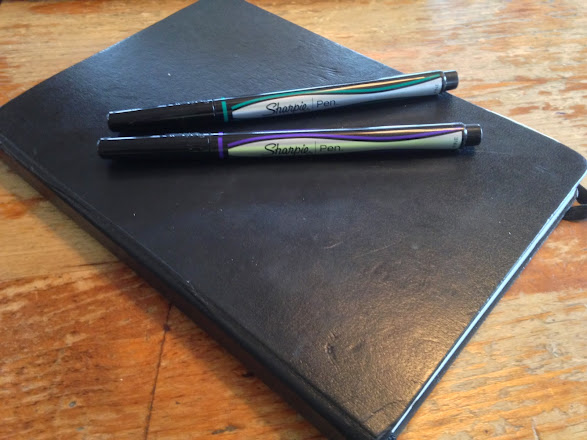
First things first… Here’s my notebook.

It’s a 5.75 x 8.25 inch Leuchtturm Medium Notebook with dots on the pages, and you can read more about it here. I love this notebook, but you don’t need it to bullet journal – any notebook will do.

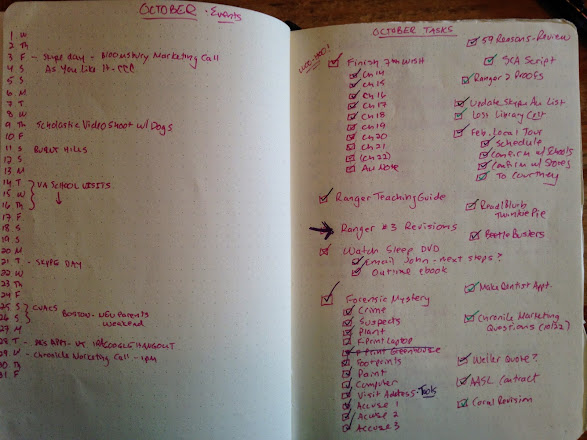
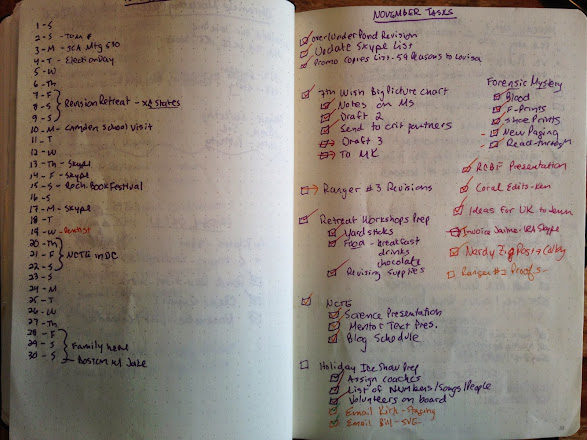
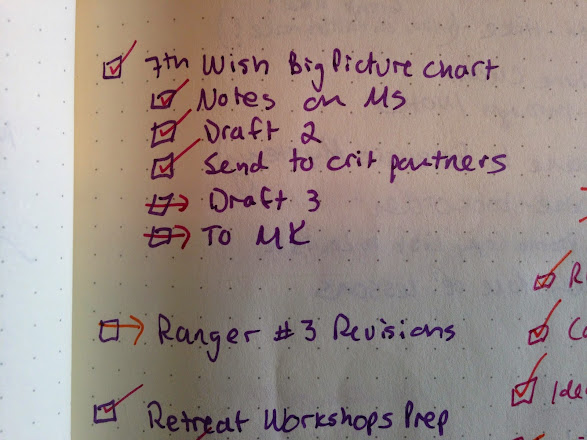
As the video suggests, I make a two-page spread for each month, with scheduled events on the left and a list of tasks for the month on the right. Here’s October – you’ll note that some tasks are broken down into smaller pieces, which keeps me from getting overwhelmed (and allows me to check things off even when I’ve just taken a small move toward completing the task. Baby steps!)

Here’s November:

As tasks are completed, I check the box next to each one.  If a task doesn’t get done in that month, it gets an arrow, showing that it’s been moved to the next month. I thought I might finish my 7th WISH novel draft in November (a girl can dream) so I put that on the list but ended up moving it to December. Ranger #3 revisions didn’t happen in October or November because my editorial letter didn’t come until later on. But I totally got to check that off in December, too.

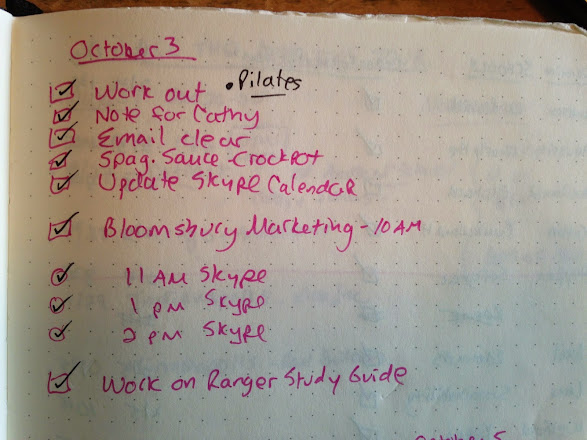
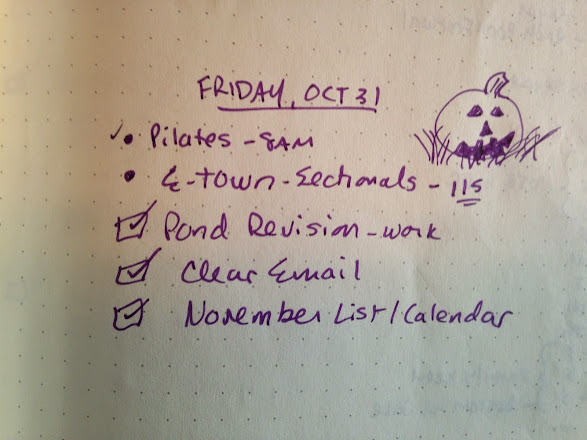
For each day of the month (most days, anyway) I make a separate entry with tasks & events for that day. I try to include everything that’s important to me – not only the work-related things that need to be done, but also my kids’ events, getting some exercise, and other things that I really want to do that day. Some – but not all of these things – are on the monthly task list, but others – phone calls, making spaghetti sauce for dinner – aren’t significant or long-term enough to warrant that, so they just pop in on the days when they come up.
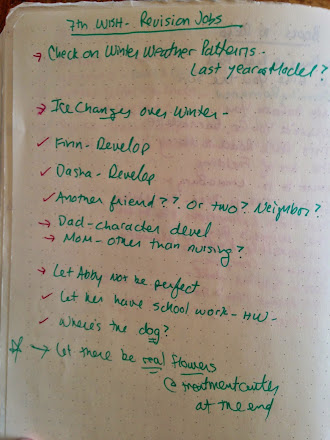
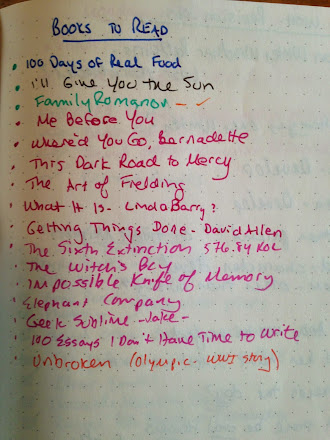
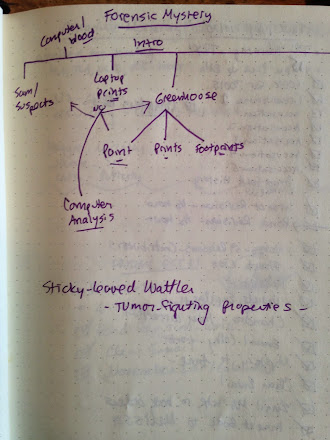
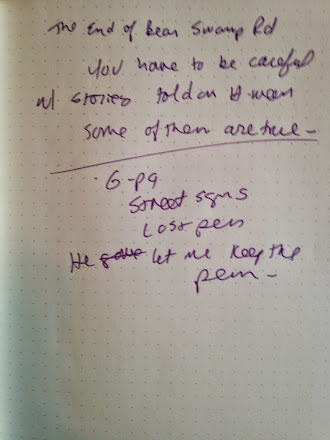
Aside from the monthly and daily calendars, I have lots of other pages in the notebook that I use for story ideas, organizational charts, phone call note-taking, grocery lists, manuscript notes, lists, etc.

(I promise you, the above scribbles make perfect sense to me. They’re lines & ideas for a maybe-story that occurred to me while I was driving to a school visit this week. I pulled over, scribbled them down in my bullet journal, and continued on my way.)

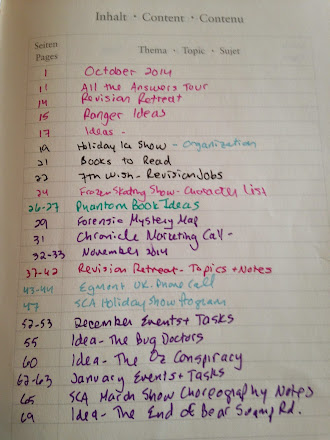
One of the reasons I chose the notebook I did was because it has page numbers and a table of contents in the front. Whenever I add an entry (other than the daily to-do lists), I add it to the table of contents so it’s easy to find later.

One thing you’ll notice here is the serendipitous nature of the whole thing – story ideas live side by side with phone call notes, brainstorming charts, grocery lists, and jobs I need to do in my role as a skating club parent volunteer.

After three and a half months of bullet journaling, I’m pretty much hooked. I am a particularly task-oriented person, so this system makes me more productive and less likely to fritter away time on social media, which is great, but it also forces me to own what’s important to me each day. If it goes in the bullet journal, it matters, and I’ve found that I’m more likely to honor my exercise plans and small writing goals when I write them down here. I’ve always kept paper to-do lists, but this is different, somehow, in its permanence. Today’s list doesn’t get tossed in the trash tomorrow, and for some reason, that adds to my motivation to keep those commitments.
I know some other writers & other book industry friends are trying this out in the new year, and I’d love to hear how it’s going for you so far!

New Books in 2015!

2015 will be my busiest book year ever, with seven new titles coming out!

I know…that’s a serious pile of books for just one year, but sometimes, things just work out that way. My new Ranger in Time series with Scholastic is on a two-books-a-year schedule, and two picture books that I wrote years ago are illustrated now and ready to meet the world. Add to that my 2015 novel, a new book for teachers and writers, and a calendar full of travel, and it’s going to be a pretty exciting year.

First on the calendar is RANGER IN TIME: RESCUE ON THE OREGON TRAIL, which releases January 6th in both hardcover and paperback, from Scholastic. This is the first in my new chapter book series, about a time-traveling search and rescue dog. His first mission is to help a family traveling west on the Oregon Trail in 1850.

School Library Journal featured Ranger in its Early Chapter Books to Cheer About feature: “This excellent story contains historical details, full-age illustrations, and enough action to keep even reluctant readers engaged. A wonderful author’s note at the end is full of quotes from authentic journals, factual information on search-and-rescue dogs, and suggestions for further reading. This is a stellar choice for readers just starting full-length chapter books and would be a hit with young history buffs and dog lovers as well.”

On January 13th, 59 REASONS TO WRITE comes out from Stenhouse. Officially, this is a book of mini-lessons, writing prompts, and inspiration for teacher-writers. But really…it’s for anyone who has always wanted to make more of a commitment to writing. You can preview this title here.

On January 27th, my new middle grade novel, ALL THE ANSWERS, comes out from Bloomsbury. It’s about an anxious 7th grader named Ava who finds a magic pencil that answers any question she asks. Almost. Booklist liked it —  “Although Ava is constantly worried, the novel’s tone remains bright and cheerful. Yes, there’s a magical pencil, but this remains an emotionally resonant portrait of a sweet girl whose struggles are firmly rooted in reality.” — and I hope you will, too.

I’ll be on tour for ALL THE ANSWERS from January 26th-February 6th – visiting schools and bookstores in Detroit, Chicago, Indianapolis, Minneapolis, Boston, Vermont, and Northern NY.  If you can’t make it to an event but would like to order personalized, signed copies of RANGER IN TIME or ALL THE ANSWERS, you can call The Bookstore Plus at 518-523-2950. I’ll be signing there on February 4th and will sign all pre-orders then.

In May, HOW TO READ A STORY comes out from Chronicle Books. It’s a playful celebration of the fine art of sharing a story aloud. This book has been a long time coming (I sold it back in 2011!), and I am so excited about how it turned out. Mark Siegel is responsible for the charming illustrations.

If you loved OVER AND UNDER THE SNOW, you’ll be happy to know that illustrator Christopher Silas Neal and I have a follow-up title coming in March.

 UP IN THE GARDEN AND DOWN IN THE DIRT explores daily life in a vegetable garden, spending time with a grandmother and child weeding and watering as well as the earthworms and beetles working away down in the dirt, doing their own part to keep the garden growing.

Some of my 2013-2014 Scholastic titles are coming out in paperback this spring, including the last two Silver Jaguar Society Mysteries. HIDE AND SEEK comes out in paperback March 31st. MANHUNT and MARTY MCGUIRE HAS TOO MANY PETS will be out in paperback April 28th.

The second Ranger in Time book launches this spring, too.

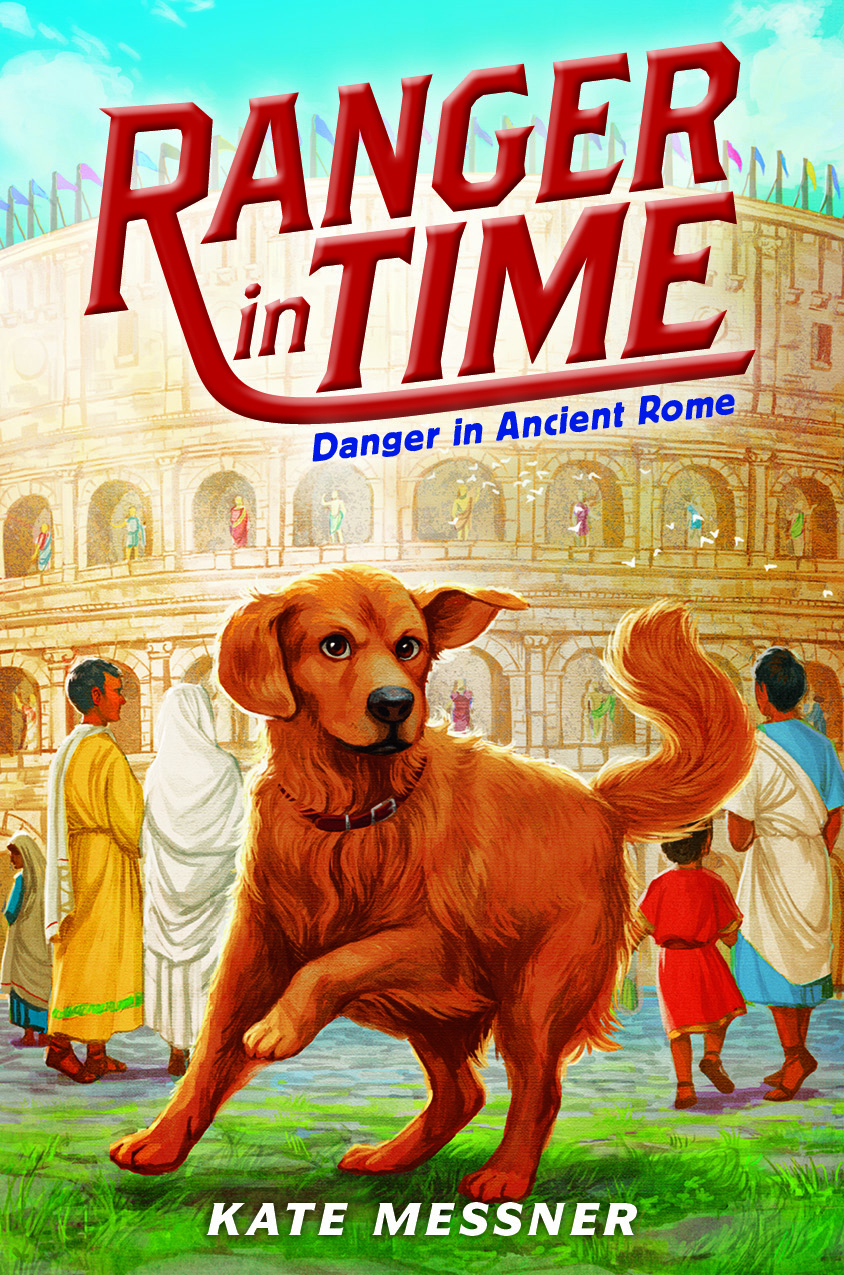
RANGER IN TIME: DANGER IN ANCIENT ROME will be out June 30th. Also a simultaneous hardcover/paperback release, this book sends Ranger back to the days of gladiator fights at the Roman Colosseum.

I plan to spend my entire summer sitting beside Lake Champlain with a cool drink in my hand, recovering from all of these book releases. (Not really. I’ll also be writing and hopefully traveling to research a new project.)

Then, in the fall, TREE OF WONDER comes out from Chronicle. I don’t have a final cover yet, but here’ s a peek at the incredible art…

Screen Shot 2015-01-02 at 3.56.20 PM

This picture book, illustrated by Simona Mulazzani, celebrates biodiversity and math as it explores the multiplication of life in a single rainforest tree.

I’ll be visiting a number of schools, libraries, bookstores, and festivals throughout the year. You can find my appearance schedule here, and if you’re near one of the cities I’ll be visiting, I do hope you’ll come say hi and introduce yourself.

Happy 2015!