Meet THE KIDS IN MRS. Z’S CLASS – an exciting new multi-author series launching in April ’24!
One third grade classroom.
18 amazing kids.
18 secrets.
18 stories, each written by a different beloved author.
I’m absolutely thrilled to be heading up this new series with an incredible team of authors, along with Pura Belpré Honor illustrator Kat Fajardo and the team at Algonquin Books for Young Readers.
I’ll be writing the first and last books in the series as well as coordinating the team and our overlapping stories. Book one, EMMA MCKENNA, FULL OUT and book two, ROHAN MURTHY HAS A PLAN by Rajani LaRocca come out together on April 30, 2024.
And here’s even more exciting news…
After the series launch, Rajani and I will be hitting the road together to visit schools all over New York and New England! We’ll share a sneak preview with readers, offer a look behind the scenes at our writing process, and lead kids in a writing workshop to develop their own characters for collaborative writing with their friends.
We’ll also be offering a virtual author visit option for schools around the country, including a recorded author visit to share with readers this spring AND an invitation to participate in live Q&A at a Zoom webinar with series authors in October 2024.
It’s hard to believe that Teachers Write wraps up this week! Today, we’re talking about one of the things that makes a poem different from prose — the way it looks on the page. Mentor poet Margarita Engle joins us for a mini-lesson on line breaks.
The Power of Line Breaks in Free Verse
Line breaks are one of the most misunderstood aspects of poetry. Beginners often attempt to write verse novels by simply inserting random line breaks into prose. Since poetry is musical, arbitrary line breaks cannot substitute for the varied rhythms and melodies of free verse. Even when there is no meter or rhyme, music is created with poetic devices such as similes, metaphors, onomatopoeia, alliteration, assonance, and the open spaces between lines and stanzas.
One of my favorite things about free verse is the way open spaces are not empty. They are used by the poet to create a mood, ask unspoken questions, even suggest the possibility of invisible answers. Open spaces are interactive—a place where the minds and emotions of poets and readers meet in midair.
I hope teachers never ask young readers what my poems mean. Please ask “how does the poem make you feel’ instead. That way, children and teens won’t be intimidated by poetry. They might even respond to open spaces by writing their own responses, or drawing pictures, or performing a dance, or joining a climate action club. I think of this powerful interaction as resonance, like the echoes after ringing a bell. Resonance can only be heard by listening. In other words, the line and stanza breaks invite us to pause, listen, imagine, question, wonder…
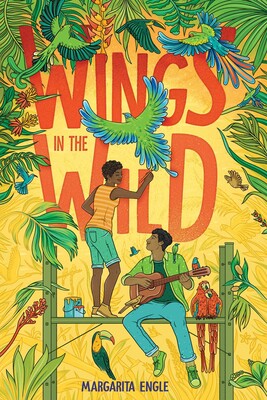
Here is an example from my new young adult verse novel, Wings in the Wild. Dariel is a climate refugee from California, and Soleida is a refugee from Cuba. They meet in Costa Rica, where they fall in love.
FOREST STROLL Dariel
fingers entwine
sunlight and mist
our voices become smiles
air lips kiss
I like to imagine a young reader listening to the gentle resonance of this tiny poem. Maybe they’ll ask the same question I have about climate action: Is there hope? Maybe they’ll hear the same unspoken answer: Yes, because people who love each other care about survival.
Today’s assignment: Choose one of the poems you’ve drafted this summer to read aloud. Take some time to play around with the line breaks. Experiment. How do different choices affect the poem?
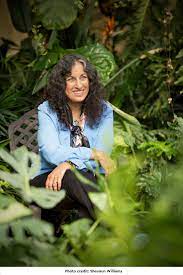
Margarita Engle is the Cuban-American author of many verse novels, memoirs, and picture books, including The Surrender Tree, Enchanted Air, Drum Dream Girl, and Dancing Hands. Awards include a Newbery Honor, Pura Belpré, Golden Kite, Walter, Jane Addams, PEN U.S.A., and NSK Neustadt, among others. Margarita served as the national 2017- 2019 Young People’s Poet Laureate. She is a three-time U.S. nominee for the Astrid Lindgren Book Award. Her most recent books are Wings in the Wild and Destiny Finds Her Way. Her next young adult verse novel is Wild Dreamers, and her next picture books are Water Day and The Sculptors of Light. Margarita was born in Los Angeles, but developed a deep attachment to her mother’s homeland during childhood summers with relatives on the island. She studied agronomy and botany along with creative writing, and now lives in central California with her husband.
Note from Kate: Teachers Write has always been and will always be free, but it does take many hours of work from me and our guest authors. Please say thanks by buying our books!
Reading aloud is a great way to revise a poem, listening for the magic. The sounds that make a line sing. As today’s mentor poet Nikki Grimes tells us, poetic devices such as alliteration and assonance help to create that magic.
Tiny Tricks to Make Your Writing Sing
Using words with the same letter or sound in close proximity—whether words with the same/same sounding consonants, or the same long vowel sounds—makes your writing sing. In the following poem, I’ve underlined such consonant pairings, and set a few paired vowel sounds in italics. This is “Sweet Sister” from Legacy:Women Poets of the Harlem Renaissance.
Clay creatures, we forget our sisterhood with earth as if we could survive without her nourishment. Iknow better, but did I always? I thank her now. Sink your teeth into a peach, and so will you! Imagine a world without rosemary or rose, even for a moment. Where would the flavor or the fragrance be? How we’d miss the quiet pleasure earth brings to nose and tongue, of which we are not worthy. Earth, your generosity deserves to be met with Love’s language.
This simple trick is very effective. It’s especially noticeable in passages that include a list or a series of things, like fruit. In such a passage, I might choose fruits that all begin with the same letter or same sound: Peaches, pears, and pomegranates vs. plums, oranges and strawberries, for example. If I needed a list of flowers, I might choose roses, ranunculus and rain lily; or lady slipper, lavender, and lantana. Such groupings create their own music.
Finally, the most important open secret to creating lyrical language is to listen. Play with word groups and then listen to them. Your own ear will tell you when the words begin to sing. You won’t need anyone else to tell you that!
Today’s assignment: Go back to one of the poems you’ve written this summer. Read it aloud and look for places where playing with the sounds might enhance the music and meaning of what you wrote.
Bestselling author Nikki Grimes received the Virginia Hamilton Lifetime Achievement Award, ALAN Award for teen literature, Children’s Literature Legacy Medal, NCTE Award for Excellence in Poetry, and the Coretta Scott King Award. Recent titles include Legacy: Women Poets of the Harlem Renaissance, Playtime for Restless Rascals, and Garvey in the Dark.
Note from Kate: Teachers Write has always been and will always be free, but it does take many hours of work from me and our guest authors. Please say thanks by buying our books!
One of the great things about being part of a writing community is that we’re constantly learning from one another. Today mentor poet Rajani LaRocca shares a challenge that’s all about how putting constraints on our writing can spark creativity — an exercise she learned about in a workshop with award-winning author K.A. Holt.
Say It Without Saying It
In poetry and verse novels, we use figurative language and sensory detail to evoke emotion—and to say things without being too on-the-nose. During a recent conference, amazing author K. A. Holt shared this exercise, and I absolutely loved it.
First, grab a random object from nearby.
Now take 5 minutes and using single words, describe this object.
Here’s an example of what I did. My object was a fork. Here’s how I described it:
Silver Metallic Pointy Barbed Shiny Cold Hard Smooth Ridged Heavy Weighted Warped
Now, for the second part. Take five minutes and write a poem about the object—but you’re not allowed to use any of the words you used to describe it!
Here’s the poem I wrote. It was kind of about the fork, but it was also about something else entirely:
You were supposed to be useful, my helpful friend. But instead you punctured me when I wasn’t prepared You wounded me where I was tender And me taste my own iron.
How did it feel to write a poem with some constraints? Was it challenging? Did it evoke emotion? Did it surprise you?
Rajani LaRocca was born in India, raised in Kentucky, and now lives in the Boston area, where she practices medicine and writes award-winning books for young readers. Her middle grade novel in verse, Red, White, and Whole, is the winner of the 2022 Walter Dean Myers Award and a 2022 John Newbery Honor. She’s always been an omnivorous reader, and now she’s an omnivorous writer of fiction and nonfiction, novels and picture books, prose and poetry. She finds inspiration in her family, her childhood, the natural world, math, science, and just about everywhere she looks. Learn more about her at www.RajaniLaRocca.com.
Kari Anne Holt has dedicated her writing career to making sure kids (and adults) understand that anyone can be the main character of a book, and everyone deserves to see themselves reflected on the page. From her award-winning middle grade novels-in-verse, Ben Bee and the Teacher Griefer, Redwood & Ponytail, Knockout, House Arrest, and Rhyme Schemer, to her prose novels From You to Me and Gnome-a-geddon, to her picture book, I Wonder, illustrated by Kenard Pak, KA Holt’s readers will discover main characters that struggle, celebrate, wonder and discover in ways both new and familiar.
Note from Kate: Teachers Write has always been and will always be free, but it does take many hours of work from me and our guest authors. Please say thanks by buying our books!
This week, we turn our attention from poetic forms to subjects. Mentor poet Rajani LaRocca joins us with a challenge to write about names.
What’s in a Name?
Names are important in the real world and in fiction. When I write, I do a lot of research when I’m trying to choose character names. In verse novels in particular, the way that characters think about their names can reveal important aspects of who they are.
Consider these poems from Red, White, and Whole:
And these poems from Mirror to Mirror:
Think about what each of these poems reveals about the characters. How do they feel about their names—are they something to be proud of, burdens, calls to action, or something else?
Now consider this writing prompt:
Choose a name that means something to you—it could be your own, or the name of someone close to you. Take five minutes and write a poem about what that name means, and what it means to you.
Rajani LaRocca was born in India, raised in Kentucky, and now lives in the Boston area, where she practices medicine and writes award-winning books for young readers. Her middle grade novel in verse, Red, White, and Whole, is the winner of the 2022 Walter Dean Myers Award and a 2022 John Newbery Honor. She’s always been an omnivorous reader, and now she’s an omnivorous writer of fiction and nonfiction, novels and picture books, prose and poetry. She finds inspiration in her family, her childhood, the natural world, math, science, and just about everywhere she looks. Learn more about her at www.RajaniLaRocca.com.
Note from Kate: Teachers Write has always been and will always be free, but it does take many hours of work from me and our guest authors. Please say thanks by buying our books!
Welcome back to Haiku Week at Teachers Write! Today, mentor poet Loree Griffin Burns shares her own haiku experience and offers up a writing challenge with lots of bonus resources to explore!
Finding Haikus
My haiku journey began in the summer, near a beach in Rhode Island. Not on the beach, because it was raining there and had been for days. But in a library near the beach, where a used book sale was underway. I was coaxing three kids through another wet vacation day with a new- to-them book when a slim paperback about writing haiku—Seeds of a Birch Tree by Clark Strand—caught my eye. It was an impulse buy. Twenty-five cents. The kids and I carted our books back to our rented cottage and read for the rest of the day.
“As haiku poets, we begin simply,” Strand wrote in his book, “by carrying a notebook and walking in nature every day.”
The next morning, I got up before everyone. I walked a notebook into the yard behind the cottage and sat on a damp, wooden chair. I planted my bare feet in wet grass, considered the salty mist, tuned into the ocean nearby. I wrote my first haiku.
I’ve been writing them ever since.
Most of us know learn that these small poems have a precise three-line structure: five syllables in the first line, seven syllables in the second, five syllables in the third. Some of us know they are small poems that somehow feel big. But did you know that in Japan, where haiku evolved from older forms, the poems always include a season word? Hot or hammock let a reader know a poem was written in summer and words like chilly or harvest moon say fall. Snow and New Year’s Eve are season words for winter, mud and dandelion for spring. This aspect of the traditional haiku form was completely new to me. And thrilling.
I started bringing a notebook everywhere, stopping to scribble when I saw something that felt like the start of a haiku. I composed in the woods or the garden or the carpool line, tapping out syllables with my fingers. I filled a first haiku notebook. I started a second. And as I did, I remembered how to savor the world around me.
outside after dark— even the songbirds struggle to let this day go
taken in their prime by a friendly guy and his mower: cornflowers
endless autumn rains flatten even the cardinal and the titmouse
stopping a minute to collect flakes on my tongue— fiftieth winter
The season words in the poems above are songbirds (spring), cornflowers (summer), autumn (fall), and flakes (winter). I’ve come to see season words as the most magical part of the form. These words connect me to deeper pasts, to the winters and summers recorded by other humans—my peers and my teachers, but also complete strangers and long-dead haiku poets writing in languages I don’t speak. I’ve always been part of this continuum, even before the rainy vacation and the twenty-five cents. I just didn’t realize it before I began paying attention. Before I started writing haiku.
Surely you’ve guessed where this is going? Your Teachers Write assignment for today is simple: find a haiku. Start by getting outside. Bring a notebook or a camera if you like. Pay attention to what catches you up, what pulls at your imagination. When you find your something, make a note or snap a picture. Later, when you have some quiet time to get creative, pull out your notes and your pictures. Look over this list of season words. Are there any that tie your recorded haiku moment to the season you are writing in? Let yourself play.
See if you can fit what you saw or heard or smelled or sensed in that resonate moment into the delicate seventeen- syllable container of a haiku.
Resources for the haiku curious:
Seeds from a Birch Tree: Writing Haiku and the Spiritual Journey, by Clark Strand (25 th Anniversary Edition, Monkfish Books, 2023)
The Essential Haiku: Versions of Basho, Buson, and Issa, edited by Robert Hass (HarperCollins, 1994)
The Haiku Handbook: How to Write, Teach, and Appreciate Haiku, by William J. Higginson and Penny Harter (Kodansha, 2013)
Haiku Mind: 108 Poems to Cultivate Awareness & Open Your Heart, by Patricia Donegan (Shambala, 2008)
Haiku: This Other World, by Richard Wright (Anchor Books, 1998)
Loree Griffin Burns writes books that celebrate our natural world and the people who study it. While researching her award-winning science books for children, she has beachcombed on both coasts, cruised the Pacific in search of plastic, surveyed birds in Central Park, stung herself with a honeybee, visited the wintering grounds of the monarch butterfly (on horseback!) and lived for a week on an uninhabited volcanic island in Iceland. Recently she’s been studying the insects that live in her neighborhood, work which inspired the picture books You’re Invited to a Moth Ball and Honeybee Rescue. Loree also teaches in the Writing for Children and Young Adults program at the Vermont College of Fine Arts. Learn more at www.loreeburns.com.
Note from Kate: Teachers Write has always been and will always be free, but it does take many hours of work from me and our guest authors. Please say thanks by buying our books!
2. Some of our Teachers Write campers are involved in a project that explores poetry and healing, and they’d love for you to fill out their survey if you have time. From Denise Krebs:
Teachers Write friends, We are a group of teachers who write poetry at EthicalELA.com, an open online writing community founded by Dr. Sarah Donovan of Oklahoma State University. Currently we’re in the process of creating a publication of stories of poetic healing along with prompts for teachers and students of middle grades through college students. If you are an educator who writes poetry and shares poetry with students, we are hoping to hear from you. Please help us make this the best collection it can be by taking our survey at: https://okstateches.az1.qualtrics.com/jfe/form/SV_0kwyrahDjPxZdoW
Welcome back to Teachers Write, friends! I hope you had a great weekend and are ready to write. This week, we’ll be focusing on haiku, a form many of us learned in grade school, but now it’s time to take our three-line poems to another level. Mentor poet Joseph Bruchac joins us for today’s mini-lesson!
Attempting Haiku
Let’s try writing haiku. It’s something that I do often. I’ve attempted to write at least one haiku every day for the last three years.
Haiku? Are you kidding me?
Yes, I know, it’s probably something you’ve already done. Haiku is perhaps the most used —or, perhaps, overused — poetic form in the world today. But let’s look at it another, fresher way. See it as my first haiku teacher Tai-yuk Kim did in a class I took from him 50 years ago. Not just an exercise in syllables but an interaction with the natural world — of which we are a part.
Not something devoid of meaning such as this
I can write haiku. Just 17 syllables there, see I did it.
No, I didn’t.
I’m sitting right now on my porch. It’s easy for me to write haiku here. Our cabin is in the middle of a 20-acre nature preserve that includes a 7 acre pond. It’s only 3 miles from the hill where my grandfather was born. I’m not just surrounded by inspiration, I’m almost drowned in it.
So, let me write (actually, to be honest, dictate into my phone) something that reflects what I’m seeing right now.
Chestnut leaves flutter. Pine trees dance in summer wind. Green everywhere.
I am using the 5-7-5 syllable form that has become so common in English haiku. A total of 17 syllables. It’s the form used in haiku written in Japanese haiku–though not as three lines, but as one single line.
I’m not always satisfied with the translations from Japanese to English. For one, they usually don’t sound anything at all like the original. Let’s take the most famous poem by Basho about that frog jumping into a pond and making a sound. I bet you’ve seen translations of it. But have you ever looked at it in the original Japanese 17 syllables and read it aloud? Here it is:
furu ike ya kawazu tobikomu mizu no oto
The way a haiku sounds is as important to me as the way it looks. And by the way it looks I don’t mean just that it’s in 17 syllables, but that a picture is painted, and that there is a moment in that picture that was described to me as the “ah-ness moment.” (Which, the first time I heard it said to me in the slightly accented English, but absolutely correct English of Tai-yul Kim I heard it as the “honest moment” Neat, eh. Actually, that could be another subject for poetry. A poem written based on hearing something and misunderstanding it.)
Here are some of some of the “rules” that might be followed when writing a haiku in English.“ (Although, of course, some rules are made to be broken. In many haiku in Japanese, you’ll find the word “kana,” which has no literal meaning–but just adds two more syllables, is commonly used.)
1. It represents an experienced moment. 2. No similes or metaphors. Nothing is compared to anything else, but is itself. 3. Draw from nature. 4. Paints a verbal picture or a series of pictures. 5. It may lead to a moment a bit like that called “Beginner’s Mind” in Zen Buddhism, seeing things as if for the first time. 6. 17 syllables in 3 lines, written 5-7-5. (This is the “rule” most often ignored.)
In writing your own haiku you might even try, as I do, to avoid the use of articles. Words such as “the,“ “a” and so on. You don’t find those words used in a lot of languages, such as Japanese, Chinese, and the Abenaki language my Native ancestors spoke and my son Jesse teaches. (We also do not have sexist pronouns, just using the word awani, but that’s another story.)
Though you may not live as I do, remember that everywhere we go nature is with us. Pay attention to the smallest things and you may see what I mean. Everything, from your heart beat to the tiniest insect buzzing to get out through your windshield, is linked to that great continuum.
So, here’s your exercise. Take a deep breath, look and listen. Then attempt a haiku.
Writer, musician, and traditional storyteller Joseph Bruchac is a citizen of the Nulhegan Abenaki Nation and member of their Elders Council. His honors include a NYS Poetry Fellowship, a National Endowment for the Arts Writing Fellowship, a Rockefeller Foundation Fellowship, the American Book Award, the NEA Civil Rights Award, the National Wildlife Federation Award, and the Lifetime Achievement Award from the Native Writers Circle of the Americas. He’s written over 180 books, including Code Talker, which was selected by Time magazine in 2022 as one of the 100 best YA books of all time.
Note from Kate: Teachers Write has always been and will always be free, but it does take many hours of work from me and our guest authors. Please say thanks by buying our books!
Welcome back, campers! Did you get a chance to play around with a found poem or two after Monday’s post? If not, no worries – you can return to earlier posts any time throughout the summer and beyond. Today, mentor poet Laura Ruby joins us with another challenge to experiment with poetic forms.
Hermit Crabs and Angry Food
When I was young, my mom would sometimes cook angry food for dinner. What is angry food, you ask? Well, angry food is food made with the weariness that comes from having to plan and prepare meals every day plus resentment that you’re the one tasked with the job in the first place. Angry food came in the form of casseroles made with Campbell’s Cream of Mushroom soup and Minute Rice, meatloafs like oversized, overcooked, under-seasoned burgers, flabby purple canned beets—always beets; to this day I can’t eat them—gray beans so soft you could suck through your teeth. Not every meal featured angry food. Only those times when my mother was most overworked and aggravated did she start slinging the casseroles and the (endless) canned beets. But I never forgot any of it.
My mom’s been sick lately, so I’ve been staying with her. It’s become my job to plan and make dinner. Though she generally enjoys my food, she still prefers her vegetables to be steamed soft and nearly colorless. We had an argument over how to cook broccoli. (She won). I wanted to write a poem about this, and about angry food in general, but I wasn’t sure how to approach it. Nothing seemed to work. My poem about angry food was not tender or wise or revealing, it was just…cranky.
And then I remembered a Lantern Review post a friend in my MFA program recommended. In this post, the poet Rick Barot wrote about a type of poem he called the “hermit crab poem.” From the post: “The prompt is a simple one. Write a poem that utilizes the structure of another text: one page of a screenplay, a multiple-choice quiz, an entry from the Oxford English Dictionary, and so on.” Using the form/format of another type of writing to contain your poetic material is a way to both get some distance on that material AND get at the emotional truth of the material. In other words, it’s an effective way of telling your story “slant.”
I love writing hermit crab poems. I especially like writing poems in the form of lists, but I’ve also written poems in the form of lab reports, recipes, travel guides, endnotes, etc.
Ready to experiment with a hermit crab poem of your own?
Some potential “crab shells” that you might want to try: a speech, list of rules, a disclaimer, fine print, field notes, recipes, dictionary entry, encyclopedia entry, multiple choice test, grocery list, owner’s manual, building instructions, letters of recommendation, ads, jingles, doctor’s note, scientific abstract, playlist, or even a weather report.
A two-time National Book Award Finalist and long-time teacher, Laura Ruby writes fiction and poetry for adults, teens and children. She is the author of the Printz Medal Winning novel Bone Gap, as well as Thirteen Doorways, Wolves Behind Them All. Other works include the Edgar®-nominated children’s mystery Lily’s Ghosts, the ALA Quick Pick for teens Good Girls (2006), and the York trilogy. Her poetry has appeared or is forthcoming in Diode, Sugar House Review, Fantasy Magazine, Poetry South, The Dallas Review, The Nassau Review, Passengers Journal, Prism Review, and Clackamas Literary Review. She is on the faculty of Queens University’s MFA program and Hamline University’s MFAC program. She makes her home in the Chicago area.
Note from Kate: Teachers Write has always been and will always be free, but it does take many hours of work from me and our guest authors. Please say thanks by buying our books!
Welcome to Teachers Write 2023! It’s day one of our online summer writing camp, and whether you’re new to Teachers Write or a returning camper who’s been writing with us for years, I’m so glad that you’re here, that you’re making a commitment to write this summer. For yourself and for your students, who always benefit when their teachers walk the walk and explore their own writing instead of just handing out assignments.
Before we get started, a few quick housekeeping things… Teachers Write is meant to be a joyful and low-stress experience, and you’re welcome to participate as much or as little as you’d like. Need to take a week off for vacation or family obligations? No worries. The writing will wait for you. And these posts will be available during the school year, too, so you can share your favorites with your students.
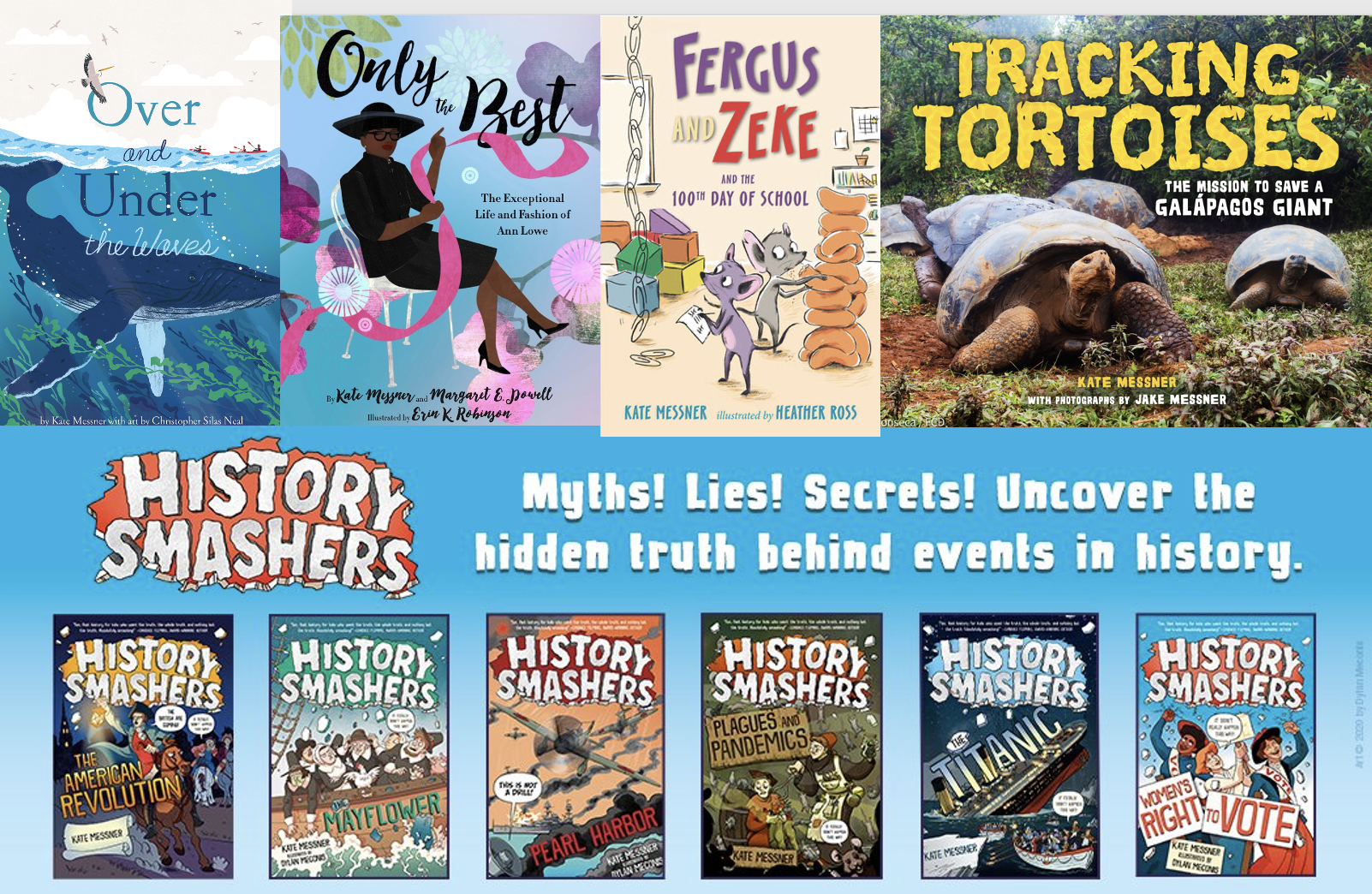
Teachers Write has always been and will always be free. But it does take many hours of work from me and our mentor authors, so if you can, we’d ask that you say thanks by buying our books this summer.
I have two new titles coming out in August – a hilarious picture book called THE SCARIEST KITTEN IN THE WORLD illustrated by MacKenzie Haley… (I promise it will become one of your favorite read-alouds!)
…and HISTORY SMASHERS: CHRISTOPHER COLUMBUS AND THE TAINO PEOPLE, co-authored by Dr. José Barreiro and illustrated by Dylan Meconis (cover art) and Falynn Koch (interior illustrations). This one smashes all the myths we were taught about the famous explorer and introduces readers to the true story of the Taino, the people who discovered Columbus when he got lost exploring the Caribbean.
Just click the covers to order your copies from my local independent bookstore. And I’m happy to sign and personalize them for you and your students! Just make a note in the order comments about how you’d like your books signed.
Finally, I want to introduce you to the teacher-writer who helped launch this summer camp, Jen Vincent! She’ll be hosting our Friday check-ins on her blog, teachmentortexts.com. It’s an amazing opportunity for you to share your writing from the week and connect with other campers.
Jen Vincent (she/her/ella) is a writer, blogger, and educator. She is a Middle School Language Arts Teacher for Bannockburn School, a K-8 district in a northern suburb of Chicago. She hosts Weekly Check-Ins for Teachers Write, co-hosts kidlit It’s Monday! What Are You Reading?, writes articles for Choice Literacy, and blogs at teachmentortexts.com. As the founder of Story Exploratory, she helps writers face their self doubt, tackle their inner critic, and brave the blank page so they can set their story free. You can find her on Instagram at @jvincentwrites and @storyexploratory.
Okay…on to the reason we’re all here. Let’s get writing! This summer’s focus is on poetry and play, so we’re going to start with a fun poetry assignment.
My current work in progress is a novel in verse called THE TROUBLE WITH HEROES, about a kid who vandalizes a cemetery and, as restitution, finds himself sentenced to climb all forty-six Adirondack High Peaks with a dog he just met. I’m using a wide variety of poetic forms in this book, including found poems, which the American Academy of Poets explains like this:
Found poems take existing texts and refashion them, reorder them, and present them as poems. The literary equivalent of a collage, found poetry is often made from newspaper articles, street signs, graffiti, speeches, letters, or even other poems.
I decided to use AllTrails reviews as the source for my “collage” poems. Here are two examples (from a hike that didn’t go as planned for my main character, Finn).
How Hiking Mt. Marcy Was Supposed to Go (A found poem from the AllTrails reviews)
Trail: well marked and easy to follow. Weather: Cool. Visibility: Perfect bluebird day. Summit: Endless mountains as far as the eye can see in every direction.
My first 46er! I’ll never forget it. What a hike! It took exactly eight hours to Kick NY’s highest peak’s butt! *
* The AllTrails review used a different word, but the last thing I need is for some smug judge to sniff at that and toss out my notebook so I have to start all over. There’s no way I’m climbing these stupid-butt mountains with this lazy-butt dog again.
How Hiking Mt. Marcy Actually Went – Part I (Also a found poem from the AllTrails reviews)
Got a late start at 11:20AM. Weather was supposed to be great. Things change quick in the ADK.
Advised by a park ranger There was a rainstorm brewing. Wouldn’t be the safest.
You need waterproof hiking boots and Microspikes are a must. Pack layers. A water filter. Bring headlightsextrasockshikingpolesgators. Some ace bandages in case ya roll an ankle.
(I did none of this.)
How Hiking Mt. Marcy Actually Went – Part II (Another found poem from the AllTrails reviews)
Cold temps. Adrenaline crash. Brutal lost-the-trail wandering through socks-wet snow.
My first 46er. I’ll never forget it. A pitch-black, had-to-turn-back Failure This mountain kicked my butt.
Every word in these poems (except the one line in parentheses and the footnote) was pulled from an AllTrails review of this particular hike. I scoured hundreds of reviews on the app, collecting words and bits of phrases to reorder and remix. From the language of hundreds of tired hikers, I curated three poems to fit my character’s experience, to create these word-collages in his voice.
Ready to give it a try? Decide where you’d like to collect words for your found poem. You can use a favorite novel, a cookbook, directions for putting together that Ikea bookshelf, a field guide, the highway signs on your summer road trip, your kid’s report card comments….the possibilities are endless. Just make sure your source fits your subject matter. And have fun!
Feel free to share your found poem in the comments if you’d like – and be sure to let us know the source for your words!
Happy Summer, friends! Our new session of Teachers Write begins on Monday, and I couldn’t be more excited about the summer of writing that’s in store. Our focus this year is Poetry and Play. I’ll be kicking off the summer with a mini-lesson on found poems that includes a sneak-preview excerpt from my current work in progress, a novel-in-verse called The Trouble with Heroes . But I’m even more excited to introduce you to the amazing mentor poets who will be joining us this summer with mini-lessons and writing prompts on everything from haikus to poetic forms and devices, the power of names, line breaks, and revision.
Teachers Write has always been and will always be free, but we’d love it if you’d say thanks to our guest authors by supporting their work. Check out this amazing team of mentor poets!
JOSEPH BRUCHAC
LOREE GRIFFIN BURNS
MARGARITA ENGLE
NIKKI GRIMES
RAJANI LAROCCA
LAURA RUBY
I’m incredibly grateful to this dream team of talented poets for sharing strategies with us all.
Now sharpen your pencils and dig out your notebook or charge your laptop so you’ll be all ready for a summer of Poetry and Play. Teachers Write begins on Monday!