Countdown to BREAKOUT: Blue ribbons and point of view

Countdown to Breakout is a 23-day blog series about the three-year writing process for BREAKOUT, which earned starred reviews from both School Library Journal and Publishers Weekly. It’s about a small-town prison break and manhunt that change the way three kids see their neighbors and the place they call home. Why a 23-day series? Because this book was inspired by the 2015 Clinton Correctional Facility prison break that led to a 23-day manhunt in June of 2015.

Blue ribbons and point of view

If I’ve noticed anything in talking current events with people from around the country this past year, it’s that sometimes, two people can hear the same speech or read about the same incident and come away with completely different perspectives on what was said or what happened. That was an idea I knew I wanted to explore in BREAKOUT.

When our real-life Northern New York prison break manhunt was underway, people reacted in lots of different ways – with fear and anxiety, with shows of support for the searchers, and in some cases, with a new apprehension about anyone who seemed different. I paid attention to all of that and thought about how people from different backgrounds might view things like a blue ribbon tied on a tree as a show of support for law enforcement…

…or a request to deliver snacks and bottled water for police manning roadblocks.

How might those public shows of support be seen by a kid like Elidee, the sister of a prison inmate, who came from a city neighborhood where community relations with law enforcement were tense?

How might she see this sign, which I saw posted on a lot of social media pages around the time of the prison break?

This one was especially interesting to me, because in a sense, it divides the entire population of a community into three categories: prison inmates (referred to as “monsters”), law enforcement (the “we” of the quote), and “the weak” (everybody else). I understood why relatives of corrections officers would love the saying, especially at a time when their loved ones were facing criticism, even as they put their lives on the line in the manhunt. But I also wondered how those signs might feel to the relatives of prison inmates. I ended up using this as one of the documents that different characters talk about in the book.  I also included the top-secret “Operation Michigan,” which we’ll talk about tomorrow. Here’s your writing prompt for today:

Your assignment: Write for a few minutes, reflecting on the “monsters and the weak” quote.  You can write from your own perspective, or take on the voice of a corrections officer, prison inmate, inmate’s relative, or civilian.

Thanks for joining me on this part of the Breakout writing-process journey! If you’d like to read the other posts in this series once they’re all posted, you can find them here.  
Breakout cover image

Buy BREAKOUT now:


Countdown to BREAKOUT: Making room for serendipity

Countdown to Breakout is a 23-day blog series about the three-year writing process for BREAKOUT, which earned starred reviews from both School Library Journal and Publishers Weekly. It’s about a small-town prison break and manhunt that change the way three kids see their neighbors and the place they call home. Why a 23-day series? Because this book was inspired by the 2015 Clinton Correctional Facility prison break that led to a 23-day manhunt in June of 2015. 

Making Room for Serendipity

I was on an airplane on my way home from the NCTE conference in 2015 when I met a stranger who ended up helping me reimagine my BREAKOUT rewrite.

I was sitting next to my writer pal Linda Urban, talking about how I wanted to start the book over, rewriting it as a collection of documents, and Linda was helping me brainstorm. When we first sat down, the woman on the other side of me was reading a book. But after a while, I noticed that she’d put it down and seemed to be listening, so I turned to let her know why her seat mates were blabbing on and on about school field days and news reports about police searchers.

She was a teacher, coming home from the conference, too. She was excited to hear that we were authors, talking about a novel-in-progress, and asked what it was about. I explained that it was about a prison break, inspired by the real life prison break at Clinton Correctional Facility in Northern New York, which was close to where I lived. When I named the prison, her eyes lit up with recognition, and I said, “Oh! You heard about this on the news?”

“Yes,” she said. “My brother is an inmate at that prison.”

My mouth dropped open. When I regained my composure enough to talk, I shared with her that my character Elidee’s brother was an inmate at the prison in Wolf Creek, too.

“Wow,” she said.

“I know,” I said. And then I took a deep breath and took a risk.

“Is there any way you might consider talking with me more about this? I’d love to have your perspective on this story.”

She nodded. “Yes, I think I’d like to do that.” She paused, and then said, “I feel like I was supposed to sit next to you today.”

My next question: “How long is your layover in Philadelphia?”

It was long enough that she had time for dinner, so we found a restaurant, ordered, and talked. She told me about her brother’s experiences and what it had been like to grow up with an older sibling who got in trouble with the law, how she’d felt pressure to be extra good to make things easier on her mother. I told her what I’d written so far, including the detail that Elidee and her mom had moved to Wolf Creek to be closer to her brother in the prison. She frowned a little. “Not sure I buy that unless she has another connection there and knows it’ll be okay. Does she know someone?”

She didn’t. But she could. What about a friend from home who’d moved there the year before? My new friend nodded. That would work, she said. And maybe give her a church community, too. That would help.

Eventually, we had to leave for our gates, but we kept in touch, and she offered to read the new version of BREAKOUT when it was ready. I still get chills when I think about how with all those flights home from NCTE, and all those seats on the plane, I ended up sitting next to her. I’m so grateful that she was open to talking with a stranger, to share her story. She provided a perspective I simply didn’t have.

Tomorrow, I’ll share more about my challenges with point of view and perspective in BREAKOUT.  Here’s today’s prompt:

Your assignment: Spend five minutes writing about a moment of serendipity in your life, as it relates to writing or something else.

Thanks for joining me on this part of the Breakout writing-process journey! If you’d like to read the other posts in this series once they’re all posted, you can find them here.  

Breakout cover image

Buy BREAKOUT now:


Countdown to BREAKOUT: It takes a village (of writer friends!)

Countdown to Breakout is a 23-day blog series about the three-year writing process for BREAKOUT, which earned starred reviews from both School Library Journal and Publishers Weekly. It’s about a small-town prison break and manhunt that change the way three kids see their neighbors and the place they call home. Why a 23-day series? Because this book was inspired by the 2015 Clinton Correctional Facility prison break that led to a 23-day manhunt in June of 2015. 

It takes a village…(of writer friends!) 

No matter what I’m working on, I depend on writer friends and critique partners to provide early feedback and ideas for how to make the project stronger. When I shared my early draft of BREAKOUT, written in first person from Nora’s point of view, one theme emerged over and over. People wanted to hear more from Elidee. She’s one of the three main characters — the one who’s just moved from the Bronx to Wolf Creek, where she’s one of two black kids at the whole middle school. Might I want to think about rewriting the book, not only from Nora’s point of view but from Elidee’s as well?

I thought about that, and the more I did, the more I realized that the different  perspectives different characters had on what was happening in this town were the most interesting part of the story. I wondered what it would be like to start over – to reimagine this not as a story told from one or two points of view but as a collection of documents reflecting many perspectives. I was traveling when I had this epiphany – I’d been attending the NCTE conference and was on the same flight home as my friend Linda Urban. We were supposed to be in different rows but managed to talk a nice lady into swapping places so we could sit together.

“So…” Linda said. “Do you want to talk about the book, or are you too wiped out from the conference.”

“I’m wiped out,” I said. “But I want to talk about it anyway.” I told her what I was thinking, that I might want to start the project over and write the story as a collection of documents.

The very best writer friends listen and ask questions that push you to think harder about your project. Linda is one of those friends.

“So is there a reason that these documents came to be collected together? Who collected them and why?” she asked. “Maybe there’s some story to it. Or maybe not. But I’m thinking of the book Where’d You Go, Bernadette? and how there’s a reason all those emails and notes are together. Were you thinking about that?”

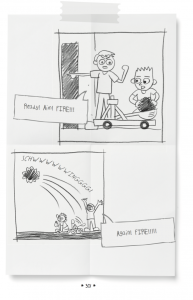
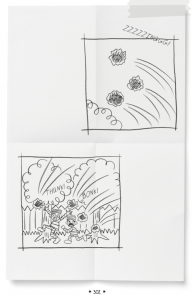
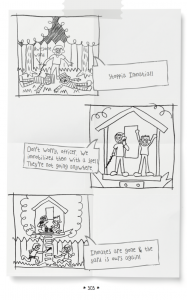
I hadn’t been. But I was now. Linda helped me brainstorm what kinds of documents might be part of the story, with a focus on the kinds of communication that are part of the end of a school year, when this story takes place – morning announcements at school, field day plans, overdue library book notices.  Here’s what that airplane brainstorming looked like by the time we landed for our layover in Philadelphia.

An hour into this in-flight brainstorming session, I noticed that the woman sitting on the other side of me had stopped reading her book and seemed to be listening. She was a teacher who was also returning from the conference, I could tell, so it didn’t surprise me that she was curious about what we were working on. But when she and I started talking, I realized that she had more of a connection to the story than I could have imagined. We’ll talk about that – and how this serendipitous meeting helped shape the story –  tomorrow. Here’s today’s prompt:

Your assignment: Choose an article from this morning’s newspaper – a story about something that happened in the news. How might you rewrite that story through a series of different documents, all sharing different perspectives on what happened? Brainstorm a list of documents that you might include.

Thanks for joining me on this part of the Breakout writing-process journey! If you’d like to read the other posts in this series once they’re all posted, you can find them here.  

Breakout cover image

Buy BREAKOUT now:


Countdown to BREAKOUT: The magic of maps

Countdown to Breakout is a 23-day blog series about the three-year writing process for BREAKOUT, which earned starred reviews from both School Library Journal and Publishers Weekly. It’s about a small-town prison break and manhunt that change the way three kids see their neighbors and the place they call home. Why a 23-day series? Because this book was inspired by the 2015 Clinton Correctional Facility prison break that led to a 23-day manhunt in June of 2015. 

The Magic of Maps

Most often, we hear the term world building as it relates to creating a fictional universe of fantasy or science fiction, but really, this is an important part of the writing process for any book with a fictional setting, including works of realistic fiction. Fictional towns need to feel real. They need all the things that actual towns have – streets and schools and shops, but also secret places where people hang out and places where you aren’t allowed to go. They need relationships between people and power structures and traditions, and I could go on and on.

One of the ways I like to wrap my head around the fictional towns in my writing is by drawing maps. Sometimes, it’s on a large scale. Here’s the (very rough!) Wolf Creek map I made when I was working on BREAKOUT. I included important places like the school, prison, library, and church as well as where my characters live. And then I added smaller details – like tree forts where the kids play and places where people worried the inmates might be hiding.

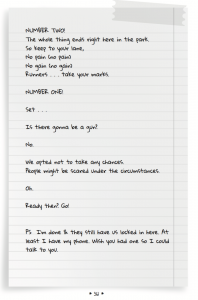
Sometimes, it’s helpful to make more specific maps to help keep track of where action is happening. Near the end of BREAKOUT, there’s a relay race, and the course is very important to the story’s plot, so I sketched out a specific map for that, too, and kept it over my desk while I was writing that scene.

The real-life manhunt in Northern New York continued while I was working on all of this. I was about fifty pages into my first draft of BREAKOUT when it finally came to an end.

The story stayed in the news for weeks, though, as I finished my draft. And then…well, then I scrapped it started over. We’ll talk about that tomorrow. Here’s today’s prompt:

Your Assignment: Make a map of your neighborhood. Think about it as a place for stories, marking not only the streets and buildings but also where things happen. Where do neighbors gather to talk on a nice day? Where have the legendary stories of your neighborhood happened?

Thanks for joining me on this part of the Breakout writing-process journey! If you’d like to read the other posts in this series once they’re all posted, you can find them here.  

Breakout cover image

Buy BREAKOUT now:


BREAKOUT news!

My next novel, BREAKOUT, comes out on June 5th, and I have fun news to share, so here’s a quick round-up of what’s happening, including some great links for teachers, librarians, and writers!

Review News

BREAKOUT is about three kids caught in the middle of a small-town prison break and manhunt that change the way they see their neighbors and the place they call home, and I’m thrilled to share that it’s earned starred reviews from both School Library Journal and Publishers Weekly. You can view the full reviews at the links, but here are some quick excerpts:

Narrated by all three girls through letters, recorded conversations, and texts, this is an effective, authentically wrought look at how fear and ignorance can lead people to treat those of different races or from different places with suspicion. Messner (The Exact Location of Home) shines a light on the ways that people are blind to their own privilege while quick to judge others. Though the look at societal racism, as in the prison system, is well explained, it’s the racism Nora and Lizzie discover in themselves, and their desire to change it, that will linger with readers.                 

~Publishers Weekly

An accessible format and a unique focus on contemporary issues of criminal justice and racial bias make this an essential purchase.

~School Library Journal

And I’m thrilled that independent booksellers chose BREAKOUT as one of their Top Ten titles for the Summer 2018 Kids’ Indie Next List!

Podcast & Interview News

BREAKOUT is also featured on one of my favorite podcasts, The Yarn! I talked with Colby Sharp about my writing process and the power of books with unconventional structures.

And here’s an interview with School Library Journal where we talk about how teaching informs a writer’s work, the power of stories with multiple points of view, and working with sensitivity readers.

#CountdownToBreakout – A Writing-Process Blog Series

In the days leading up to BREAKOUT’s release, I’m sharing a series of blog posts called #CountdownToBreakout, a detailed look at the writing process behind this novel, from brainstorming and research to revision. There will be revision charts and marked-up manuscript pages galore, and I hope that you’ll check it out if you’re interested in writing and teaching writing. It will be a great one to share with student writers, and every post ends with a writing prompt! Clicking here will bring you to a list of the posts published so far. 

BREAKOUT Sneak Preview!

Want to start reading BREAKOUT now? You can download a sneak preview of the first 40 pages or so here.

Pre-Order BREAKOUT

Finally – if you haven’t already, I’d love it if you’d pre-order your copy of BREAKOUT now. Here are some ways to do that:

PRE-ORDER SIGNED COPIES OF BREAKOUT FROM THE BOOKSTORE PLUS

If you’d like a signed copy, you can call my local indie booksellers at The Bookstore Plus at 518-523-2950 or order online here and note in the comments field how you’d like your book signed. I’ll personalize and sign it for you, and it’ll be mailed out on release day!

PRE-ORDER BREAKOUT FROM ANOTHER FAVORITE BOOKSELLER

You can also order from your own favorite bookseller, either online or in person at the store. (Indie bookstores are always my favorite because that way, you can buy a great book and support a business in your own community. You can find your nearest indie bookseller here.)

Bloomsbury is offering a great incentive for pre-orders, too – a free poster and set of bookmarks to share. Details about that are here.

And if you live near one of the cities where I’ll be on book tour this June, please come by and say hello!

Countdown to BREAKOUT: Seeing through middle schoolers’ eyes

Countdown to Breakout is a 23-day blog series about the three-year writing process for BREAKOUT, which earned starred reviews from both School Library Journal and Publishers Weekly. It’s about a small-town prison break and manhunt that change the way three kids see their neighbors and the place they call home. Why a 23-day series? Because this book was inspired by the 2015 Clinton Correctional Facility prison break that led to a 23-day manhunt in June of 2015. 

Seeing through middle schoolers’ eyes

On my drive to Dannemora one day during the prison break, I ended up stopped at a roadblock in a long line of cars and trucks. Up ahead of me were a couple of school buses, and that got me thinking about how this manhunt must be affecting the kids in town.

Were the officers actually boarding the bus to ask questions? How might that affect kids who were anxious and already afraid?

I was reading lots of articles about the manhunt and talking with real kids who lived near the prison as well. One of my daughter’s figure skating friends missed the Saturday ice time one day because when she and her mom opened the door to go to the car, police standing guard on her road told them to go back inside because it wasn’t safe; the search was too close, and they were worried they might flush the inmates out of the woods and into their front yard. I saved this photo on the NPR website as a reminder of how this all felt to kids. It became the inspiration for Nora’s little brother Owen’s story, and for the tree fort on BREAKOUT’s cover.

Breakout cover image

While the manhunt was going on, kids found that their June schedules were turned upside down. Area schools cancelled outdoor activities and field trips. Some had state troopers stationed outside for several days.

I made a phone call to ask if I could visit one of those schools and talk to a 7th grade English class. I explained that I was working on a novel inspired by the manhunt, offered to share that process with the ELA students, and asked for permission to interview them about their experiences during the prison break.

The kids were amazing, as kids always are. They asked lots of questions about my writing process, and then they told me stories. They told me how the officers at the roadblock did, in fact, board their school bus to ask if anyone had seen “strangers in the woods.” One girl who was on the track team said she was frustrated because her mom wouldn’t let her outside, so she had to run on the treadmill. She hated the treadmill. One girl told me that she and her siblings had been allowed to play out in the yard that weekend, but only while their dad was standing on the porch with a shotgun. Many kids had relatives involved in the search – dads and aunts and uncles – who were corrections officers or state troopers, and they shared the fears they’d brought to school with them that day, worried about what might happen out in the woods.

Their stories helped to inspire Nora’s narrative as well as the perspectives of her classmates at Wolf Creek Middle School. My next job was making sure that Nora’s  neighborhood felt real, and tomorrow I’ll talk about the role of map-making in brainstorming the setting for a novel. But first, today’s prompt:

Your assignment: Imagine that you’re one of the kids on a school bus, stopped at a police roadblock, and an armed officer comes on the bus to ask if anyone has information about the inmates. Write a few lines about what happened and how it affected your school day.

Thanks for joining me on this part of the Breakout writing-process journey! If you’d like to read the other posts in this series once they’re all posted, you can find them here.  

Breakout cover image

Buy BREAKOUT now:


Countdown to BREAKOUT: Collecting real-world details for a fictional setting

Countdown to Breakout is a 23-day blog series about the three-year writing process for BREAKOUT, which earned starred reviews from both School Library Journal and Publishers Weekly. It’s about a small-town prison break and manhunt that change the way three kids see their neighbors and the place they call home. Why a 23-day series? Because this book was inspired by the 2015 Clinton Correctional Facility prison break that led to a 23-day manhunt in June of 2015. 

Collecting real-world details for a fictional setting

When I started working on BREAKOUT, I knew that my book was going to be fictional – about a made-up prison break in a made-up town that I named Wolf Creek, NY. But fictional settings need to be grounded with real-world details, and I spent my days in Dannemora collecting all sorts of notes that I knew I might use as I was building the town of Wolf Creek.

Each day as I drove into town, I’d see how the manhunt had changed a usually quiet place into a community buzzing with police activity. I took notes, not just on what I observed but on how I thought it would look and feel from the perspective of a middle school student who was excited about the end of school before all this happened.

This meant collecting not only details about the manhunt but details about everyday life in a small mountain town, too. In those three days I spent at the market and coffee shop near the prison, I made it a point to notice things. How the best sellers in the deli case were hot dogs and macaroni salad. How people from out of town were the only ones who bought the Adirondack Moose t-shirts. How the lady behind the counter couldn’t really keep up with slicing all the tomatoes they needed for subs and looked like she was ready to cross tomatoes right off the list of options.

I also paid attention to how the prison break affected that one small market in particular – how the manager had the police scanner turned on while she made subs, and how she paused every time there was a report that someone thought they may have spotted the inmates at the ice cream stand or worried that the escapees had broken into their attic.

Also…it was community garage sale day while all this was happening. One lady came in so excited that a CNN producer in town for the prison break had bought curtains at her yard sale. I jotted that down in case it was a detail I might want to use later.

Writers are expert eavesdroppers. And listening to the conversations of a place can be so helpful when you’re working to ground a fictional place in those specific, tiny details that make it feel real.

There were more settings and perspectives I needed to explore, and tomorrow I’ll talk about how a school visit helped with that. But for now, here’s your prompt of the day:

Your assignment: Go somewhere with your notebook – a coffee shop or diner or a kids’ soccer game. Collect as many tiny, unexpected details as you can. What kind of shoes is your waitress wearing? Does he have a quirky way of talking or a funny way she greets everyone? What are the kids who aren’t in the game doing over there on the bench? And listen in, too – what snippets of conversation can you collect?

Thanks for joining me on this part of the Breakout writing-process journey! If you’d like to read the other posts in this series once they’re all posted, you can find them here.  

Breakout cover image

Buy BREAKOUT now:


Countdown to BREAKOUT: It starts with curiosity

Countdown to Breakout is a 23-day blog series about the three-year writing process for BREAKOUT, which earned starred reviews from both School Library Journal and Publishers Weekly. It’s about a small-town prison break and manhunt that change the way three kids see their neighbors and the place they call home. Why a 23-day series? Because this book was inspired by the 2015 Clinton Correctional Facility prison break that led to a 23-day manhunt in June of 2015.  

It starts with curiosity…

On June 6, 2015, I was at a book festival in the Thousand Islands, and my husband and daughter were driving in that morning to meet up with me. A few hours before they were due to arrive, I got a text message.

It was huge news. That prison, Clinton Correctional Facility in Dannemora, is famous for being among the toughest in New York State, and the most secure. Everyone was sure the inmates would be captured within hours, but the next morning, they were still on the run, and it was front-page news.

Searchers poured in from all over the state. Surely they’ll be caught today, we all thought. Right?

Wrong.

When I arrived home from my book festival, I returned to a community on edge. My neighbors were glued to their police scanners, listening for news. People who never worried about safety in our quiet town double and triple locked their doors and windows. We went to bed at night with police helicopters circling overhead. Even the usual night noises — rain on the roof, raccoons in the garbage cans —  somehow sounded sinister.

Many of my readers know that before I was a full-time writer, I was a middle school teacher, and some know that before that, I was a TV news reporter. That’s what I went to college for, and journalism will always be in my blood. That week, I was chatting online with a college friend who asked if I was missing the news business, given all of the excitement, and I had to admit that I was pretty envious of the reporters out at the prison.

“So why don’t you take your notebook and go out there?” he said. “Do you have somewhere else you need to be today?”

I didn’t. And I know from experience in my writing life that when I feel curious about something – whether it’s animals living under the snow or coral reefs or what really happened in Viking Age Iceland – it’s good to follow that impulse. So I drove through the police roadblocks to Dannemora, where network TV trucks were already lined up outside the prison.

I attended that day’s news conference and then settled in at a coffee shop across the street from the prison.

The place was mobbed. It seemed like everyone in town was there, and everyone had a story. There were police officers who came in for lunch, covered in mud and ticks after a morning out searching the woods. There were neighbors who talked about how they couldn’t get their kids to sleep in their own beds at night. And there were relatives of inmates who’d come to town to visit, only to be told that the prison was on lockdown, and they wouldn’t be able to visit for a long time. I hung out at that coffee shop for the better part of three days, just talking with people and listening to their stories.

Somewhere near the end of the second day, a story started to take shape in my imagination, written in the voice of Nora Tucker, a prison superintendent’s daughter. This is the scribble that would become the first line of my first draft of BREAKOUT.

From there, it was a matter of collecting more ideas, more details, discovering more about Nora’s voice, and making my way through a first draft. Tomorrow, we’ll talk about setting and how a fictional town can be crafted from tiny specific details of real-world places.

But first – I’m finishing each of these posts with a quick writing prompt for readers who are also writers, or want to be.

Your assignment: Take five minutes today and write about something you’re curious about. What might you do to feed that curiosity and learn a bit more? 

Thanks for joining me on this part of the Breakout writing-process journey! If you’d like to read the other posts in this series once they’re all posted, you can find them here.  

Breakout cover image

Buy BREAKOUT now:


Introducing our Teachers Write 2018 Guest Authors!

Teachers Write is a free, online summer writing camp for teachers and librarians. This summer, our program runs from July 9th to August 3rd. You can learn all about the program and sign up to join us here. 

The best thing about Teachers Write is that you’ll have the opportunity to write with and learn from many of your students’ favorite authors!  Here’s our amazing line-up of guest authors for Summer 2018. Please take some time before July to visit their websites, read some of their books, and get ready for a great summer of writing!

Mini-Lesson Monday – July 9 – Kate Messner shares a mini-lesson on perspective and point of view using her new novel-in-documents Breakout as a mentor text.

Tuesday Quick-Write – July 10 –  Traci Sorell, author of the upcoming picture book We are Grateful: Otsaliheliga, shares a quick writing prompt to get your pencils moving (or keyboards tapping – whichever you prefer!)

Q&A Wednesday – July 11 – Guest authors Grace Lin and Emma Otheguy are your hosts for Q&A Wednesday. They’ll be answering questions about writing in the comments section throughout the day. Grace is the Newbery Honor author of Where the Mountain Meets the Moon and an upcoming picture book, A Big Mooncake for Little Star. Emma’s debut picture book biography, Martí’s Song for Freedom/Martí y sus versos por la libertad, came out last year.

Thursday Quick-Write – July 12 – Justina Ireland, New York Times bestselling author of Dread Nation, joins us for a writing prompt that challenges campers to use anachronistic historical moments for character development – a fun way to understand a character on a deeper level and provoke a more meaningful character arc in a story.

Mini-Lesson Friday – July 13 – Michelle Cusolito, author of the nonfiction picture book Flying Deep: Climb Inside Deep-Sea Submersible ALVIN, shares a mini-lesson about writing & revising nonfiction.

Mini-Lesson Monday – July 16 – Anne Marie Pace, author of Vampirina Ballerina and Busy-Eyed Day, shares a mini-lesson on revising picture books.

Tuesday Quick-Write – July 17 – Debbi Michiko Florence, author of the Jasmine Toguchi chapter book series, shares a quick-write prompt on using traditions (cultural and family) to spark story ideas and creating characters.

Q&A Wednesday – July 18 – Mike Jung and Jess Keating are your hosts for Q&A Wednesday today! Mike’s latest middle grade novel is Unidentified Suburban Object. Jess’s nonfiction titles Pink is for Blobfish and Shark Lady.

Thursday Quick-Write – July 19 – Heidi Schulz, author of Hook’s Revenge, shares a prompt that challenges writers to look at setting as a lens for character.

Mini-Lesson Friday – July 20 – Erin Dionne, author of Lights, Camera, Disaster, shares a mini-lesson that challenges writers to take a closer look at sentence structure. She’ll offer tips for getting rid of passive voice, distancing words, etc.

Mini-Lesson Monday – July 23 – Sarah Albee writes MG nonfiction like Poison and Dog Days of History. Her mini-lesson is about how history is made up of the stories we choose to tell about the past, and how each generation writes its own history from its own historical present. 

Tuesday Quick-Write – July 24 – Hena Khan will share a writing prompt inspired by the first title in her new chapter book series, Zayd Saleem: Chasing the Dream: Power Forward. Hena also writes picture books (Golden Domes & Silver Lanterns and Crescent Moons and Pointed Minarets) and MG novels (Amina’s Voice).

Q&A Wednesday – July 25 – Phil Bildner and Tanya Lee Stone are guest authors today. Phil is the author of the Rip and Red series, including Most Valuable Players. Tanya is best known for her nonfiction; her new picture book is Pass Go and Collect $200: The Real Story of How Monopoly Was Invented.

Thursday Quick-Write – July 26 – Jen Petro Roy, author of P.S. I Miss You and Ammi-Joan Paquette, author of The Train of Lost Things, team up today for a conversation and quick write that focuses on writing about tough topics for kids.

Mini-Lesson Friday – July 27 – Linda Urban’s new books are an early MG novel called Road Trip with Max and his Mom and a picture book called Mabel and Sam. Today, she’ll share a mini-lesson about notebooks and how writers might use them to inspire creativity and play.

Mini-Lesson Monday – July 30 – Chris Tebbetts, co-author of the Middle School series (Middle School: The Worst Years of my Life), shares a mini-lesson called “Three Steps to Character Dimension: Internal Conflict, Contradiction, and Shadow Traits.”

Tuesday Quick-Write – July 31 – Today’s writing prompt is from Olugbemisola Rhuday-Perkovich, author of Two Naomis and the forthcoming sequel Naomis, Too, both with Audrey Vernick.

Q&A Wednesday – August 1 – Meg Medina and Ann Angel are your hosts for our final Q&A Wednesday. Meg write picture books (Tia Isa Wants a Car) and YA novels (Burn Baby Burn), and her first middle grade novel, Merci Suarez Changes Gears, comes out in September. Ann Angel writes both fiction and nonfiction, including the YA biography Janis Joplin: Rise up Singing.

Thursday Quick-Write – August 2 – Tracey Baptiste, author of The Jumbies and Rise of the Jumbies, shares a prompt that challenges writers to think about nonverbal communication.

Friday Farewell  – August 3 – Kate Messner & guests

And don’t forget that we’ll have Friday Feedback with Gae Polisner, Sunday check-ins with writer-educator Jen Vincent, and amazing writing prompts from Jo Knowles, who shares her Monday Morning Warm-Ups to kick off each week, too!

Every time I look at this lineup, I get more excited about the summer to come. And it’s almost time to get writing! Have you signed up for Teachers Write 2018 yet? Go ahead and do that now! 

Then take some time to check out the links above. Buy some books. Get to know your guest authors. Follow them on Twitter & find them on Facebook if you like to hang out in those places, too. We’ll be back Monday, July 9th to get started!

More Voices, More Faces: A Challenge for Educators, Conference & Festival Organizers, and Authors & Illustrators

We’re celebrating Women’s History month with 31 days of posts focused on improving the climate for social and gender equality in the children’s and teens’ literature community. Join in the conversation on Facebook https://www.facebook.com/kidlitwomen or Twitter #kidlitwomen


I have never met an educator or children’s book creator who didn’t claim to support diversity in children’s literature. Surely, all of our kids deserve to see themselves in the stories we share. And most of us are rightly troubled when we look at statistics like these:

And yet…  Somehow, year after year, we see conference keynote lists and book festival lineups and conference panels that are made up entirely or almost entirely of men and/or white people, which only serves to reinforce the inequities. We see conference panels that promote “FIVE FUNNY MEN!” and “ADVENTURE BOOKS FOR BOYS,” all by white male authors. When girls and people of color see these lineups over and over again, it sends a persistent and insidious message.

Your voice doesn’t matter here.

This business of telling stories and making art is not for you.

Librarian Edi Campbell notes that when indigenous people and people of color are invited to speak, they’re often relegated to diversity panels. “Associations think that having panels on topics of social justice, equity, or diversity makes them look more inclusive. Rather, having these panels with IPOC, LGBT+ individuals or people with disabilities without including them on topics that address literary, scholarly, or professional topics perpetuates the colonization of youth literature,” Campbell says. “Have we ever seen Ellen Oh, Jacqueline Woodson, or Meg Medina afforded the honor (!) of speaking solely on their craft?” Campbell also notes that not enough work is done to make panels accessible. “People with disabilities are often excluded even from panels centered on marginalized people and adding insult to injury, they often are not afforded a way to access the information presented.”

Conference organizers should also think about the issues involved with inviting only one person of color to participate in an otherwise all-white panel. Tracey Baptiste, author of The Jumbies and Rise of the Jumbies, says that can be exhausting. “I have often been the only POC on a panel,” she says. “It’s uncomfortable, especially when someone says something insensitive or low-key racist, like ‘It’s easy to add diversity to your books, just change some of the kids’ names!’ Which is a real thing that was said when I was on a panel of me, and three white men. I’m put in the position of having to teach or correct publicly, or smile and deal with the insult of comments like that, and it’s mentally and emotionally exhausting.”

Most often, an unbalanced panel like this doesn’t happen because organizers are carefully planning to leave out women and people of color. It happens because they’re not planning carefully enough. Creating a great panel or festival lineup or book display takes thought. It requires one to read widely and make a point to learn about new authors and illustrators from all different backgrounds. Often, it requires asking for help.

Author-Educator Colby Sharp often asks for input in creating a more diverse lineup of speakers for NerdCamp MI. “I ask publishers to consider sending a diverse groups of creators to camp,” he says. “They are almost always willing to do this.”

I’ve found this to be the case in recent years, too, and have had great luck when I’ve approached publishers to request an author or illustrator for a panel. But sometimes, this can be tricky territory for educators to navigate. As a conference or panel organizer, you’re often asking publishers to sponsor an author or illustrator’s travel to your event. What happens when you’re trying to create a diverse group and you request a particular author, but the publisher offers up another white male author instead? It’s okay to say no thanks. In this situation, I usually say something like, “I so appreciate this offer. Author A was at the top of our wish-list for this event, but we’re planning to reach out to a few other people if you’re not able to send her. Thanks for considering – and I’ll circle back to you if it turns out that we have another opening for Author B.”

Sarah Mulhern Gross, a teacher & writer who also works on conference lineups says, “When dealing with publishers we are very clear about our focus on the authors/illustrators being representative of our student population. Sometimes we have to say it twice (and often in writing), but so far, so good.”

She brings up a great point. If we’re presenting content related to children’s books, shouldn’t we aim for a lineup of featured authors and illustrators that represents our kids?  Census data shows us that America is growing more diverse, and by 2020, half of the nation’s children will be non-white.  Just over half of our population is female, too. What does that mean for our conference lineups and panels?  If you’re committed to fairness and real representation, it means that you should aim for any group you put together to be at least half women and at least half people of color. And it’s important to think about other kinds of inclusion, too, relating to gender, orientation, religious & cultural backgrounds, and disability.

So here’s the challenge. Can we agree that we’d like to live in a world where all kids get to see themselves in books and see creators who look like them? If so, here’s what we can all do to move a step in that direction.

A CHALLENGE FOR EDUCATORS, CONFERENCE AND FESTIVAL ORGANIZERS, AND PANEL MODERATORS

I reached out to author-educator Donalyn Miller, whose conference panels are among my favorites because they always feature diverse voices and views. She offered four tips for conference, book festival, and panel organizers:

  1. Refuse to moderate groups that are all male or all white.
  2. Read widely, so that you know lots of diverse authors, not just the same four.
  3. Read the books your authors are promoting and look for connections between books beyond representation.
  4. As moderator, ensure equity of voices among panelists, and don’t allow individuals to dominate the discussion (including you)

A CHALLENGE FOR AUTHORS AND ILLUSTRATORS

  1. Don’t participate in all-male or all-white events or panels. Encourage organizers to consider other kinds of diversity as well.
  2. Let your publicists know that this is something you’ve committed to do. (They’ll be great about it – I promise. Publishers are interested in social justice, too.)
  3. When you’re invited to an event, before you commit, ask who else is invited. Explain to the organizer that you’ve made a commitment to only participate in events and panels that feature a diverse group.
  4. Offer to help. The pledge to only participate in events that also feature people of color is one that I made quietly several years ago. A number of times since then, I’ve been invited to be on panels that were originally planned as all-white. I explained to the organizers that I only participate in panels that also feature people from traditionally underrepresented groups, and I offered some suggestions. In one of those cases, I stepped back from a panel to make room for someone else, and in the others, the organizers were happy to add more voices. Most often, people want to do a better job with this. They just don’t always know where to start.

There are many dynamics at work, creating and sustaining the inequities we see in the world of children’s books. But there are also some things we can easily address. If no one moderates or participates in all-male/all-white panels, we’ll stop seeing them, and we’ll begin to see more festival and conference lineups that better reflect the amazing kids for whom we make books.

Give it some thought, okay? Later this month, Mike Jung will be coordinating a pledge for men of children’s literature who are committed to no longer participating in all-male panels or conference/festival lineups. And Laurel Snyder will be coordinating a pledge for those who promise not to participate in events & panels unless they include people of color. It’s important to note that this isn’t the only kind of diversity we need in children’s literature, and we have a long way to go to make sure that all of our kids are represented. But maybe this can be a start. I think it’s a conversation worth continuing.