It’s Friday! That means we have a Teachers Write mini-lesson for you, and you can also hop on over to Friday Feedback if you’d like to get some feedback on your work & help others as well.
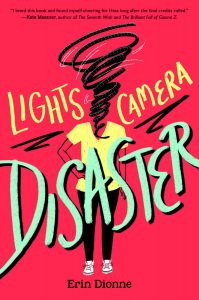
Today’s guest author is Erin Dionne, whose latest book for tweens is Lights, Camera, Disaster (Scholastic 2018). Erin is the author of five other books for young readers, including the 2014 Edgar Award finalist Moxie and the Art of Rule Breaking (Dial 2013). Her first picture book, Captain’s Log: Snowbound, will be released in 2018 from Charlesbridge Publishers. She teaches at Montserrat College of Art and lives outside of Boston with her husband, two children, and a very indignant dog. Find her online at http://www.erindionne.com.

The Nitty-Gritty:
Distancing Words and Tightening Prose
When we’re telling stories, we’re inviting readers into our characters’ worlds. We want our readers to experience the same emotions and situations that our character feels, because the closer we identify with a character, the stronger the story. Also, the harder it is for that reader to put the book down (and we never want readers to stop reading!).
One of the craft elements that I’ve been focusing on recently, and wish I had known about when I was writing my earlier novels, is the elimination of distancing words. These words dilute the connection between reader and character—so instead of being in a character’s shoes, it’s as though we’re watching them live their lives through a pane of filmy glass.
We do so much work to build exciting worlds, use active verbs, give our main characters strong voices and clear wants and desires…but these distancing words can put all that work aside.
These words on the page create distance between the reader and the story. Think about the way that you experience the world. Is this the way you talk in your head?
I am going into the room.
I hear the whirring of the fan.
I realize that I left my sneakers at the pool.
I’m willing to bet that you don’t actually think this way in real life. So we don’t want our characters, and by extension, our readers, thinking this way, either. Distancing words separate readers from the main character, whether we’re aware of it or not. There’s that filmy glass plate between the reader and the narrator—and no one wants to look at or listen to something through filmy, sticky glass.
So how do you fix it?
Distancing words are easy to spot once you know what you’re looking for, and make an incredible difference once they are gone.
Distancing words (sometimes called “filter” words) include:
I heard/hear/saw/see
She smells/feels/thinks
They realize/understand
We look/watch
One way to think about these words is that they are telling readers what the action the character is doing, as opposed to directly showing readers the character’s actions.
Here’s an example:
I saw the cat enter the room.
Without the distancing word:
The cat entered the room.
The reader already knows we are in a first person narrative, and that the narrator sees with their eyes (assuming this character is not visually impaired). So the we as the writer can safely eliminate the distancing word and restructure the sentence to be more of a direct experience for the reader.
Now, my two caveats to all of this: 1.) this is a great craft element to focus on in revision, or to help you warm up for the day’s writing by reviewing the previous day’s work. This is not something that I focus on while drafting, because I’d be so busy worrying about distancing words that I wouldn’t get work on the page!
2.) Sometimes you need a distancing word—the sentence/idea won’t work without it. That’s okay! If you try to remove the word and you can’t, you likely need it! And that’s how you know you’re using those words to the best of their ability.
Ready to tighten your story and get rid of those distancing words?
Your Assignment: Select a section of your work – either from a work-in-progress or from something you wrote for camp earlier in the summer. Print it out (or you can do this on the computer, but I like to work with paper when I revise). Highlight all of the distancing words that you find in the section. Then, go through them: are there ones that are necessary to keep? Ones that you can get rid of?
Make the edits and review the tightened section the next time you’re at the computer. Does it feel more immediate to you? What does it do to your pacing?
Leave me your thoughts in the comments. I’ll respond, and draw a random winner on July 24 to receive a copy of my newest novel, LIGHTS, CAMERA, DISASTER (Arthur A. Levine, 2018).